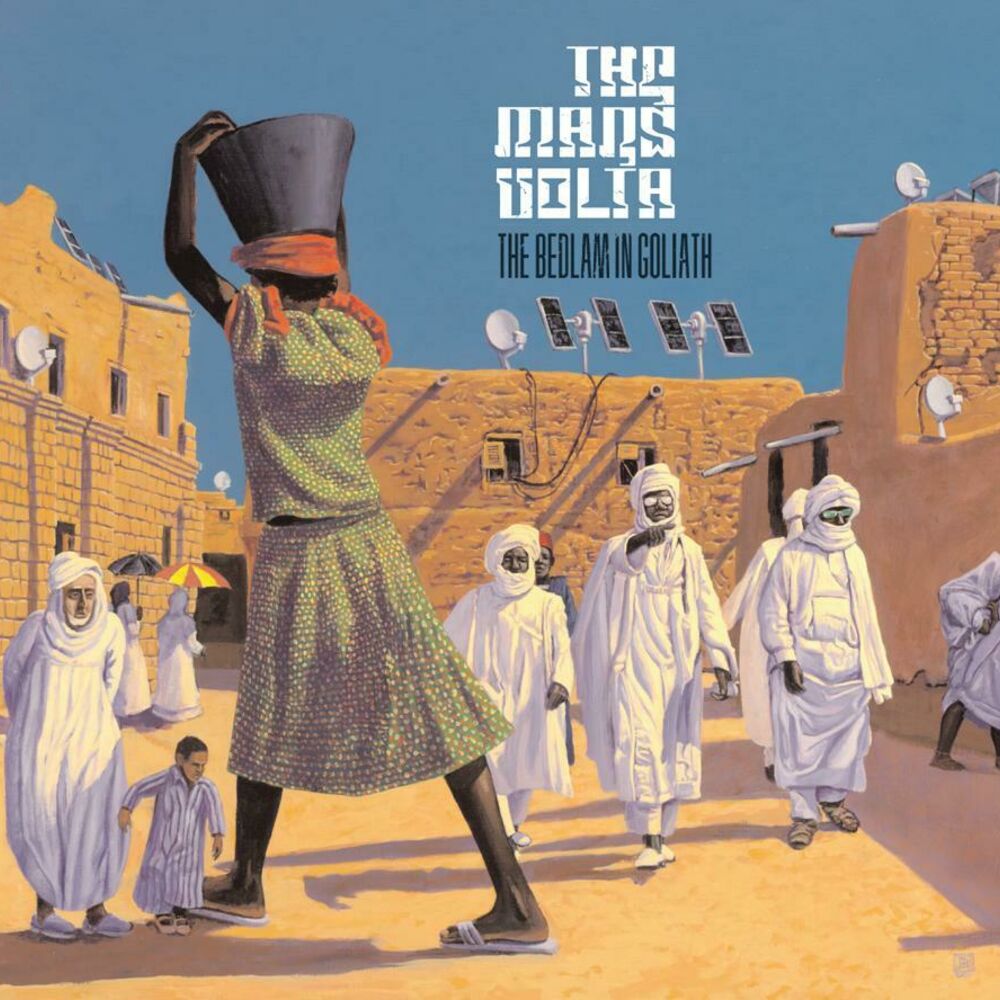
The Bedlam in Goliath
- Released1 January 2008
- UK peak No. 42
- Weeks on UK chart 1
- Entered UK chart 3 February 2008
- LabelMotown
- Tracks12 · 76 min
Tracks
| 1 | Aberinkula (Album Version) | 5:44 | |
| 2 | Metatron (Album Version) | 8:11 | |
| 3 | Ilyena (Album Version) | 5:35 | |
| 4 | Wax Simulacra | 2:38 | |
| 5 | Goliath (Album Version) | 7:15 | |
| 6 | Tourniquet Man (Album Version) | 2:37 | |
| 7 | Cavalettas (Album Version) | 9:32 | |
| 8 | Agadez (Album Version) | 6:43 | |
| 9 | Askepios (Album Version) | 5:10 | |
| 10 | Ouroborous (Album Version) | 6:35 | |
| 11 | Soothsayer (Album Version) | 9:07 | |
| 12 | Conjugal Burns (Album Version) | 6:35 |
About the album
The Bedlam in Goliath is the fourth studio album by American progressive rock band the Mars Volta, released on January 29, 2008, on Gold Standard Laboratories and Universal Motown Records. Produced by guitarist and songwriter Omar Rodríguez-López, the album's creation was fraught with strange occurrences after an experience with a ouija that Rodriguez-Lopez bought as a gift for vocalist Cedric Bixler-Zavala. The album is their first to feature drummer Thomas Pridgen, and the last to include guitarist and sound manipulator Paul Hinojos, wind multi-instrumentalist Adrián Terrazas-González, and keyboardist Isaiah "Ikey" Owens.
The album debuted at No. 3 on the Billboard 200, becoming the band's highest-charting release after selling over 54,000 copies in its opening week. As of June 2009 it has sold 153,000 copies in United States. "Wax Simulacra" was released on November 19, 2007, as the album's first single, coupled with a cover version of "Pulled to Bits", originally by Siouxsie and the Banshees. Vinyl editions of the album include a ouija inside the gatefold, claimed to be the band's own take on the board they previously owned.
Background
On a trip in Jerusalem, Rodriguez-Lopez purchased an archaic Ouija-type talking board at a curio shop as a gift for Bixler-Zavala. They would return to their tour bus after shows to play with it during their 2006 tour with the Red Hot Chili Peppers, as it quickly became the band's post-show ritual. Dubbed "The Soothsayer", the board revealed stories, gave names and made demands, as the band was contacted by three different people who appeared in the form of one, who was then referred to as "Goliath". The more the band interacted with "The Soothsayer", otherworldly coincidences began plaguing the band's experience writing and recording The Bedlam in Goliath.
Recording process
Recorded and mixed at Ocean Way Studios in Hollywood and Rodriguez-Lopez's home studio in Brooklyn, New York, song material for The Bedlam in Goliath dates back to April 2006 when demos were first written. Without a stable studio drummer after the three consecutive losses of Jon Theodore, Blake Fleming and Deantoni Parks in a single year, the band was introduced to then 24-year-old Thomas Pridgen, whose youthful presence—as described by Bixler-Zavala—had given the Mars Volta new life. Rodriguez-Lopez worked with Rich Costey to finish the album in a three-week stretch, assisted by Shawn Michael Sullivan and Claudius Mittendorfer as editors.
In an interview, Carranza described the recording process for The Bedlam in Goliath stating that no more than three takes an hour were recorded, as a way to soak in what was recorded and to hear the differences, which in turn improved the general mood and atmosphere of the album's creation. Elaborating on the method, Carranza stated that "when van Gogh was around he wasn't just painting, painting, painting.
Themes
Bixler-Zavala incorporated themes and names into the lyrics that were taken from messages given by "The Soothsayer". It also includes excerpts from poems that were found attached to the ouija, describing a love triangle between a woman, her daughter and a man in a Muslim society, along with an honor killing involving these people. Each song reinterprets the relationship in some shape or form, and as a good luck charm to counteract the cryptic themes, Bixler-Zavala incorporated elements of the Afro-Caribbean religious tradition Santería into the lyrics as a "protective skin" to protect the band.
The album ultimately serves as an attempt to artistically reverse their perceived bad luck by "setting traps" for the listeners to use as a way to undo what "The Soothsayer" had brought upon the band. To aid the concept, vinyl editions of the album contain the band's own version of the ouija inside the gatefold.
Reception
The album has a score of 66 out of 100 from Metacritic, indicating "generally favorable reviews". Jason Pettigrew of Alternative Press gave the album all five stars and called it "the first great record of 2008". John Hanson of Sputnikmusic gave the album a score of 4.5 out of five and called it "simply an immense album". Uncut gave it a score of four stars out of five and called it the band's "most digestible record yet". Blender also gave it a score of four stars out of five and said, "Never before have these kings of experimental metal sustained such pulse-quickening energy, honing their tricks—cryptic lyrics, cliffhanging cries, spine-twisting rhythms—into a screaming arrow of sound." Gary Graff of Billboard gave it a favorable review and said, "Most of the time, however, the band makes a righteous racket that straddles the worlds of prog rock, funk, fusion jazz and world music, with Eastern motifs spicing 'Aberinkula' and a bit of cosmic blues making its way into 'Conjugal Burns'." Vibe likewise gave it four stars out of five and said, "Rarely does rock music feel so simultaneou