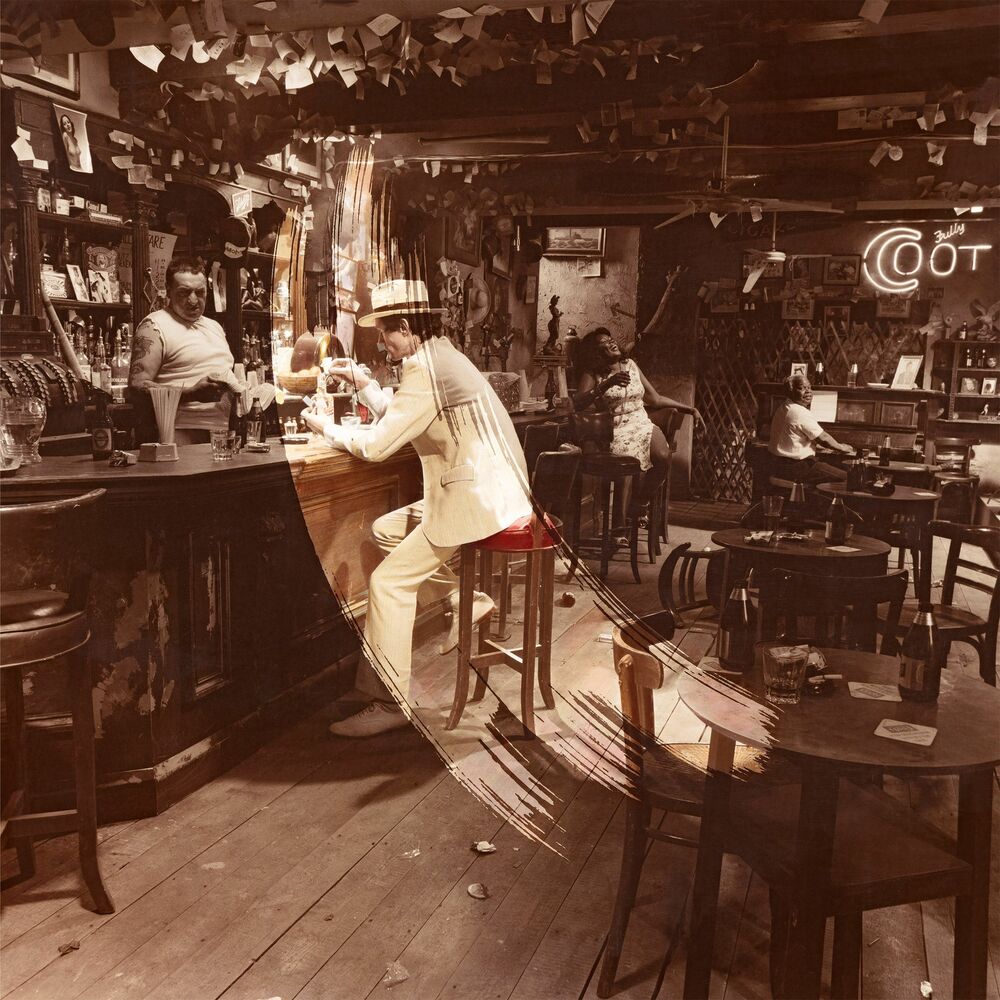
In Through the out Door (Remaster)
- Released15 August 1979
- UK peak No. 1
- Weeks on UK chart 17
- Entered UK chart 2 September 1979
- LabelAtlantic Records
- Tracks7 · 43 min
One track from it charted as a single. Press a flag to play it in the chart where it peaked.
Tracks
| 1 | In the Evening (Remaster) | 6:53 | |
| 2 | South Bound Saurez (Remaster) | 4:13 | |
| 3 | Fool in the Rain (Remaster) No. 21 · 1980 | 6:10 | |
| 4 | Hot Dog (Remaster) | 3:18 | |
| 5 | Carouselambra (Remaster) | 10:34 | |
| 6 | All My Love (Remaster) | 5:53 | |
| 7 | I'm Gonna Crawl (Remaster) | 5:31 |
About the album
In Through the Out Door is the eighth studio album by the English rock band Led Zeppelin. It was recorded in three weeks in November and December 1978 at ABBA's Polar Studios in Stockholm, Sweden, and released by Led Zeppelin's label Swan Song Records on 22 August 1979 in the US and 24 August 1979 in the UK.
Unlike earlier Led Zeppelin albums, In Through the Out Door was predominantly composed by John Paul Jones and Robert Plant, because Jimmy Page and John Bonham were frequently absent from its sessions due to their respective heroin and alcohol abuse. It was the band's last release before the death of Bonham in September 1980, three months after which the remaining members disbanded.
The album was a commercial success: it went to No. 1 on the Billboard 200 in its second week on the American chart; and it also went to No. 1 in the UK, Canada, and New Zealand.
Background
The album was named by the group to describe its struggles after the death of Robert Plant's son Karac in 1977, and after the group's tax exile from the UK, during which they were unable to tour Britain for more than two years, after which they described their attempt to recapture the British public's attention as being as difficult as "trying to get in through the 'out' door."
The group began rehearsing material in September 1978. After six weeks, they travelled to Polar Studios in Stockholm to begin recording. In contrast to previous Led Zeppelin albums, In Through the Out Door features much greater influence from bassist and keyboardist John Paul Jones and vocalist Robert Plant, and less influence
from guitarist Jimmy Page and drummer John Bonham, both of whom failed to attend rehearsals as a consequence of their respective heroin and alcohol abuse. Jones later said, "there were two distinct camps by then, and we [Plant and I] were in the relatively clean one." Many of the songs were consequently arranged by Jones and Plant before Page and Bonham joined their rehearsals at night.
Packaging and artwork
The original album featured an unusual gimmick: The outer sleeve was made to look like a plain brown paper bag, reminiscent of similarly packaged bootleg album sleeves with the title rubber-stamped on it, and the inner sleeve featured black and white line artwork which when wiped with a wet rag or sponge would activate an invisible ink and become permanently colored. There were also six different cover sleeve variants (A - F), featuring a different pair of photos for the front and back, and the external brown paper sleeve meant that it was impossible for record buyers to tell which sleeve they were getting. The corresponding letter was printed on the spine to indicate which cover variant it was, and this was sometimes exposed while the record was still sealed. The pictures all depict the same scene of a man sitting at a bar burning a Dear John letter along with six onlookers including the bartender, a piano player, a man holding his coat and three female patrons, all taken from a different point of view with slightly different poses.
Release and promotion
The album was intended to be released before the band's twin concerts at Knebworth in 1979, but production delays meant that it was released shortly after their performances at this event, on 4 and 11 August 1979. Plant jokingly referred to the delays at times during the performance on 4 August 1979.
The album reached No. 1 on the Billboard 200 in its second week on the album chart, reportedly selling 1.7 million copies within weeks of release. Subsequently, Led Zeppelin's entire catalogue appeared in the Billboard 200 between the weeks of 23 October and 3 November 1979, an unprecedented feat, topping their own record in 1975, when all their albums up to Physical Graffiti were on the chart. The album remained on the US top spot for seven weeks and sold three million copies by the end of September 1979. It was credited with helping to revive the US record industry, which had begun to struggle. In January 1980, "Fool in the Rain" was released as a single to further promote the album, but it narrowly missed the top 20 of the singles chart.
Critical reception
In Through the Out Door divided contemporary critics and Led Zeppelin fans; some found its synthesiser-influenced music forward-thinking while others felt the band had forsaken their heavy, fast sound. According to Jimmy Page biographer Martin Power, "predictably, in the wake of punk, In Through the Out Door received a rough ride from some critics, with Zep's veteran status in the music business now used as a stick with which to beat them."
Reviewing the album in Rolling Stone, Charles M. Young said Page's diminishing creativity resulted in little good material to work with for Plant, whose lyrics Young found inane, and Bonham, whose drumming was viewed as heavy handed. This brought to the forefront the keyboard playing of Jones, who Young said "functions best behind Page, not in front of him". Chris Bohn from Melody Maker said "the impressionable first play" of the record "had everyone in the office rolling around laughing", while accusing the band of being "totally out of touch" and "displaying the first intimations of mortality".