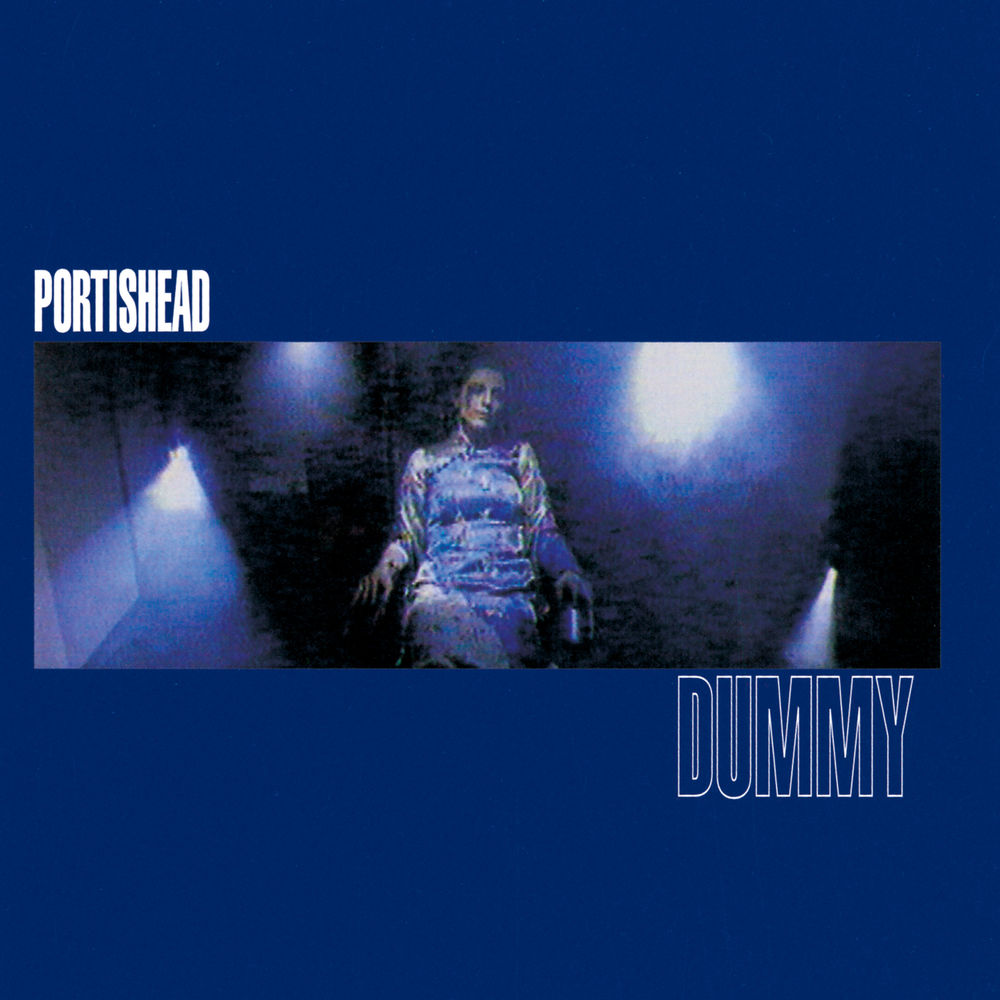
Dummy
- Released18 October 1994
- UK peak No. 2
- Weeks on UK chart 111
- Entered UK chart 28 August 1994
- LabelPolydor Associated Labels
- Tracks11 · 49 min
2 tracks from it charted as singles. Press a flag to play it in the chart where it peaked.
Tracks
| 1 | Mysterons | 5:02 | |
| 2 | 4:11 | ||
| 3 | Strangers | 3:55 | |
| 4 | It Could Be Sweet | 4:17 | |
| 5 | Wandering Star | 4:51 | |
| 6 | It's A Fire | 3:45 | |
| 7 | Numb | 3:55 | |
| 8 | Roads | 5:04 | |
| 9 | Pedestal | 3:37 | |
| 10 | Biscuit | 5:01 | |
| 11 | Glory Box No. 13 · 1995 | 5:08 |
About the album
Dummy is the debut studio album by English electronic music band Portishead, released on 22 August 1994 by Go! Beat Records.
The album received critical acclaim and won the 1995 Mercury Music Prize. It is often credited with popularising the trip hop genre, and is frequently cited in lists of the best albums of the 1990s. Dummy was certified triple platinum in the UK in February 2019, and had sold 920,000 copies in the United Kingdom as of September 2020. Worldwide, the album had sold 3.6 million copies by 2008.
Background
Geoff Barrow and Beth Gibbons met during an Enterprise Allowance course in February 1991. They started recording their first ideas for the songs in Neneh Cherry's kitchen in London while Barrow was hired by her husband Cameron McVey to work on her second album, Homebrew (1992). In Bristol, they recorded at the Coach House Studios. The first song that they finished for the album was "It Could Be Sweet" in 1991. There Adrian Utley met Barrow while they were recording, heard this track and started exchanging ideas on music. Barrow taught Utley sampling while Utley introduced the band to unusual sounds such as cimbaloms and theremins, which led to an "amalgamation of ideas". According to Barrow, "It was like a light-bulb coming on" when Utley joined them, and they realised they could make their own samples not found on other records, and created one of the most distinctive sounds of the decade.
The production of the album uses a number of hip hop techniques, such as sampling, scratching, and loop-making. The album was not recorded digitally.
Singles
The first song released from the album was "Numb". Two further singles were released from the album: "Glory Box", which reached number 13 on the UK Singles Chart; and "Sour Times", which was released before "Glory Box" but re-released after the success of "Glory Box", also reaching number 13 on its re-release in 1995. The success of both singles drove the sales of the album, which eventually reached number two on the UK Albums Chart. "Sour Times" achieved moderate success in the U.S., reaching peak positions of number five and number 53 on the Billboard Alternative Airplay and Hot 100 charts, respectively, in February 1995. On 3 December 2008, Universal Music Japan released Dummy and Portishead as limited SHM-CD versions.
The tracks "Roads" and "Strangers" were used in the soundtrack of the film Nadja.
Music
Philip Sherburne assessed the album's style and instrumentation: "Despite its reputation as one of the cornerstones of trip-hop, Bristol trio Portishead’s 1994 debut is much darker—and stranger—than the conventional wisdom might lead you to believe. [...] Geoff Barrow wasn’t much interested in ambient music. [...] Sampling vintage soul and channeling the spirit of old spy movies, he and 37-year-old guitarist Adrian Utley sketched out a skeletal strain of boom-bap where dial-tone buzz and homemade breakbeats swam in an ocean of silence. It was 29-year-old singer Beth Gibbons who was tasked with filling in that emptiness, but despite the warmth of her Billie Holiday-indebted croon her singing is uniformly forlorn, her presence as unsettling as it is intimate."
Artwork
The cover of the album is a still image of vocalist Beth Gibbons taken from To Kill a Dead Man—the short film that the band created—for which the self-composed soundtrack earned the band its record contract.
Critical reception
Upon release, Dummy received universal acclaim from critics. NME reviewer Stephen Dalton summed up the record by writing: "This is, without question, a sublime debut album. But so very, very sad." He observed, "From one angle, its languid slowbeat blues clearly occupy similar terrain to soulmates Massive Attack and all of Bristol hip-hop's extended family. But from another these are avant-garde ambient moonscapes of a ferociously experimental nature." Dalton concluded that "Portishead's post-ambient, timelessly organic blues are probably too left-field, introspective and downright Bristolian to grab short-term glory as some kind of Next Big Thing. But remember what radical departures Blue Lines, Ambient Works and Debut were for their times and make sure you hear this unmissable album." Melody Maker's Sharon O'Connell stated that the band "are undeniably the classiest, coolest thing to have appeared in this country for years ...
Legacy
Retrospective reviews of the album have praised it highly. AllMusic's John Bush wrote: "Portishead's album debut is a brilliant, surprisingly natural synthesis of claustrophobic spy soundtracks, dark breakbeats inspired by frontman Geoff Barrow's love of hip-hop, and a vocalist (Beth Gibbons) in the classic confessional singer/songwriter mold ... Better than any album before it, Dummy merged the pinpoint-precise productions of the dance world with pop hallmarks like great songwriting and excellent vocal performances." Laura Barton recommended it as Portishead's key release in Uncut, commenting that the band, by setting their own original compositions to looped and scratched samples from "distressed vinyl", created "an introspective and avant-garde blues". In 2010, BBC Music reviewer Mike Diver called Dummy "quite simply one of the greatest debut albums of the 1990s" and said that "the constituents that make up much of this collection are easily traced – back to dub, to soul, and especially to hip hop ...
Accolades
Dummy won the 1995 Mercury Music Prize, ahead of other shortlisted albums including PJ Harvey's To Bring You My Love, Oasis' Definitely Maybe, and Tricky's Maxinquaye.
Associated Press - Voted as one of the top 10 pop albums of the 1990s.
Melody Maker - ranked number one album of the year.
Mojo (p. 62) – Ranked No. 35 in Mojo's "100 Modern Classics".
Mojo (January 1995, p. 50) – Included in Mojo's "25 Best Albums of 1994".
The New York Times (5 January 1995, p. C15) – Included on Neil Strauss' list of the Top 10 Albums of '94.
NME (8 December 2000, p. 29) – Ranked No. 29 in The NME "Top 30 Heartbreak Albums".
NME (24 December 1994, p. 22) – Ranked No. 6 in NME's list of the "Top 50 Albums of 1994".
NME (October 2013, p. 59) – Ranked No. 168 in NME's list of the '500 Greatest Albums of all time'.
Q (December 1999, p. 82) – Included in Q Magazine's "90 Best Albums of the 1990s".
Q (June 2000, p. 66) – Ranked No. 61 in Q's "100 Greatest British Albums".
In 2000 it was voted number 41 in Colin Larkin's All Time Top 1000 Albums.
Rolling Stone (13 May 1999, pp.