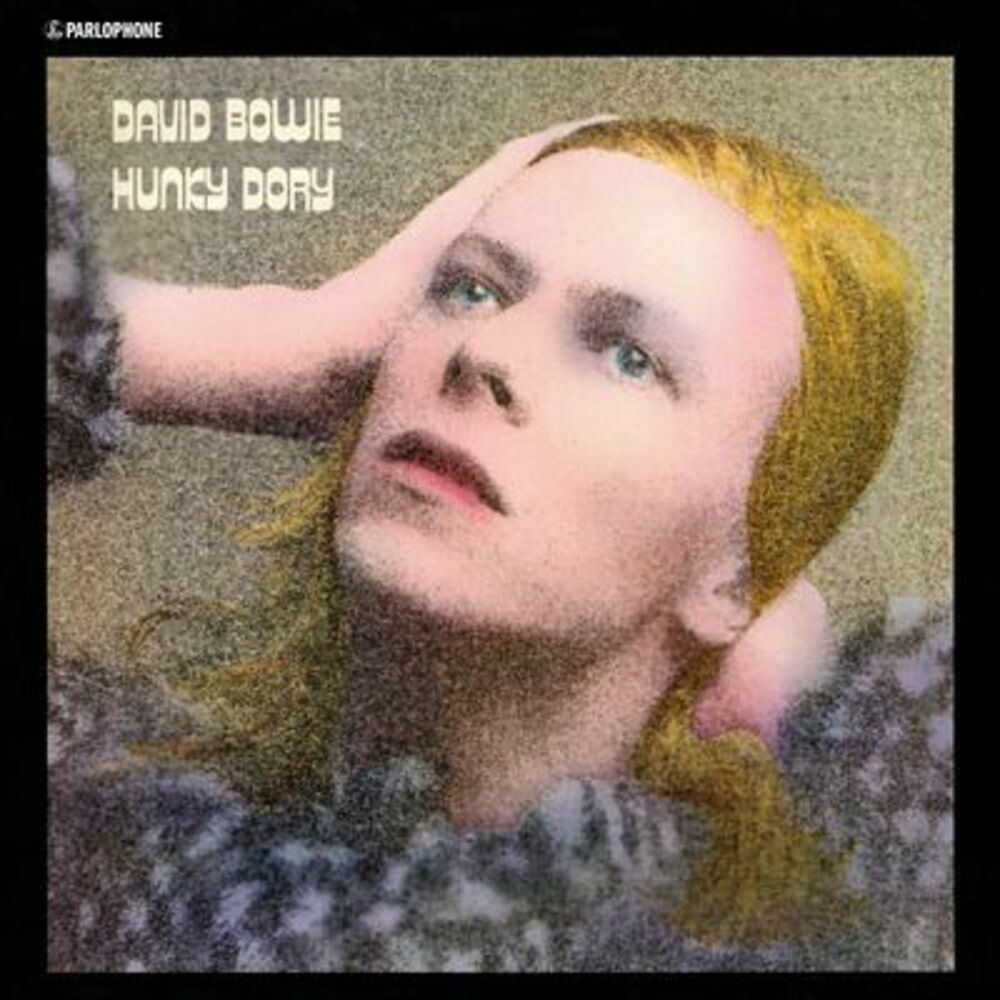
Hunky Dory (2015 Remaster)
- Released25 September 2015
- UK peak No. 3
- Weeks on UK chart 151
- Entered UK chart 17 September 1972
- LabelParlophone UK
- Tracks11 · 42 min
2 tracks from it charted as singles. Press a flag to play it in the chart where it peaked.
Tracks
| 1 | 3:32 | ||
| 2 | Oh! You Pretty Things (2015 Remaster) | 3:13 | |
| 3 | Eight Line Poem (2015 Remaster) | 2:55 | |
| 4 | 3:55 | ||
| 5 | Kooks (2015 Remaster) | 2:53 | |
| 6 | Quicksand (2015 Remaster) | 5:06 | |
| 7 | Fill Your Heart (2015 Remaster) | 3:10 | |
| 8 | Andy Warhol (2015 Remaster) | 3:54 | |
| 9 | Song for Bob Dylan (2015 Remaster) | 4:13 | |
| 10 | Queen Bitch (2015 Remaster) | 3:20 | |
| 11 | The Bewlay Brothers (2015 Remaster) | 5:29 |
About the album
Hunky Dory is the fourth studio album by the English musician David Bowie, released in the United Kingdom on 17 December 1971 through RCA Records. Following a break from touring and recording, Bowie settled down to write new songs, composing on piano rather than guitar as in earlier works. Bowie assembled Mick Ronson (guitar), Trevor Bolder (bass) and Mick Woodmansey (drums), and recorded the album in mid-1971 at Trident Studios in London. Rick Wakeman contributed piano shortly before joining Yes. Bowie co-produced the album with Ken Scott, who had engineered Bowie's previous two records.
Compared to the guitar-driven hard rock of The Man Who Sold the World, Bowie opted for a warmer, more melodic piano-based pop rock and art pop style on Hunky Dory. His lyrical concerns on the record range from the compulsive nature of artistic reinvention on "Changes" to occultism and Nietzschean philosophy on "Oh! You Pretty Things" and "Quicksand"; several songs make cultural and literary references. He was also inspired by his United States tour to write songs dedicated to three American icons: Andy Warhol, Bob Dylan and Lou Reed. The song "Kooks" was dedicated to Bowie's newborn son Duncan.
Background
After David Bowie completed his third studio album, The Man Who Sold the World, in May 1970, he became less active in both the studio and on stage. His contract with the music publisher Essex had expired and his new manager Tony Defries was facing prior contractual challenges. Bowie was also without a backing band, as the musicians on The Man Who Sold the World – including its producer and bassist Tony Visconti, the guitarist Mick Ronson and the drummer Mick Woodmansey – departed in August 1970 due to personal conflicts with the artist. After hearing a demo of Bowie's "Holy Holy", recorded in autumn 1970, Defries signed the singer to a contract with Chrysalis, but thereafter limited his work with Bowie to focus on other projects. Bowie, who was devoting himself to songwriting, turned to Chrysalis's partner Bob Grace, who loved the demo of "Holy Holy" and subsequently booked time at Radio Luxembourg's studios in London for Bowie to record his demos.
Writing and recording
After his short-lived band Arnold Corns folded in February, Bowie returned to the studio in May 1971 to record his next album. He brought back Ronson and Woodmansey and hired Trevor Bolder, a former hairdresser and piano tuner, as a bass player to replace Visconti. After Bolder was hired, the trio grouped at Haddon Hall to rehearse some of Bowie's new material, such as the song "Andy Warhol". Bowie and his new backing trio, soon to be named the Spiders from Mars, played for the first time on 3 June on BBC DJ John Peel's radio programme In Concert. The set included debut performances of several songs Bowie had recently written such as "Queen Bitch", "Bombers", "Song for Bob Dylan" and "Andy Warhol". The title Hunky Dory was also announced at this session.
Bowie and the future Spiders officially started work on the new album at Trident Studios in London on 8 June 1971. Ken Scott, who had engineered Bowie's two previous records, was hired to co-produce alongside him.
Title and artwork
The cover photograph was taken by Brian Ward, who was introduced to Bowie by Bob Grace at Ward's studio in Heddon Street. An early idea was for Bowie to dress as a pharaoh, partly inspired by the media's infatuation with the British Museum's new Tutankhamun exhibit. According to Pegg, photos of Bowie posing "as a sphinx and in a lotus position" were taken – one was released as part of the 1990 Space Oddity reissue – but the idea was ultimately abandoned. Bowie recalled: "We didn't run with it, as they say. Probably a good idea." Bowie opted for a more minimalist image reflecting the album's "preoccupation with the silver screen". He later said: "I was into Oxford bags, and there are a pair, indeed, on the back of the album. [I was attempting] what I presumed was kind of an Evelyn Waugh Oxbridge look." The final image is a close-up of Bowie looking past the camera while he pulls back his hair. Pegg writes that his pose was influenced by the actresses Lauren Bacall and Greta Garbo.
Release
A few months after he had terminated Bowie's contract with Mercury, Defries showcased the newly recorded Hunky Dory to multiple labels in the US, including New York City's RCA Records. Defries told RCA that they "had nothing since the fifties" but they could "own the seventies" if they hired Bowie. "Because David Bowie is going to remake the decade, just like the Beatles did in the sixties." Its head Dennis Katz had never heard of Bowie but recognised the potential of the piano-based songs that Defries played for him and signed the artist to a three-record deal on 9 September 1971; RCA was Bowie's label for the rest of the decade.
Hunky Dory was released in the UK on 17 December 1971 through RCA. By this time, the sessions for Ziggy Stardust were underway. The album release was supported by the single "Changes" on 7 January 1972. The album received little promotion from RCA due to its unusual cover image and a warning that Bowie was changing his image for his next album.
Reissues
The album has been reissued multiple times. Following its release on compact disc in the mid-1980s, Hunky Dory was rereleased by Rykodisc/EMI in 1990 with bonus tracks, including the outtake "Bombers". In 1999, the original album was rereleased on CD through Virgin/EMI with 24-bit digitally remastered sound. This edition was reissued in 2014 by Parlophone, having acquired the Virgin-owned Bowie catalogue. In 2015, the album was remastered for the Five Years (1969–1973) box set. It was released in CD, vinyl, and digital formats, both as part of this compilation and separately. In 2021, to celebrate the record's 50th anniversary, Parlophone announced a vinyl picture disc reissue of the album (2015 remaster), which was released on 7 January 2022. The announcement coincided with the digital release of a new mix of "Changes" by Scott. In November 2022, a multi-disc box set focusing on Hunky Dory was released with the title Divine Symmetry: The Journey to Hunky Dory. The collection comprises home demos, BBC radio sessions, alternate mixes, and other live and studio recordings from 1971.