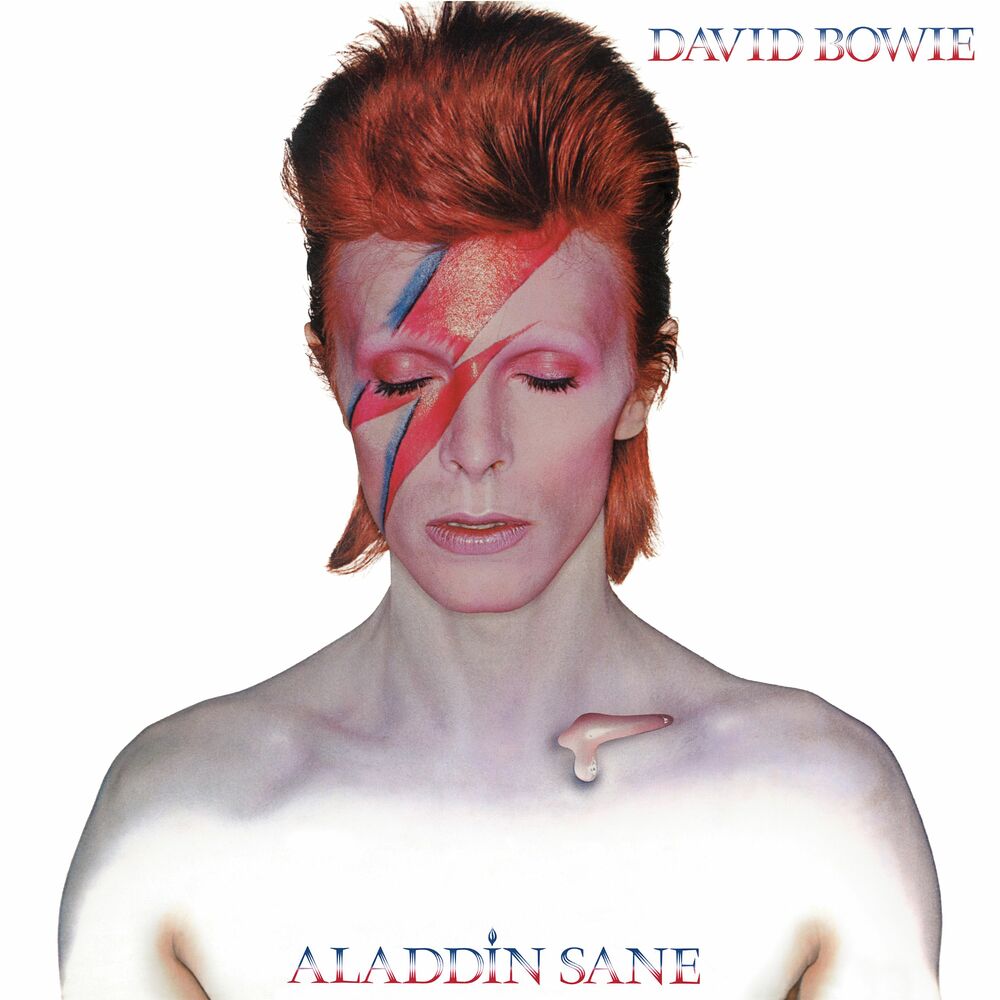
Aladdin Sane (2013 Remaster)
- Released19 April 1973
- UK peak No. 1
- Weeks on UK chart 84
- Entered UK chart 29 April 1973
- LabelParlophone UK
- Tracks10 · 42 min
2 tracks from it charted as singles. Press a flag to play it in the chart where it peaked.
Tracks
| 1 | Watch That Man (2013 Remaster) | 4:30 | |
| 2 | Aladdin Sane (2013 Remaster) | 5:10 | |
| 3 | Drive-In Saturday (2013 Remaster) No. 3 · 1973 | 4:32 | |
| 4 | Panic in Detroit (2013 Remaster) | 4:28 | |
| 5 | Cracked Actor (2013 Remaster) | 3:01 | |
| 6 | Time (2013 Remaster) | 5:15 | |
| 7 | The Prettiest Star (2013 Remaster) | 3:31 | |
| 8 | Let's Spend the Night Together (2013 Remaster) | 3:10 | |
| 9 | 4:08 | ||
| 10 | Lady Grinning Soul (2013 Remaster) | 3:55 |
About the album
Aladdin Sane is the sixth studio album by the English musician David Bowie, released in April 1973 through RCA Records. The follow-up to his breakthrough The Rise and Fall of Ziggy Stardust and the Spiders from Mars (1972), it was the first album he wrote and released after achieving global stardom.
The album was co-produced by Bowie and Ken Scott and features contributions from Bowie's backing band the Spiders from Mars (Mick Ronson, Trevor Bolder and Mick Woodmansey), along with pianist Mike Garson, two saxophonists and three backing vocalists. Recorded in London and New York City between legs of the Ziggy Stardust Tour, the record was Bowie's final album with the full Spiders lineup.
Most of the tracks were written on the road in the US and are greatly influenced by Bowie's perceptions of the country. Due to the American influence and the fast-paced songwriting, the record features more hard rock influences than his earlier glam rock. The lyrics reflect the pros of Bowie's newfound stardom and the cons of touring and contain images of urban decay, drugs, sex, violence and death. Some of the songs are influenced by the Rolling Stones; a cover of their song "Let's Spend the Night Together" is included. Bowie described the album's title as a pun ("A Lad Insane") and as "Ziggy Stardust goes to America".
Background and writing
David Bowie launched to stardom in early July 1972 through the release of his fifth studio album The Rise and Fall of Ziggy Stardust and the Spiders from Mars and his performance of "Starman" on BBC's Top of the Pops. He promoted the record through the Ziggy Stardust Tour in the United Kingdom and the United States, writing new songs on the road that appeared on his next album.
Aladdin Sane was the first album Bowie wrote and released from a position of stardom. Writing new material on the US leg of the tour in late 1972, many of the tracks were influenced by America and his perceptions of the country. The biographer Christopher Sandford believes the album showed that Bowie "was simultaneously appalled and fixated by America". The tour, combined with other side projects during the period, such as co-producing Lou Reed's Transformer and mixing the Stooges' Raw Power, took a toll on Bowie's mental health, further influencing his writing.
Recording
Aladdin Sane was mainly recorded between December 1972 and January 1973 between tour legs. Like his two previous records, it was co-produced by Bowie and Ken Scott and featured Bowie's backing band the Spiders from Mars – the guitarist Mick Ronson, the bassist Trevor Bolder and the drummer Mick Woodmansey. The lineup also featured the pianist Mike Garson, who was hired by Bowie at the suggestion of the RCA executive Ken Glancey and the singer-songwriter Annette Peacock; he remained with Bowie's entourage for the next three years. The pianist came from a jazz and blues background, which the biographer Nicholas Pegg believes veered the album from pure rock 'n' roll and expanded Bowie's experimental horizons. Buckley called Aladdin Sane the beginning of Bowie's "experimental phase" and cited Garson's presence as "revolutionary". Scott noted that Garson added elements to the arrangements that were not there before, including more keyboards and synthesisers.
Music and lyrics
Like Ziggy Stardust, Aladdin Sane is predominantly glam rock, with elements of hard rock. The album's American influence and fast-paced development added a tougher, rawer and edgier rock sound. Some of the songs, including "Watch That Man", "Drive-In Saturday" and "Lady Grinning Soul" are influenced by the Rolling Stones; a cover of their song "Let's Spend the Night Together" is included.
According to Pegg, the album's lyrics paint pictures of urban decay, degenerate lives, drug addiction, violence and death. He says that some themes present on Bowie's previous works also appear in Aladdin Sane, including "notions of religion shattered by science, extraterrestrial encounters posing as messianic visitations, the impact on society of different kinds of 'star' and the degradation of human life in a spiritual void." The author James E. Perone states that thematically, the album deals with "the concept and definition of sanity", while Ric Albano of Classic Rock Review wrote that the music reflects the pros of newfound stardom and the cons of the perils of touring.
Title and artwork
The title is a pun on "A Lad Insane", which at one point was expected to be the title. When writing the album during the tour, it was under the working title Love Aladdin Vein, which Bowie said at the time felt right, but decided to change it partly due to its drug connotations.
The cover artwork features a shirtless Bowie with red hair and a red-and-blue lightning bolt splitting his face in two while a teardrop runs down his collarbone. It was shot in January 1973 by Brian Duffy in his north London studio. In an effort to ensure RCA promoted the album extensively, Bowie's manager Tony Defries was determined to make the cover as costly as possible. He insisted on an unprecedented seven-colour system, rather than the usual four. The image was the most expensive cover art ever made at the time. The make-up designer was artist Pierre Laroche, who remained Bowie's make-up artist for the remainder of the 1973 tour and the Pin Ups cover shoot. Cann writes that Duffy and Laroche copied the lightning bolt from a National Panasonic rice-cooker in the studio.
Release
RCA issued "The Jean Genie" as the lead single on 24 November 1972. In its advertising, the label said it was "the first single to come from Bowie's triumphant American tour". The song charted at number two on the UK Singles Chart, making it Bowie's biggest hit to date. The single fared worse in the US, reaching number 71 on the Billboard Hot 100. It was promoted with a video by Mick Rock, featuring bits of concert footage shot in San Francisco in late October 1972, interspersed with shots of Bowie posing around the Mars Hotel and actress Cyrinda Foxe. The second single, "Drive-In Saturday", was released in the UK on 6 April 1973. Like the previous single, it was a commercial success, peaking at number three in the UK. "Time" was issued as a single in the US and Japan in April, and "Let's Spend the Night Together" in the US and Europe in July.