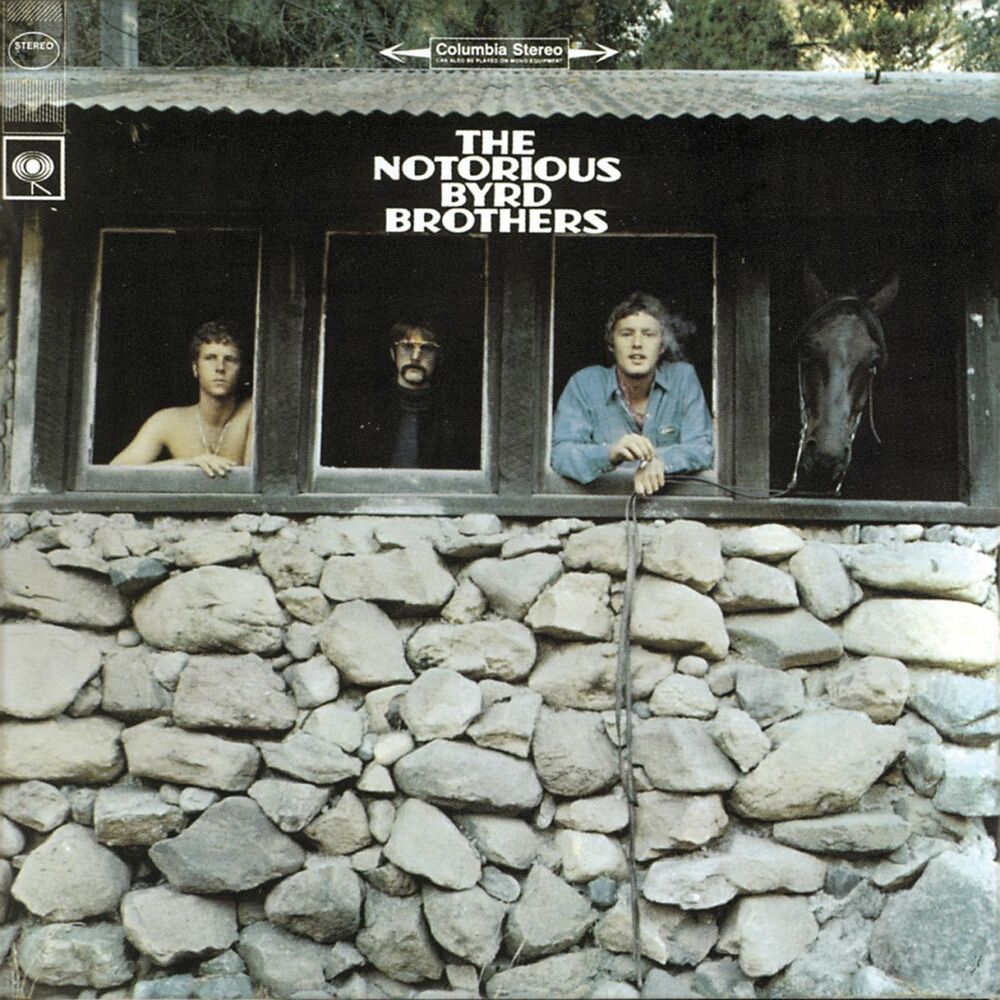
The Notorious Byrd Brothers
- Released8 November 2019
- UK peak No. 12
- Weeks on UK chart 11
- Entered UK chart 28 April 1968
- LabelColumbia/Legacy
- Tracks17 · 48 min
One track from it charted as a single. Press a flag to play it in the chart where it peaked.
Tracks
| 1 | Artificial Energy | 2:18 | |
| 2 | Goin' Back No. 89 · 1967 | 3:26 | |
| 3 | Natural Harmony | 2:11 | |
| 4 | Draft Morning | 2:43 | |
| 5 | Wasn't Born to Follow | 2:04 | |
| 6 | Get to You | 2:39 | |
| 7 | Change Is Now (Single Version) | 3:21 | |
| 8 | Old John Robertson | 1:49 | |
| 9 | Tribal Gathering | 2:05 | |
| 10 | Dolphin's Smile | 1:59 | |
| 11 | Space Odyssey | 3:52 | |
| 12 | Moog Raga (instrumental) | 3:24 | |
| 13 | Bound to Fall (instrumental) | 2:08 | |
| 14 | Triad | 3:29 | |
| 15 | Goin' Back (Extended Version) No. 89 · 1967 | 3:55 | |
| 16 | Draft Morning (alternate end) | 2:55 | |
| 17 | Universal Mind Decoder (Alternate Backing Track) | 3:36 |
About the album
The Notorious Byrd Brothers is the fifth studio album by the American rock band the Byrds, released on January 15, 1968, by Columbia Records. The album represents the pinnacle of the Byrds' late-'60s musical experimentation, with the band blending together elements of psychedelia, folk rock, country, electronic music, baroque pop, and jazz. With producer Gary Usher, they made extensive use of a number of studio effects and production techniques, including phasing, flanging, and spatial panning. The Byrds also introduced the sound of the pedal steel guitar and the Moog modular synthesizer into their music, making it one of the first LP releases on which the Moog appears.
Recording sessions for The Notorious Byrd Brothers took place throughout the latter half of 1967 and were fraught with tension, resulting in the loss of two members of the band; rhythm guitarist David Crosby was fired in October 1967 and drummer Michael Clarke left the sessions midway through recording, returning briefly before finally being dismissed after completion of the album. Additionally, original band member Gene Clark, who had left the group in early 1966, rejoined for three weeks during the making of the album, before leaving again.
Background
The recording of The Notorious Byrd Brothers, during the latter half of 1967, was marked by severe internal dissolution and acrimony. The Byrds began the recording sessions as a four-piece band, consisting of Roger McGuinn, David Crosby, Chris Hillman, and Michael Clarke—the same line-up that had recorded their two previous albums. By the time of the album's release, however, only McGuinn and Hillman remained in the group. The first line-up change occurred when drummer Michael Clarke quit the sessions after having played on several songs, over disputes with Crosby and the other band members over his playing ability and his apparent dissatisfaction with the material the three songwriting members of the band were providing.
Production
Despite its troubled genesis, the album contains some of the band's most gentle and ethereal music, as well as some of its most progressive and experimental. In a 2002 interview, McGuinn said it was "kind of Beatles-inspired" and cited their album Revolver as an influence. Lyrically, it attempted to deal with many contemporary themes such as peace, ecology, freedom, drug use, alienation and mankind's place in the universe. The album, as a whole, represented the apex of the McGuinn–Crosby–Hillman songwriting partnership, and took the musical experimentation of the original Byrds to its farthest logical extreme, mixing folk rock, country, psychedelia and jazz, often within a single song. The band and producer Gary Usher also used a number of innovative studio-based production techniques on the album, in particular making heavy use of phasing, spatial panning, and rotary speaker effects.
The band also began experimenting with the Moog modular synthesizer on a number of tracks, making The Notorious Byrd Brothers one of the first rock albums to feature the instrument.
Release and reception
The Notorious Byrd Brothers was released on January 15, 1968, in the United States (catalogue item CL 2775 in mono, CS 9575 in stereo) and on April 12, 1968, in the UK (catalogue item 63169 in mono, S 63169 in stereo). However, there is some debate about the U.S. release date, with some sources suggesting that it may have been brought forward to January 3, 1968. Regardless, the album's appearance during the first month of 1968 surprised many fans of the band, who had been led to believe by contemporary press reports that the album was still in the planning stages.
It peaked at number 47 on the Billboard Top LPs chart, during a chart stay of 19 weeks, but fared better in the United Kingdom where it reached number 12, spending a total of 11 weeks on the UK chart. The album's front cover photograph was taken by Guy Webster, who had also been responsible for the cover of the Byrds' Turn! Turn! Turn! album. The "Goin' Back" single was released ahead of the album on October 20, 1967, and reached number 89 on the Billboard Hot 100, but failed to chart in the UK.
Legacy
Over the years, The Notorious Byrd Brothers has gained in reputation and is often considered the group's best work, while the contentious incidents surrounding its making have been largely forgotten. The album managed to capture the band at the height of their creative powers, as they pushed ahead lyrically, musically and technically into new sonic territory. Band biographer Johnny Rogan has written that the Byrds' greatest accomplishment on the album was in creating a seamless mood piece from a variety of different sources, bound together by innovative studio experimentation. Although the album is widely regarded as the band's most experimental, its running time of a little under 29 minutes also makes it their briefest.
The album was voted the fourth-best album ever in a 1971 ZigZag magazine readers' poll and the 1977 edition of the Critic's Choice: Top 200 Albums book ranked it at number 154 in a list of the "Greatest Rock Albums of All-Time". A subsequent edition of the book, published in 1988, ranked the album at number 75.