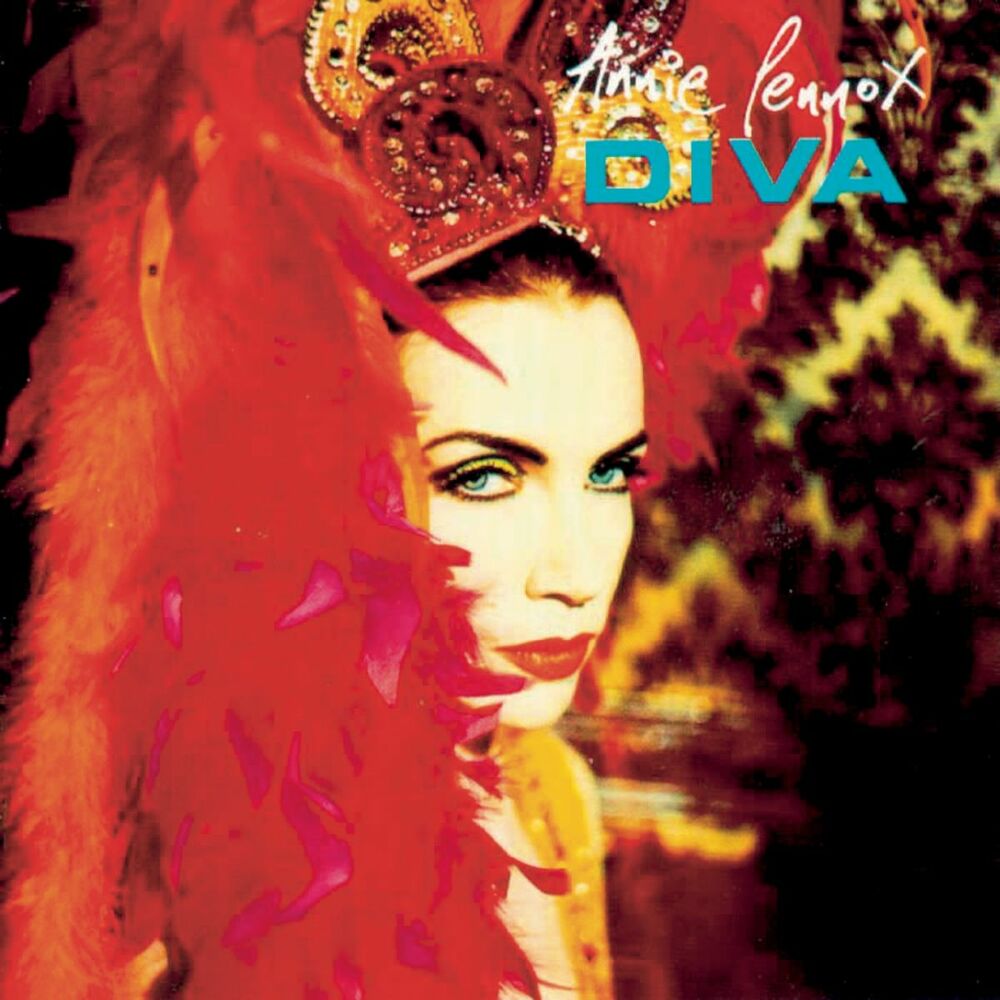
Diva
- Released2 April 1992
- UK peak No. 1
- Weeks on UK chart 91
- Entered UK chart 12 April 1992
- LabelRCA Records Label
- Tracks11 · 50 min
5 tracks from it charted as singles. Press a flag to play it in the chart where it peaked.
Tracks
| 1 | 4:53 | ||
| 2 | 4:12 | ||
| 3 | Precious No. 23 · 1992 | 5:08 | |
| 4 | Legend In My Living Room | 3:45 | |
| 5 | Cold No. 26 · 1992 | 4:20 | |
| 6 | Money Can't Buy It | 4:58 | |
| 7 | 4:48 | ||
| 8 | Primitive | 4:16 | |
| 9 | Stay By Me | 6:26 | |
| 10 | The Gift | 4:53 | |
| 11 | Keep Young And Beautiful | 2:17 |
About the album
Diva is the debut solo studio album by Scottish singer Annie Lennox, released on 6 April 1992 by RCA Records. The album entered the UK Albums Chart at number one and has since sold over 1.2 million copies in the UK alone, being certified quadruple platinum. Diva was the 7th best selling album of 1992 in the United Kingdom. In the United States, it reached number 23 on the Billboard 200 and has been certified double platinum.
The album spawned five successful single releases, beginning with "Why" in March 1992, and followed by "Precious" in May, "Walking on Broken Glass" in August and "Cold" in October 1992. "Little Bird" was released in February 1993 as a double A-side with "Love Song for a Vampire", a song Lennox had recorded for the 1992 film Bram Stoker's Dracula. All five single releases reached the UK Top 30 (three of them Top 10), and achieved commercial success internationally.
Worldwide, Diva has sold over seven million copies, and won the Brit Award for British Album of the Year at the 1993 Brit Awards. The album received nominations for Album of the Year, Best Female Pop Vocal Performance and Best Long Form Music Video, winning the latter award at the Grammy Awards the same year. Diva has been described as "state-of-the-art soul pop" by Rolling Stone magazine, who also included the album in their "Essential Recordings of the '90s" list.
Background and recording
Following the informal dissolution of Eurythmics in 1990, Lennox took some time away from the music industry, during which she gave birth to her eldest daughter. She commenced working on her first solo album in 1991 with producer Stephen Lipson. Though she had been accustomed to co-writing material with Dave Stewart during her years with Eurythmics, eight of the ten tracks on Diva were written solely by Lennox herself, with two tracks being co-written by her. In a 1992 interview with BBC, Lennox claimed she had "two years when I didn't do anything", and confirmed that during that period she was doubtful as to whether she should write and record a solo album or not. She highlighted that after much deliberation, "it all came back to you are supposed to write songs", claiming that when she writes songs "it affirms who I am", citing it being "part of her identify".
Composition
Speaking to the BBC in 1992, Lennox said that the song "Why" is "a deep dialogue with myself", stating that the song was inspired by ones lack of communication. At the end of the song, Lennox describes the ending as "a big rant", stating that she wrote that part of the song to affirm to others that she is not what she had often been portrayed by others to be. She described her writing technique for the ending of the song as a "denouncement of things that had been applied" to her up until that point in her career, further adding that she "reserves the right" to not let people know exactly who she is as a person.
Title
Lennox explained that the album's title was meant ironically. During a radio interview with BBC Radio 2, she said, "It's quite an arrogant thing to take that name and put it on yourself. It's like taking a crown and putting it on your head, in a way. But I do it with a smile because the diva that you see, the person in performance, is not necessarily the person that I am." Lennox further explained: "As a performer, I've lived that diva-esque existence. Being in a little box, and having that box opened up, night after night, when you come out and perform and everybody sees this thing, this entity, and then go back and disappear, and pack your suitcase. I've experienced that balance of being the public person that is this monstrous kind of diva, a personage, and then trying to maintain my life."
The notion of being a "diva" is a central theme throughout the album, and, as argued by Felix Rowe of Classic Pop, "understanding this notion is central to unwrapping the themes of the record, and the picture is fully realised through the accompanying visuals."
Release and promotion
Lennox released the lead single from Diva, "Why" on 16 March 1992. Upon release, "Why" was the most played track across European radio networks. The choice to release "Why" as the lead single and launch of Lennox's solo career was described as a "bold move" by some due to its heart wrenching nature. Lennox described "Why" as "a deep dialogue with myself in a funny way. A song about communication, or lack of communication.” Diva was released on 6 April 1992, one month after the release of "Why" as the first single. Upon release, album entered the UK Albums Chart at number one and has since sold over 1.2 million copies in the UK alone, being certified quadruple platinum. In the United States, it reached number 23 on the Billboard 200 and has been certified double platinum.
"Precious" was released as the albums second single on 25 May 1992. Described as "by far the hardest-hitting track on the album in terms of the attack of its instrumentation" by Classic Pop magazine, "Precious" is composed around a low-slung bass groove.
Critical reception
Diva received acclaim from critics upon release. In their review, Rolling Stone commented:
State-of-the-art soul pop, Annie Lennox's solo debut is sonically gorgeous; it also declares her aesthetic independence. Ace sessionmen polish Diva's gloss, and producer Stephen Lipson (Pet Shop Boys, Propaganda) operates in hyperdrive, but these eleven songs are fiercely those of a sister doing things for herself. Three years after her last outing with Dave Stewart, her cohort in Eurythmics, Lennox voids any notion that he was her Svengali and she merely the MTV beauty with stunning pipes. Writing nearly all of Diva, she manages a whirlwind tour of mainstream R&B and retains her singular persona – an ice queen thirsting to be melted by love.
Diva was included in Q magazine's year-end list of the "50 Best Albums of 1992". It was later included in Rolling Stone's Essential Recordings of the 90's list.
Pitchfork stated that the album is "a joyous and liberated pop album with a prophetic message about the disillusionment of fame".
Artwork
Laurence Stevens – sleeve designs
Satoshi Saïkusa – photography (front cover)
Anton Corbijn – photography