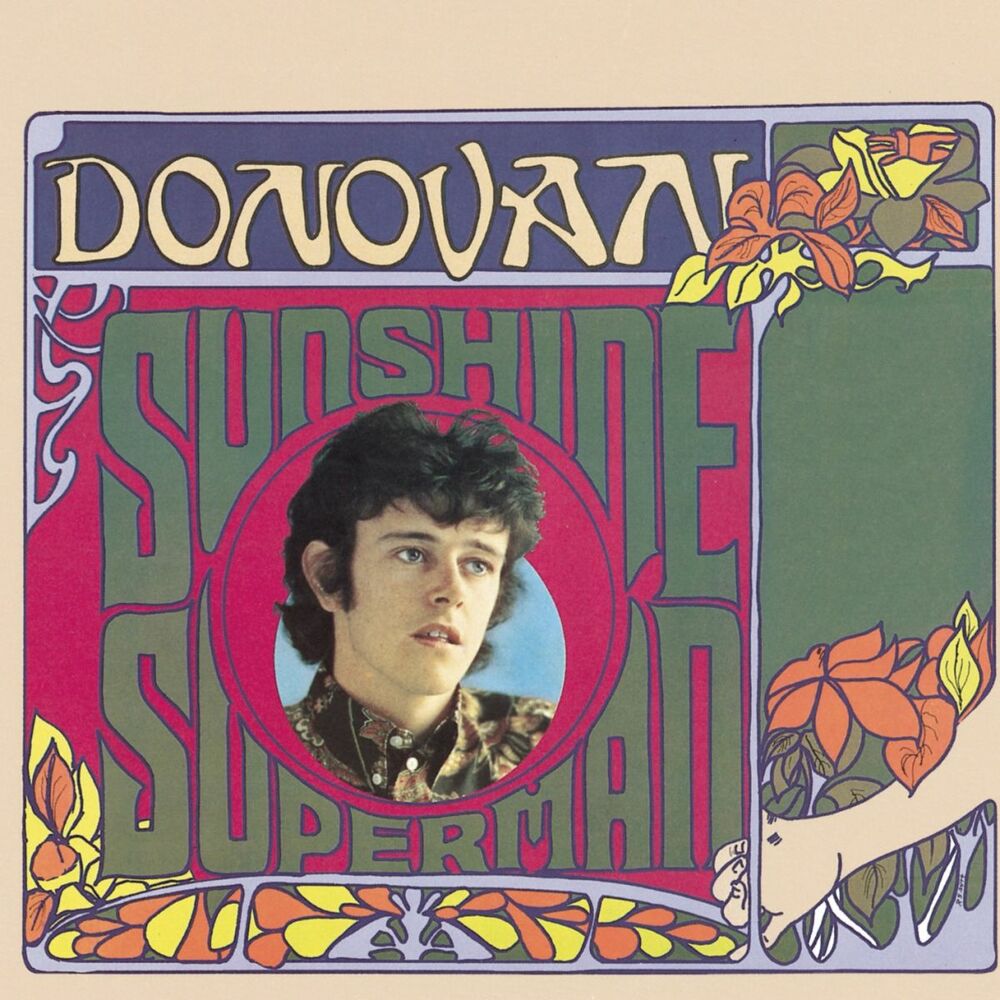
Sunshine Superman
- Released1 July 1966
- UK peak No. 25
- Weeks on UK chart 7
- Entered UK chart 2 July 1967
- LabelEpic
- Tracks10 · 44 min
One track from it charted as a single. Press a flag to play it in the chart where it peaked.
Tracks
| 1 | 4:33 | ||
| 2 | Legend of a Girl Child Linda | 6:50 | |
| 3 | Three King Fishers | 3:16 | |
| 4 | Ferris Wheel | 4:12 | |
| 5 | Bert's Blues | 3:56 | |
| 6 | Season of the Witch | 4:56 | |
| 7 | The Trip | 4:34 | |
| 8 | Guinevere | 3:41 | |
| 9 | The Fat Angel | 4:11 | |
| 10 | Celeste | 4:08 |
About the album
Sunshine Superman is the third studio album by Scottish singer-songwriter Donovan. It was released in the United States on 26 August 1966, but was not released in the UK because of a contractual dispute. In June 1967, a compilation of tracks from this album and the follow-up Mellow Yellow was released as Sunshine Superman in the UK.
The album featured Donovan's titular hit single, which was initially released in the US in July 1966. The album was Donovan's most successful, peaking at number 11 in the US and remaining on the Billboard Top LPs chart for six months. The 1967 UK edition peaked at number 25.
The tracks from Sunshine Superman and Mellow Yellow were not mixed into stereo, with the exception of the title track and "Season of the Witch" which appeared in that format on Donovan's Greatest Hits, until the 2011 2-CD deluxe edition issued by UK EMI.
Background
Donovan had enjoyed a year of chart success in both Britain and the United States through 1965, beginning with his first hit "Catch the Wind" that March. However, the singer had been stung by accusations of copying Bob Dylan's look and musical style and was now looking to break out of his established folk image; the jazz-classical backing on "Sunny Goodge Street" from his second album Fairytale pointed in a new direction. Around this same time toward the end of 1965 he suffered a breakup in his relationship with Linda Lawrence, who was unwilling to marry a pop star after a prior relationship (and child) with Brian Jones. The fallout of his relationship with Lawrence would inspire most of the new crop of songs he was writing, in which he pined for her presence and vowed he would win her back again.
In October Donovan's solicitor announced the termination of his contract with managers Peter Eden and Geoff Stephens (who had also co-produced his records up to that point), to be replaced by Ashley Kovack as his business manager and his father Donald Leitch as his personal manager.
Style
Whilst still incorporating folk music, these recordings mark a distinct change in Donovan's music, representing some of the first psychedelia released. A full rock band backs up Donovan on many of the songs, and the instrumentation had been expanded, being one of the first pop albums extensively to use the sitar, bouzouki, electric violin and other unique musical instruments. This change is partially the result of working with producer Mickie Most, whose pop sensibilities led to chart hits for many other artists at the time, as well as arranger John Cameron.
The album's lyrical content encompasses Donovan's increasing ability to portray Swinging London and give listeners an insider's look into the mid-sixties pop scene. Donovan's penchant for name-dropping in songs such as those influenced by his stay in Los Angeles, "The Trip" and "The Fat Angel", recount his association with other big rock stars of the day which when coupled with his chart success helped elevate him to superstar status.
Release
The continued contractual dispute with Pye greatly delayed the album's release in Britain. Instead, the album was released by Epic in the US ((Epic Records LN 24217 (monaural) / BN 26217 (stereo)) on 26 August 1966, a week prior to the title track topping the Billboard charts. The stereo edition was "electronically reprocessed", and a true stereo version of the album was not remixed and released until the 2011 deluxe edition. Finally, the album received its UK release (Pye NPL 18181) in June 1967, featuring 7 tracks from the US version of the album combined with 5 from its February 1967 followup Mellow Yellow that had also not seen release in the artist's home country. Donovan was disappointed, as he felt the delayed release had allowed many other innovative 1966-67 recordings to appear to have come first.
The album proved to be his most successful in America outside of 1969's Greatest Hits , charting at number 11, while the UK release peaked at number 25.
Reception
Upon release, Sunshine Superman received positive reviews in Billboard and Cashbox, with the former calling the material "new and intriguing", singling out "Celeste" as "exceptionally performed" while the latter picked "Season of the Witch", "The Fat Angel" and "Legend of a Girl Child Linda" as "blue ribbon tracks". Paul Williams of Crawdaddy, in a track-by-track review, claimed "what may be overlooked as one remarks upon the sitar, the overdubbing, the electricity, is the fact that this album has a producer, an excellent one. Most ... has translated concept to actuality with remarkable grace" and also favourably compared the album to The Beatles' Revolver, noting that its atmosphere was more consistently applied. Ralph Gleason of the San Francisco Examiner opined it was the best work Donovan had done to date, singling out the title track and "The Fat Angel".
Upon the album's 1967 UK release, Melody Maker's Nick Jones noted that "every number has a mood, an atmosphere, a current along which the perceptive listener can float.
Legacy
Sunshine Superman is often singled out as pioneering due its combination of classical, jazz, Celtic folk, acid rock and raga-rock influences, as well as its lyrical preoccupation with Eastern, medieval and nature themes which would come to define the flower-power movement. To put the album in context, its eclectic arrangements were recorded at the same time Brian Wilson was working on Pet Sounds, and the last day of recording on 6 April 1966 coincided with the first day of work on The Beatles' Revolver. However, because of delays in the album's release, both Pet Sounds and Revolver beat it to the shops, although it paralleled or pre-dated both comparably ambitious works.
In 2017, Sunshine Superman was ranked the 199th greatest album of the 1960s by Pitchfork.
In the video for the Beatles' "A Day in the Life", a close up of a spinning turntable shows the Epic Records version of Sunshine Superman playing. The film was shot at the recording sessions for the song, which was included on Sgt. Pepper's Lonely Hearts Club Band.