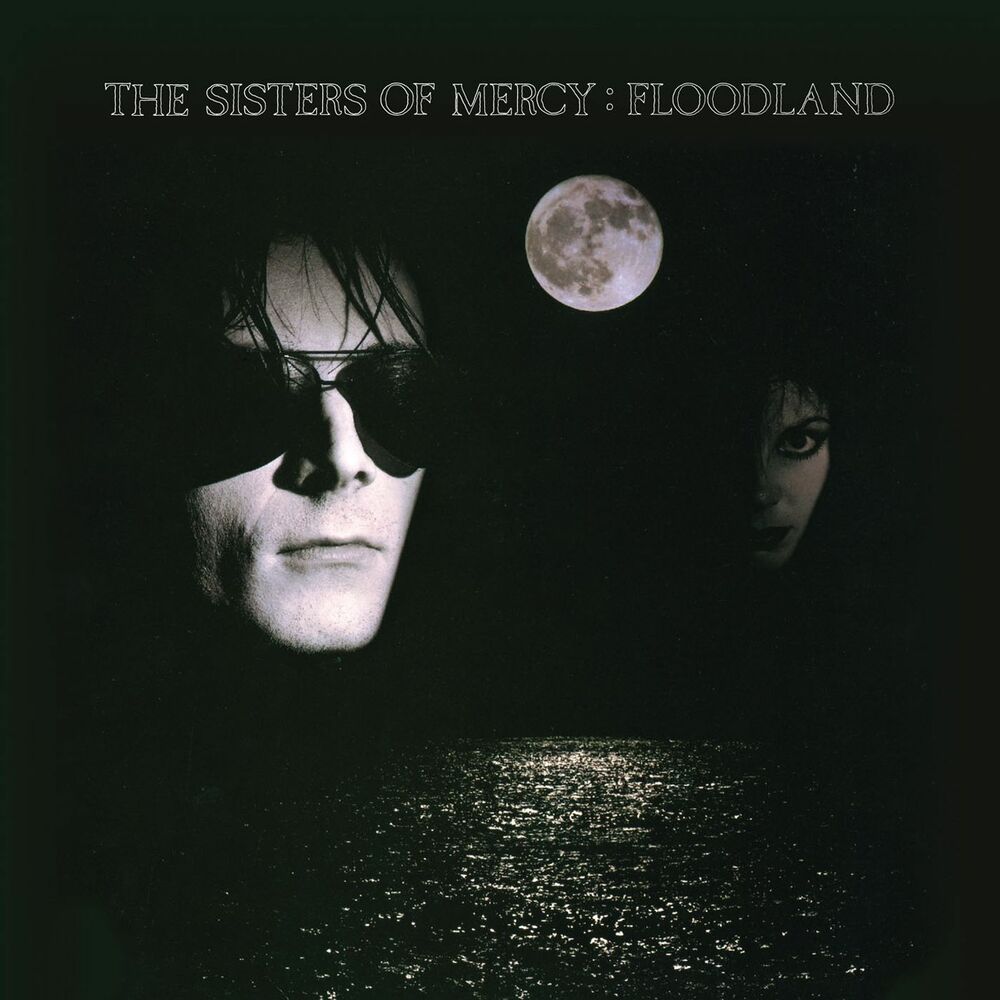
Floodland
- Released25 September 2015
- UK peak No. 9
- Weeks on UK chart 20
- Entered UK chart 22 November 1987
- LabelRhino
- Tracks8 · 46 min
2 tracks from it charted as singles. Press a flag to play it in the chart where it peaked.
Tracks
| 1 | Dominion / Mother Russia | 7:00 | |
| 2 | Flood I | 6:17 | |
| 3 | Lucretia My Reflection (Vinyl Version) No. 20 · 1988 | 4:55 | |
| 4 | 1959 | 4:12 | |
| 5 | This Corrosion No. 7 · 1987 | 9:30 | |
| 6 | Flood II (Vinyl Version) | 6:14 | |
| 7 | Driven Like the Snow (Vinyl Version) | 4:38 | |
| 8 | Never Land (A Fragment) | 2:48 |
About the album
Floodland is the second studio album by the English gothic rock band the Sisters of Mercy. It was released on 16 November 1987, through Merciful Release, a subsidiary of WEA, internationally and through Elektra Records in the United States. After the release of the band's debut studio album, First and Last and Always (1985), members Craig Adams and Wayne Hussey left to form the Mission, causing the dissolution of the Sisters of Mercy. As a result, band frontman Andrew Eldritch formed a side project known as the Sisterhood. After the first Sisterhood album was received negatively overall, Eldritch restarted the Sisters of Mercy and hired the Sisterhood member Patricia Morrison for the recording of a new album.
Eldritch wrote the songs of Floodland in Hamburg; the city's large amount of water influenced its title as well as the recurring lyrical theme of water. He then called upon Larry Alexander to produce the album with him and Jim Steinman to produce the songs "Dominion" / "Mother Russia" and "This Corrosion". Recording sessions began at Power Station Studios in New York City during January 1987 and carried on throughout the first half of the year at Strawberry Studios in Stockport and The Wool Hall in Bath.
Background
After the release of the Sisters of Mercy debut studio album First and Last and Always in March 1985, frontman Andrew Eldritch intended for them to record an ABBA cover as a single, and tried to hire Jim Steinman as a producer. Eldritch originally contacted him when the ABBA song "Gimme! Gimme! Gimme!" (1979) was part of the band's setlist. Steinman was interested in producing the cover version, but was too busy at that time. Shortly afterward, the Sisters of Mercy disbanded. The break-up occurred while the band prepared their second studio album in October 1985, which was going to be titled Left on Mission and Revenge.
Recording
After what was dubbed the "Sisterhood fiasco" by Sounds, Eldritch decided to continue under the name the Sisters of Mercy, feeling as though doing so would improve the name's reputation after the previous fallout. He also thought that it would have been nonsensical to change the name, as he still wrote songs the same way as before. Eldritch, who in 1985 first moved to Bramfeld and then to St. Pauli, began to compose a new album while in Hamburg, under the Warner Elektra Atlantic (WEA) label. The demos for the album were mainly recorded with a Casio CZ-101 synthesiser, acoustic guitars and a new drum machine. At the time, Eldritch was attempting to find a MIDI drum machine of a modest price that featured a "tighter snare drum" sound.
Despite hiring her to play bass guitar on the album, Eldritch later claimed that Morrison did not contribute to the songwriting for it, with him saying that it was practically a solo record.
Music
The music of Floodland was described as a mix of gothic rock and dark wave. In contrast to the Sisters of Mercy's previous album, First and Last and Always, which had been recorded in a conventional way, Floodland was pieced together on a computer that used sequencers to help. Eldritch worked on the recorded parts with a Voyetra Sequencer Plus, while a Yamaha SPX90 was used as an effects unit and the parts were saved on a Compaq Portable 286. The guitars were played by Eldritch himself, apart from the solo on "This Corrosion", which was played by Steinman's friend Eddie Martinez. The drum sounds on the album were sampled together from various drum machines with an Akai S900. The tom sound was from an Oberheim DMX, which had previously been used on First and Last and Always. The other drum sounds were from a Yamaha RX-5. The track "1959" features only the sound of a piano, but was pieced together with a sequencer by Eldritch and played without an actual piano.
Lyrics
Regarding the title Floodland, Eldritch realised that, after writing all the songs for the album, the theme of water came up repeatedly. He attributed the theme's recurrence to the amount of water within Hamburg, where he was writing these songs. Michael Bonner of Uncut viewed Eldritch as casting himself in a role where he is a "jaded observer, watching cynically as he and the world slouch towards Armageddon," adding that the songs are bonded together by "images of the apocalypse that straddle the gap between the personal and the political."
Floodland's two-part opening track, "Dominion" / "Mother Russia", was inspired by "Ozymandias" (1818), a Shelley sonnet about a tyrant whose legacy of conquest diminishes as time passes by, from which one line is lifted. Bonner noted that the song seemed to have been inspired by geopolitics of the Cold War as well. Eldritch additionally took inspiration from his time in Central Europe during the aftermath of the 1986 Chernobyl disaster.
Release and promotion
"This Corrosion" was selected as the lead single from Floodland, although Eldritch initially had pleaded for "Dominion" to be the lead single. The song was released on 21 September 1987 through Merciful Release, a subsidiary of WEA operated by Eldritch, being released as a 7-inch, 12-inch, CD and cassette; each version contained a different mix of the song. Eldritch originally wanted the long version on the single release, but the record label preferred an edited version. The mix of the LP version is similar to that of the 12-inch version, though the version lasts about 45 seconds longer. The cassette version was mixed by Steinman, and differs from other single versions. The B-side of the single was "Torch", which Eldritch produced and played every instrument for. It had been written in 1985 for the scrapped album Left on Mission and Revenge album. The 12-inch single added Eldritch's version of the Sisterhood song "Colours" (1985), while WEA conceded a budget of over £50,000 for the music video of "This Corrosion".