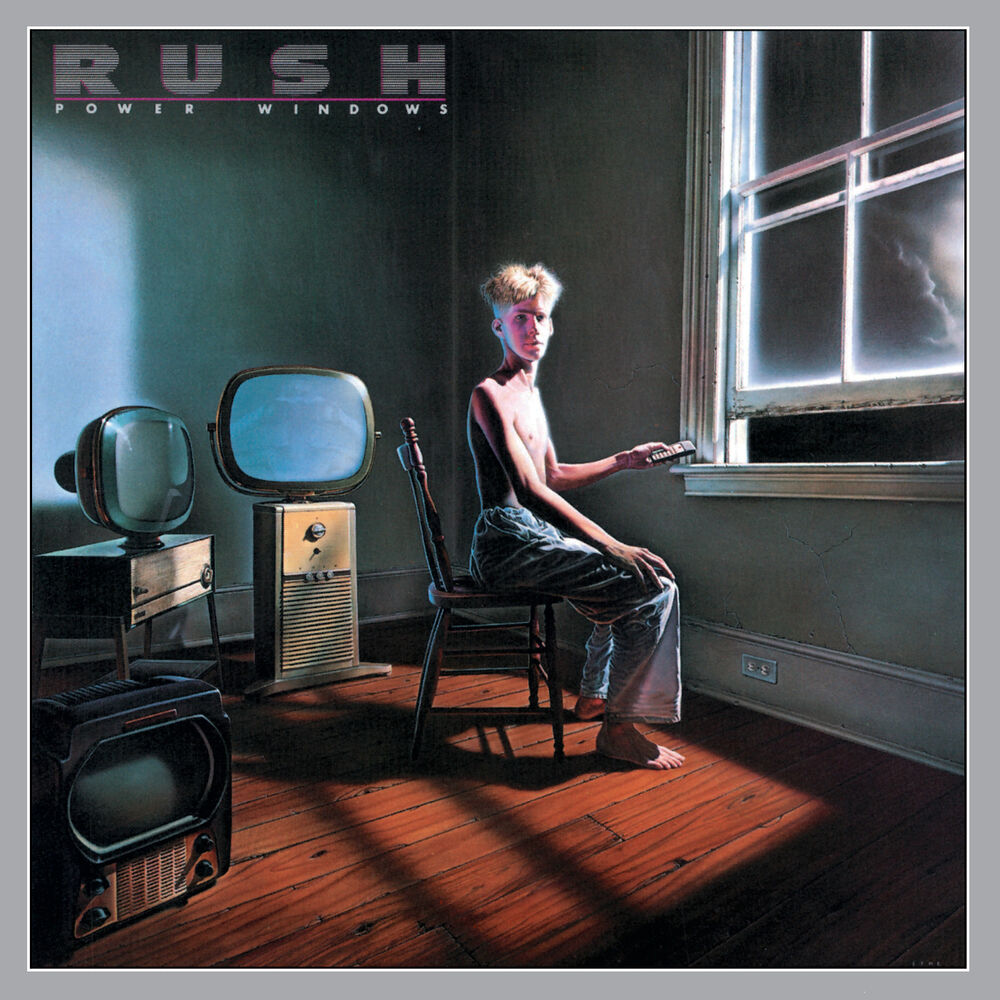
Power Windows
- Released21 June 2007
- UK peak No. 9
- Weeks on UK chart 4
- Entered UK chart 3 November 1985
- LabelIsland Mercury
- Tracks8 · 45 min
One track from it charted as a single. Press a flag to play it in the chart where it peaked.
Tracks
| 1 | 5:37 | ||
| 2 | Grand Designs | 5:06 | |
| 3 | Manhattan Project | 5:07 | |
| 4 | Marathon | 6:09 | |
| 5 | Territories | 6:20 | |
| 6 | Middletown Dreams | 5:15 | |
| 7 | Emotion Detector | 5:11 | |
| 8 | Mystic Rhythms | 5:53 |
About the album
Power Windows is the eleventh studio album by Canadian rock band Rush, released on October 11, 1985 in Canada by Anthem Records and on October 21, 1985 in the United States on Mercury Records. After touring in support of their previous album, Grace Under Pressure (1984), the band took a break and reconvened in early 1985 to begin work on a follow-up. The material continued to display the band's exploration of synthesizer-oriented music, this time with the addition of sampling, electronic drums, a string section, and choir, with power being a running lyrical theme. Power Windows was recorded in Montserrat and England with Peter Collins as co-producer and Andy Richards on additional keyboards.
The album reached No. 5 in Canada, No. 9 in the United Kingdom, and No. 10 in the United States. In January 1986, the album reached platinum certification by the Recording Industry Association of America (RIAA) for one million copies sold in the United States. Rush released two singles from the album, "The Big Money" and "Mystic Rhythms". The band supported the album with their 1985–1986 tour.
Background and writing
In November 1984, the band ended their concert tour in support of their previous album, Grace Under Pressure (1984). After a short respite, the group started work for a follow-up album in early 1985. Guitarist Alex Lifeson looked back at this period, and noted their conscious effort in taking the strongest elements of their previous two records, Signals (1982) and Grace Under Pressure and capitalizing on them for Power Windows. To Lifeson, this resulted in a more cohesive and satisfying album.
In February 1985, Rush had relocated to Elora Sound Studios in Elora, Ontario to write and rehearse new songs. Drummer Neil Peart would write a set of lyrics from the studio's farmhouse while Lifeson and frontman Geddy Lee worked on music to fit Peart's words in the adjacent barn which housed a 24-track recording studio. Peart worked on a small desk in his room, "about the right size for a five-year-old". During this time, Peart researched the Manhattan Project to write lyrics for the same-titled song.
Production
Rush recorded Power Windows from April to August 1985 in five different recording studios. The group recorded Power Windows with a new producer, Peter Collins. During their warm-up gigs in Florida, the band first met Australian engineer James "Jimbo" Barton, whom Collins had recommended. They accepted, and Peart later praised Barton's contributions and suggestions to the band, considering his small recommendations to improve a song, which he referred to as "events", was "just what we were looking for". Lifeson compared the experience of recording Power Windows as more pleasant and fun than Grace Under Pressure, which presented various problems for the band. He added that the album contained elements that Rush had not incorporated before and broke several boundaries that had existed with previous albums.
Critical reception
Power Windows has been met with mixed reviews from music critics. AllMusic's Eduardo Rivadavia retrospectively described the album as Rush's coldest album, citing the sparse, horn-like guitar playing of Lifeson, the prominent synthesizer of Lee and Peart's crisp, clinical percussion and stark lyrical themes. However, he also described the album as one that rewards patience and repeated listens. Rolling Stone magazine, in a positive review of the album, highlighted a number of bands that seemingly influenced Power Windows, such as The Police, U2, Genesis, and Siouxsie and the Banshees. The review concludes that Power Windows may be the missing link between Yes and the Sex Pistols. In 2005, the album was ranked number 382 in Rock Hard magazine's book The 500 Greatest Rock & Metal Albums of All Time. It was also in the top ten of a 2014 Rolling Stone website reader poll of best Rush albums.
Power Windows introduced more synthesizers into the band's sound.
Reissues
Although the original recording had a SPARS code of DDD and was considered to be of good quality, a remastered edition was issued in 1997. The remastered edition follows the industry's more recent trend of the loudness war, as it is considerably louder.
The tray has a picture of three fingerprints, light blue, pink, and lime green (left to right) with "The Rush Remasters" printed in all capital letters just to the left. All remasters from Moving Pictures to A Show of Hands feature this logo, originally found on the cover art of Retrospective II.
Includes the original grey border around the back cover image, along with lyrics and credits.
Power Windows was remastered again in 2011 by Andy VanDette for the "Sector" box sets, which re-released all of Rush's Mercury-era albums. Power Windows is included in the Sector 3 set.
Power Windows was remastered for vinyl by Sean Magee in 2015 at Abbey Road Studios as a part of the official "12 Months of Rush" promotion.