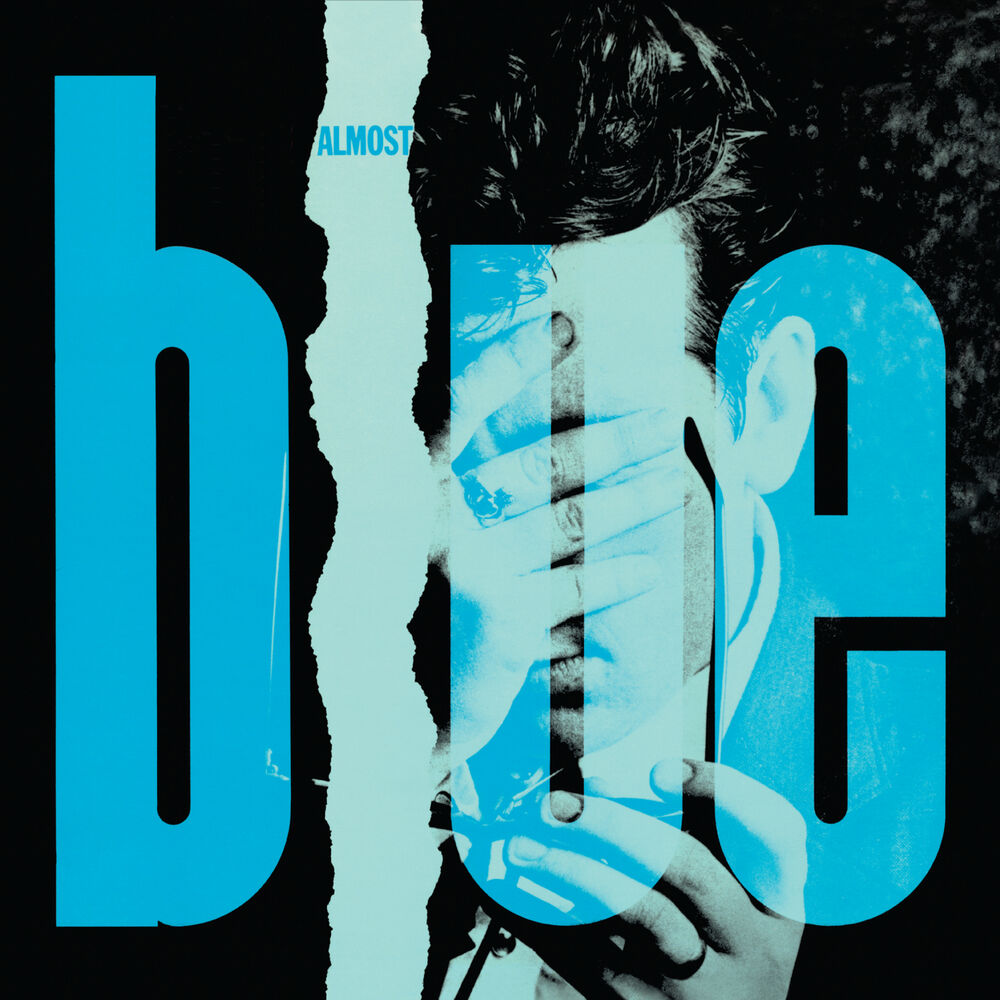
Almost Blue
- Released1 May 2007
- UK peak No. 7
- Weeks on UK chart 16
- Entered UK chart 25 October 1981
- LabelUMe/Elvis Costello
- Tracks12 · 32 min
2 tracks from it charted as singles. Press a flag to play it in the chart where it peaked.
Tracks
| 1 | Why Don't You Love Me (Like You Used To Do)? | 1:36 | |
| 2 | Sweet Dreams No. 42 · 1982 | 2:58 | |
| 3 | Success | 2:39 | |
| 4 | I'm Your Toy No. 51 · 1982 | 3:22 | |
| 5 | Tonight The Bottle Let Me Down | 2:09 | |
| 6 | Brown To Blue | 2:39 | |
| 7 | Good Year For The Roses | 3:08 | |
| 8 | Sittin' And Thinkin' | 3:00 | |
| 9 | Colour Of The Blues | 2:19 | |
| 10 | Too Far Gone | 3:27 | |
| 11 | Honey Hush | 2:13 | |
| 12 | How Much I Lied | 2:45 |
About the album
Almost Blue is the sixth studio album by the English singer-songwriter Elvis Costello, and his fifth with the Attractions—keyboardist Steve Nieve, bassist Bruce Thomas and drummer Pete Thomas (no relation). It was recorded in May 1981 in Nashville, Tennessee, and released in October the same year. A departure from Costello's previous works, it is a covers album composed entirely of country music songs, including works written by Hank Williams and George Jones. The project originated with Costello's desire to record a collection of covers after his two previous studio albums commercially underperformed following Armed Forces (1979).
Produced by Billy Sherrill, the recording sessions were marked by a fraught atmosphere, including resistance from Sherrill himself. The Doobie Brothers member John McFee contributed pedal steel as a way to add an authentic country sound. Most of the songs are relatively straightforward renditions of their original counterparts; a few were based on other covers of the originals. Costello's poor health during recording and troubled personal life reflected in the song choices. All of the tracks express a "blue" state of mind, reflected in the cover artwork, an homage to jazz guitarist Kenny Burrell's Midnight Blue (1963).
The lead single, a cover of Jones's "Good Year for the Roses", received heavy airplay and reached the UK top ten.
Background
By 1981, Elvis Costello had experimented with country music throughout his entire career. While he did not grow up listening to country music, his discovery of Gram Parsons' work with both the Byrds and the Flying Burrito Brothers inspired him to explore other country acts such as Merle Haggard and the Louvin Brothers. He played country rock songs during his time with the pub rock band Flip City in the mid-1970s and recorded the country tracks "Radio Sweetheart" and "Stranger in the House" during the sessions for his debut album My Aim Is True (1977). At the suggestion of Columbia Records' executive Greg Geller—who signed Costello to Columbia in America in 1977—Costello sang "Stranger in the House" as a duet with country musician George Jones in 1979, which appeared on the latter's My Very Special Guests album the same year. Costello first met Jones's longtime producer, Billy Sherrill, during an initial session in Nashville, Tennessee a year earlier.
Recording
The album was recorded from 18 to 29 May 1981 at Nashville's CBS Studio A; Studio B was being renovated so operations were forced to move to the adjacent studio, which Costello said was more generic and less atmospheric. Sherrill produced while Ron "Snake" Reynolds engineered; it was Costello's first studio album not produced by Nick Lowe. Alongside the Attractions, Doobie Brothers member John McFee was invited to contribute pedal steel and additional guitar overdubs to add an authentic country sound. Costello said: "We wanted the sound but we didn't necessarily want the main instrumental line which usually comes from the steel in country to be somebody we'd never heard before." The sessions were filmed by a camera crew, directed by Peter Carr, for the arts programme The South Bank Show.
The sessions were marred by a tense atmosphere. Costello himself was in poor health: he looked pale, was overweight and constantly drinking, which led to the recording of Haggard's "Tonight the Bottle Let Me Down" (1966) and Rich's "Sittin' and Thinkin'".
Composition
A departure from Costello's previous works, Almost Blue is composed of 12 country songs that all reflect a "blue" state of mind. In his review for Melody Maker, Allan Jones stated that the tracks are divided between "driving, shitkicking honky tonk tunes and exquisitely poignant ballads". Costello's troubled personal life, including his failing marriage and alcoholism, were reflected in the song choices, particularly "Tonight the Bottle Let Me Down", "Sittin' and Thinkin'" and George Jones's "Brown to Blue". Rolling Stone's Will Hodge argued that other than the fast-paced version of "Why Don't You Love Me (Like You Used to Do)?" that opens the album, the album itself bears little resemblance to the artist's previous works. The author Mick St.
Packaging and artwork
The album's design is an homage to Kenny Burrell's Midnight Blue (1963) and was packaged in four different coloured sleeves, all with blue as the base. Photographed by Keith Morris, the image depicts Costello with his glasses removed and face covered with one hand – a ring on his middle finger – appearing as though he is hiding tears. The original LP came with a removable sticker reading "Warning: This album contains country & western music and may produce radical reaction in narrow minded people". In his memoir, Costello stated the "warning" was a tease for listeners who desired "More New Wave Hits". On the back cover, Costello and the Attractions appear with small grins, along with an image of McFee in a Stetson. A logo reads "no spoiler signal".
Release
"Good Year for the Roses" was issued as the lead single, backed by a cover of Jack Ripley's "Your Angel Steps Out of Heaven", in September 1981. It received heavy airplay on BBC Radio One and Radio Two and charted at number 6 on the UK Singles Chart, proving Costello's prediction that it "would probably reach a lot of people that don't buy our records normally". It was promoted with a music video that was filmed at the Meldrum House. According to Costello, they could not take a piano onto the wood floor of the saloon so Nieve mimed the string parts using a violin. The video was played frequently on MTV in America during the programme's early days. "Sweet Dreams" was released as the second single in December, backed by a live version of Leon Payne's "Psycho", and reached number 42 in the UK.
Almost Blue was released on 23 October 1981 through F-Beat Records in the UK and Columbia in the US. It reached number 7 on the UK Albums Chart and number 50 on the US Billboard Top LPs & Tape chart, the latter of which Costello attributed to the lack of promotion from country radio stations.