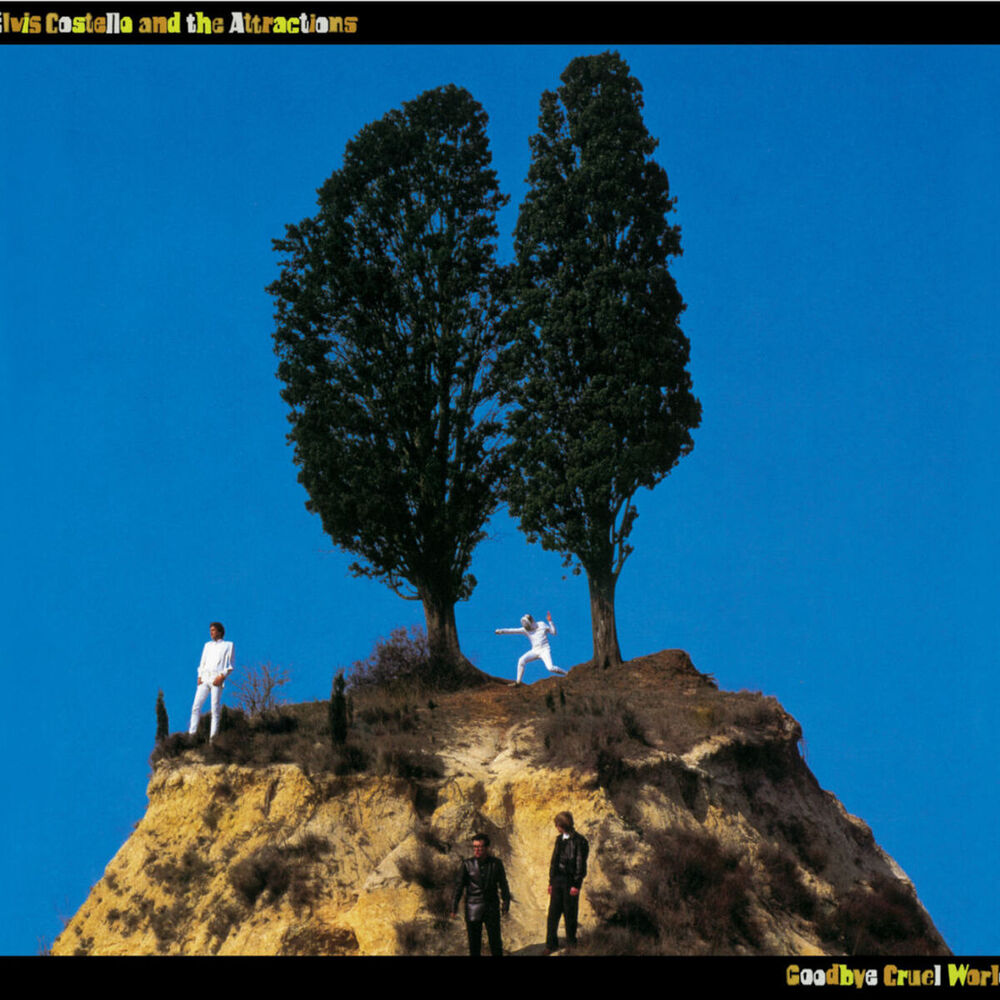
Goodbye Cruel World
- Released1 May 2007
- UK peak No. 10
- Weeks on UK chart 10
- Entered UK chart 1 July 1984
- LabelUMe/Elvis Costello
- Tracks13 · 44 min
2 tracks from it charted as singles. Press a flag to play it in the chart where it peaked.
Tracks
| 1 | 4:02 | ||
| 2 | Home Truth | 3:13 | |
| 3 | Room With No Number | 4:13 | |
| 4 | Inch By Inch | 2:29 | |
| 5 | Worthless Thing | 3:04 | |
| 6 | Love Field | 3:34 | |
| 7 | I Wanna Be Loved No. 25 · 1984 | 4:48 | |
| 8 | The Comedians | 2:36 | |
| 9 | Joe Porterhouse | 3:30 | |
| 10 | Sour Milk Cow Blues | 2:50 | |
| 11 | The Great Unknown | 3:00 | |
| 12 | The Deportees Club | 2:54 | |
| 13 | Peace In Our Time | 4:08 |
About the album
Goodbye Cruel World is the ninth studio album by the English singer-songwriter Elvis Costello, and his eighth with the Attractions—keyboardist Steve Nieve, bassist Bruce Thomas and drummer Pete Thomas (no relation). It was released on 18 June 1984 through F-Beat Records in the United Kingdom and Columbia Records in the United States. Produced by Clive Langer and Alan Winstanley, who returned from 1983's Punch the Clock, the album was recorded at London's Sarm West Studios in March 1984 during a period of turmoil for the artist. The problematic sessions included disagreements between Costello and the producers over the album's direction and high tensions amongst the Attractions.
The album features a commercial pop sound in line with music trends of the time. The mostly downbeat lyrics reflect Costello's personal upheavals at the time, including his failing marriage. Daryl Hall and Green Gartside contributed guest vocals to the singles "The Only Flame in Town" and "I Wanna Be Loved", respectively. The cover artwork features Costello and the band on a cliffside against a blue sky, while the title, taken from an obscure 1960s single, was intended as black humour.
Costello supported Goodbye Cruel World through music videos and tours, both solo and with the Attractions. Upon release, the album sold poorly, reaching number 10 in the UK and number 35 in the US.
Background
Elvis Costello released his eighth studio album Punch the Clock in August 1983. With a mainstream pop-soul sound fashioned by one of England's top production duos at the time, Clive Langer and Alan Winstanley, the record rebounded from the commercial disappointment of 1982's Imperial Bedroom, reaching number three in the United Kingdom and number 24 in the United States. To support the album, Costello and his backing band the Attractions—keyboardist Steve Nieve, bassist Bruce Thomas and drummer Pete Thomas (no relation)—toured for the rest of the year. The additions of the horns and backing singers, who played on Punch the Clock, to the shows added tensions between Costello and the band, who felt sidelined.
Recording
Recording for the album took place over two weeks in March 1984 at Trevor Horn's Sarm West Studios in London. Although Costello had initially thought of Richard Thompson to produce, Langer and Winstanley ultimately returned following Punch the Clock's commercial performance. From the start, the artist and producers disagreed on the album's direction. The former envisioned a "ragged, folk rock sound", while the latter wanted their signature style. Langer later stated:
He would have been better off going back to [his former producer] Nick Lowe. I wanted to carry on from where we had got to with 'Everyday I Write the Book', but Elvis was saying he wanted it really rough.
Music and lyrics
In his book The Words and Music of Elvis Costello, the author James E. Perone states that the music on Goodbye Cruel World offers a "commercial, conventional pop sound" tied to the "prevailing trends of the time". In his review of the album for The New York Times, Stephen Holden wrote that it contains "a freewheeling dictionary of pop and rock references that run from Memphis soul to slinky pop-jazz, from Fats Domino to Burt Bacharach to the Beatles." He dubbed the sound "trebly, carnival pop". Costello himself said in the 1995 liner notes the record has a "lack of rock 'n' roll". The author Mick St. Michael found the music more melancholy than Punch the Clock.
The album's lyrics reflect Costello's personal upheavals at the time and are mostly downbeat. Tracks such as "Worthless Thing", "The Deportees Club", "Joe Porterhouse", "The Comedians" and "The Great Unknown" all hint at, in Costello's words, his "unhappiness" and "self-disgust"; disillusionment also runs throughout several, including "The Deportees Club" and "The Great Unknown".
Packaging
The album's title came from a little-known 1960s single written by James Darlin. According to Costello, it was intended as black humour. Brian Griffin, who took the inner shots for Armed Forces (1979), shot photos for the Goodbye Cruel World album sleeve in Montpellier before the recording sessions began. The cover artwork is adorned by two trees on top of a cliffside, where Costello and the band—two in white and two in black—reside against a bright blue sky. Hinton says that Nieve looks like a fencer while Costello appears ready for a fist fight. Analysing the slightly oft-centred photograph, Hinton believes it has "an unsettling background of pure sky, as if the whole hillock is ascending to heaven.
Release and promotion
Shortly following the recording sessions, Costello booked a solo tour for the US and Europe in April 1984; it was the first time he performed solo since the sessions for My Aim Is True (1977). He later said: "I was having a miserable time. I basically ran away to sea." Supported by T Bone Burnett, Costello played stripped-down versions of Goodbye Cruel World tracks, his back catalogue and several covers he had yet to record. The tour was acclaimed for Costello's enthusiastic playing, above average vocal performances and as a lyrical showcase.
"Peace in Our Time" was released as a single under the pseudonym the Imposter through Costello's own IMP record label on 15 April 1984. It was his second release under the guise and label following "Pills and Soap" a year prior.
Critical reception
Goodbye Cruel World received mixed reviews on release. Several noticed a lack of musical innovation, lack of focus, hard to understand lyrics and felt the arrangements suffered from the production. Mat Snow of NME called the album Costello's first disappointment in seven years, asking why the only cover song comes across as "more heartfelt" than any of the originals. He also highlighted the recycling of melodies and themes conveyed superiorly on prior works. Musician magazine's Fred Schruers referred to the album as a "brilliant slough of despond" and not one "made for hits". Some negatively compared the arrangements to Costello's recent solo tour; Creem's Mitchell Cohen particularly criticised them on the record as being "so errant from the thrust of the material". McKenna said that Costello "occasionally overreaches himself" some of his "most ambitious" arrangements to date in the Los Angeles Times. Shewey found the "right balance between craft and intuition" a rarity in Rolling Stone.