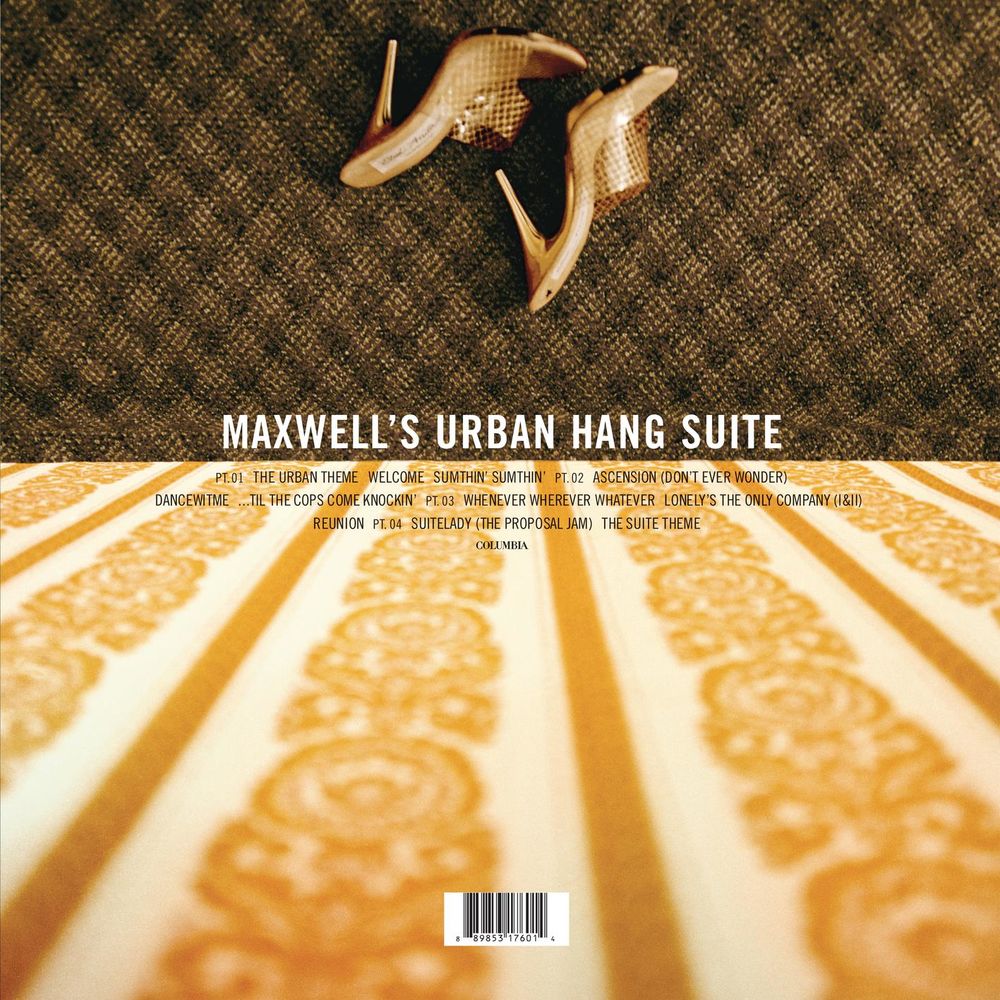
2 tracks from it charted as singles. Press a flag to play it in the chart where it peaked.
Tracks
| 1 | The Urban Theme (Remastered 2021) | 2:43 | |
| 2 | Welcome (Remastered 2021) | 5:17 | |
| 3 | Sumthin' Sumthin' (Remastered 2021) | 4:17 | |
| 4 | Ascension (Don't Ever Wonder) (Remastered 2021) No. 36 · 1996 | 5:44 | |
| 5 | Dancewitme (Remastered 2021) | 6:15 | |
| 6 | ...Til the Cops Come Knockin' (Remastered 2021) No. 63 · 1996 | 6:56 | |
| 7 | Whenever Wherever Whatever (Remastered 2021) | 3:45 | |
| 8 | Lonely's the Only Company (I&II) (Remastered 2021) | 6:21 | |
| 9 | Reunion (Remastered 2021) | 4:53 | |
| 10 | Suitelady (The Proposal Jam) (Remastered 2021) | 4:48 | |
| 11 | The Suite Theme (Remastered 2021) | 6:01 | |
| 12 | ...Til The Cops Come Knockin' (Remastered 2021) No. 63 · 1996 | 1:41 |
About the album
Maxwell's Urban Hang Suite is the debut album by American R&B singer-songwriter Maxwell. It was recorded in 1994 and 1995 and released on April 2, 1996, by Columbia Records.
Maxwell largely wrote and produced the album himself, recording in sessions at Electric Lady Studios, RPM, Sorcerer, and Chung King Studios in New York City, and CRC recording studios in Chicago. The resulting music features a mellow, groove-based sound with elements of funk, jazz, smooth soul, and quiet storm. A concept album, Maxwell's Urban Hang Suite was composed as a song cycle that focuses on an adult romance, based in part on Maxwell's personal experiences.
Maxwell's Urban Hang Suite was not an immediate commercial success, but it was helped by the release of its second single "Ascension (Don't Ever Wonder)" in July 1996, and the album eventually became a million-seller. It was also a success with critics, who praised it as a departure from the mainstream, hip hop-oriented R&B of the time, while earning Maxwell several accolades and comparisons to soul singers of the past, particularly Marvin Gaye and Prince.
The success of Maxwell's Urban Hang Suite elevated Maxwell's reputation to that of a sex symbol and a notable performer in the music industry. He was credited with shaping the "neo soul" movement of musicians that rose to prominence during the late 1990s.
Background
After receiving a low-cost Casio keyboard from a friend, Brooklyn, New York-native Maxwell began composing material at age 17. Raised in the borough's East New York-section, Maxwell's previous musical experience included his beginnings as a singer in the congregation of his Baptist church, which had become an integral part of his life after the death of his father in a plane crash. Already a fan of what he described as "jheri curl soul", which was the trademark of early 1980s R&B acts such as Patrice Rushen, S.O.S. Band and Rose Royce, Maxwell began to teach himself to play a variety of instruments. According to him, the R&B of the early 1980s contained "the perfect combination of computerized instrumentation with a live feel", and that the genre's dynamics later became lost due to the influence of hip hop on R&B. Despite facing ridicule from classmates for being shy and awkward, he progressed and continued to develop his musical abilities.
At 19, Maxwell began performing throughout the New York club circuit while supporting himself by waiting tables during the day.
Recording and production
Maxwell recorded his debut album between 1994 and 1995 at Electric Lady Studios, RPM Studios, Sorcerer Studios and Chung King Studios in New York City, and at CRC Studios in Chicago, Illinois. Maxwell's Urban Hang Suite was produced primarily by Peter Mokran, who was credited as P.M., and Maxwell, who was credited as "MUSZE", a play on the word muse. Columbia executives reluctantly gave Maxwell creative freedom in his contract and were hesitant to allow him produce the album alone. They assigned Chicago-based, English producer and multi-instrumentalist Stuart Matthewman to the project, but he only produced the first few tracks. Matthewman had previously worked with English R&B and jazz group Sade. During the recording sessions, Maxwell worked extensively with collaborators, including Matthewman, soul singer-songwriter Leon Ware, and funk guitarist Melvin "Wah-Wah Watson" Ragin.
Music and lyrics
Although one of his earliest influences was early 1980s urban R&B, Maxwell's Urban Hang Suite was inspired by the sounds and themes of classic soul artists such as Marvin Gaye, Curtis Mayfield, Barry White, Stevie Wonder and Prince. According to Prince biographer Alex Hahn, Maxwell adopts the singer's sound and style, particularly from songs such as "Do Me, Baby" (1982) and "Pink Cashmere" (1993), while The New York Times's Amy Linden said that he "melds a soft-spoken singing style with the fluid, spacious grooves often associated with the cocktail funk of Sade". Critics have also noted Maxwell's falsetto singing voice, and the music's atmospheric, funky instrumentation, featuring mellow horns, wah wah guitar, Rhodes piano and deep, articulate bass lines. The tempo of the songs slowly diminishes through the course of the album's songs. One critic attributes the tempo decrease to Stuart Matthewman's production.
Release and promotion
After Maxwell's Urban Hang Suite was completed, the finished recordings were presented to Columbia Records in mid 1995. It was shelved for nearly a year, because of issues with Columbia's management, the label's extensive reorganization, and record executives' doubts regarding the album's commercial potential. The marketplace dominance of hip hop soul in 1995 was in contrast with Maxwell's monogamous themes and older soul influences, which Columbia worried would be interpreted as old-fashioned. The label's executives also feared that his romantic concept and image would not appeal to listeners. Maxwell made matters worse by refusing to allow his picture to be placed on the album's front cover; instead he preferred to have the track listing and other information he felt was more important about the album in place of his photo. Regarding the cover, Maxwell later said "I wanted people to have the facts: the title, the selections and the fact that you had to basically buy it. I wanted people to come to the music and not base any opinion on the image".
Critical reception
Maxwell's Urban Hang Suite received positive reviews from critics. It was called a "masterpiece" by several reviewers who viewed it as a departure from the mainstream, hip hop-oriented R&B of the time. Maxwell was also compared to soul singers of the 1960s and 1970s.
Writing for Vibe, OJ Lima said the record was a "refreshing detour from hump-bouncin' '90s R&B", while Dimitri Ehrlich from Entertainment Weekly wrote that Maxwell "smooths hip-hop's and soul's edges, proving that black dance music doesn't automatically mean ghetto culture." Jim Farber of the New York Daily News called it "one of the few modern sex albums to offer a sense of succor", and Urban Latino hailed it as "one of the most soulful releases of the year", writing that Maxwell exhibited "the soul of Curtis Mayfield, the poetics of Beni More and the stage presence of Michael Jackson, pre-Thriller". In American Visions, Michael George wrote, "In an age where young, black artists are criticized (often rightly so) for misogynistic lyrics, Maxwell's focus on commitment is refreshing.