Imperial Bedroom
- Released1 January 2007
- UK peak No. 6
- Weeks on UK chart 7
- Entered UK chart 4 July 1982
- LabelUMe/Elvis Costello
- Tracks15 · 51 min
2 tracks from it charted as singles. Press a flag to play it in the chart where it peaked.
Tracks
| 1 | Beyond Belief | 2:34 | |
| 2 | Tears Before Bedtime | 3:01 | |
| 3 | Shabby Doll | 4:46 | |
| 4 | The Long Honeymoon | 4:15 | |
| 5 | Man Out Of Time No. 58 · 1982 | 5:26 | |
| 6 | Almost Blue | 2:47 | |
| 7 | ...And In Every Home | 3:20 | |
| 8 | The Loved Ones | 2:47 | |
| 9 | Human Hands | 2:42 | |
| 10 | Kid About It | 2:45 | |
| 11 | Little Savage | 2:36 | |
| 12 | Boy With A Problem | 2:10 | |
| 13 | Pidgin English | 3:58 | |
| 14 | You Little Fool No. 52 · 1982 | 3:09 | |
| 15 | Town Cryer | 4:16 |
About the album
Imperial Bedroom is the seventh studio album by the English singer-songwriter Elvis Costello, and his sixth with the Attractions—keyboardist Steve Nieve, bassist Bruce Thomas and drummer Pete Thomas (no relation). It was released on 2 July 1982 through F-Beat Records in the United Kingdom and Columbia Records in the United States. Recording took place at AIR Studios in London from late 1981 to early 1982 with production handled by Geoff Emerick. Placing an emphasis on studio experimentation, the album saw the group use unusual instruments, including harpsichord, accordion and strings arranged by Nieve. Songs were rewritten constantly while Costello tinkered with the recordings, adding numerous overdubs.
Employing a variety of pop styles that embody new wave, baroque pop and art rock, Imperial Bedroom contains an ornately lush production that several commentators compared to the Beatles and Phil Spector's wall of sound. The lyrics primarily concern love and relationships, with insight into the emotional problems of individuals. Squeeze's Chris Difford co-wrote the lyrics for "Boy With a Problem". The cover artwork, a painting by Barney Bubbles, is a pastiche of Pablo Picasso's Three Musicians.
Promoted under the tagline "Masterpiece?", Imperial Bedroom reached number 6 in the UK and number 30 in the US.
Background
By 1981, Elvis Costello had released six studio albums in four years. Following the release of his country covers album Almost Blue (1981), the artist was facing diminishing popularity, particularly in America, where Trust (1981) and the Taking Liberties (1980) collection of non-album tracks had only reached the top 30; Armed Forces (1979) and Get Happy!! (1980) had both reached the top 15. He had experimented musically with Get Happy!!, Trust and Almost Blue, and began to write more introspective lyrics than the angry material of his first three albums. However, the weaker commercial performances of these projects caused him to re-evaluate himself as an artist, leading him to take a new direction for his next album.
Costello's initial vision for his seventh studio project was to record most of it live with minimal overdubs. He and his backing band the Attractions—keyboardist Steve Nieve, bassist Bruce Thomas and drummer Pete Thomas (no relation)—spent two weeks rehearsing the material at a remote college in Devon using this method, yielding an eight-track album.
Recording and production
The band regrouped at London's AIR Studios in November 1981, where Costello had booked 12 weeks to record the album. He chose former Beatles engineer Geoff Emerick to produce the album, who the artist primarily used to "make his scattershot ideas a reality"; Emerick would be listed on the album sleeve as producing "from an original idea by Elvis Costello, assisted by Jon Jacobs". It was Costello's first album of original material not produced by Nick Lowe, as Costello believed his complex ideas for the record would be too much for the producer; engineer Roger Béchirian did not return either. Lowe later returned to produce 1986's Blood & Chocolate.
Emerick's primary role was to let the musicians take charge of themselves, as a way to "draw things out of the artist". Costello commented in 1995: "He was used to being thrown an incomprehensible garble of sounds and musical directions and making some sense of it.
Music and lyrics
A departure from the artist's previous albums, Imperial Bedroom employs a variety of musical styles, characterised by commentators as new wave, baroque pop, and art rock. Reviewers also found it Beatlesque, and drew comparisons to Tin Pan Alley. AllMusic's senior editor Stephen Thomas Erlewine regarded the songs as an extension of the jazz and pop infatuations explored on Trust. In The New York Times, Palmer summarised, "the music is a sumptuous mélange of pop styles, from Beatles-baroque to Phil Spector Wall-of-Sound to torch-song intimacy." Rolling Stone's Parke Puterbaugh wrote that the album contains a "potent, articulate musical kick" that relates to the Who's Tommy (1969), the Pretty Things' S.F. Sorrow (1968) and the Beatles' Sgt. Pepper's Lonely Hearts Club Band (1967). The biographer David Gouldstone says the production makes the songs sound "spontaneous and immediate", while the author James E. Perone remarks that Costello's voice is higher in the mix, presenting a "clearer presentation" of his voice than any of Lowe's productions.
Artwork and packaging
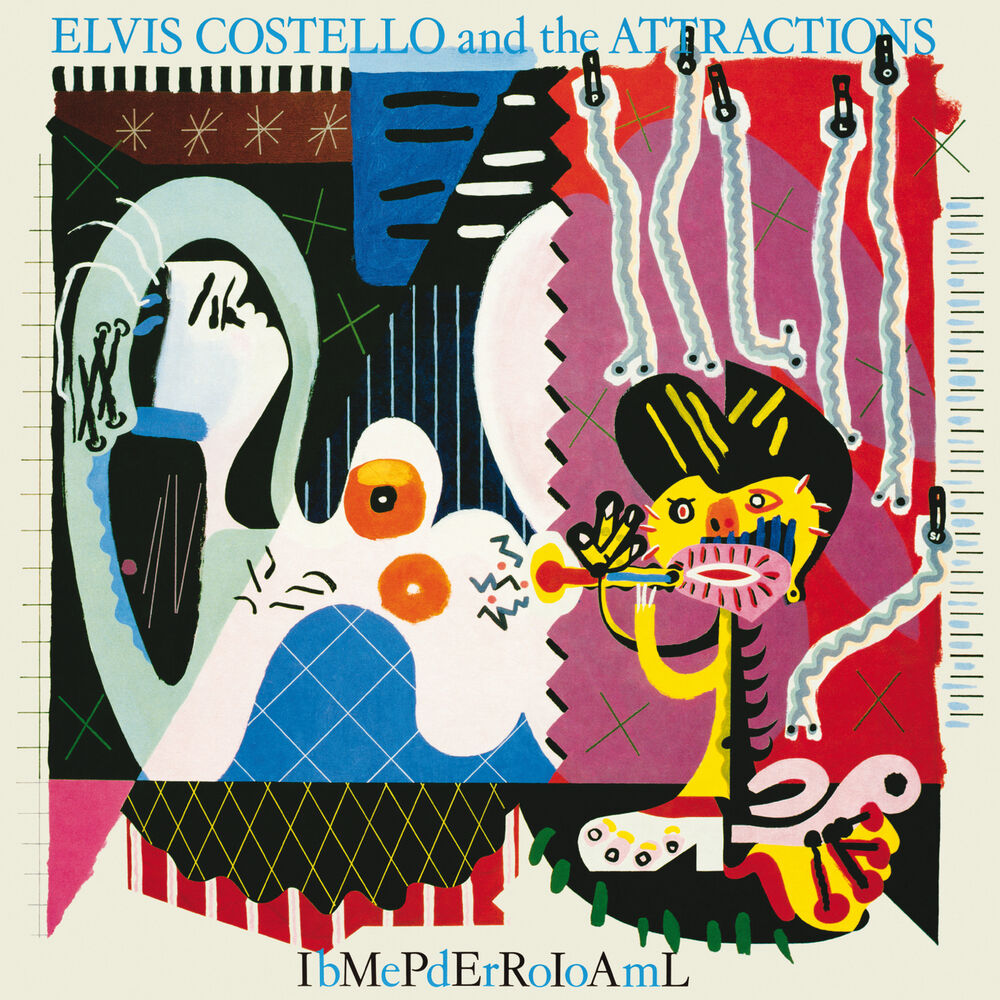
The cover artwork, a painting titled Snakecharmer & Reclining Octopus by Barney Bubbles (credited to "Sal Forlenza"), is a pastiche of Pablo Picasso's Three Musicians (1921). Costello was taken aback upon seeing the painting for the first time, believing Bubbles had responded to "the more violent and carnal aspects of the songs". The painting depicts a resting woman with laced hands surrounded by zipper-like creatures—which spell out "Pablo Si"—sitting next to ringmaster-type figure, wearing what Costello interpreted as a tricorn hat. In his book Let Them All Talk, Hinton describes the picture as "a violent exercise in harsh red and blues". The cover won the Creem readers' poll for the best album cover of 1982. The original LP's inner sleeve boasted photographs by David Bailey of the entire band in black-and-white. The one of Costello, in which he glares into the camera with his chin resting on his fist, was used as the sleeve photo for the "Man Out of Time" single.
Imperial Bedroom was Costello's first album to include a lyric sheet.
Release and promotion
Although the album was finished by March 1982, its release was pushed back four months due to financial disputes between F-Beat and Columbia Records. Costello and the Attractions toured Holland and Oceania from April to June as pre-release promotion. Released on 2 July 1982, Imperial Bedroom reached number 6 on the UK Albums Chart and number 30 on the US Billboard Top LPs & Tape chart; it spent 12 weeks overall in the UK top 100. Elsewhere, it peaked at number 18 in Norway, 30 in Sweden, 37 in New Zealand, 45 in the Netherlands and 49 in Australia. F-Beat also issued a now-rare collectible double promotional LP, titled A Conversation with Elvis Costello, featuring album tracks interspersed with comments by the artist on the makings of each track.
The album's singles performed poorly. The first, "You Little Fool" backed by the Lowe-produced outtakes "Big Sister" and "The Stamping Ground", was released in June 1982 and reached number 52 in the UK.