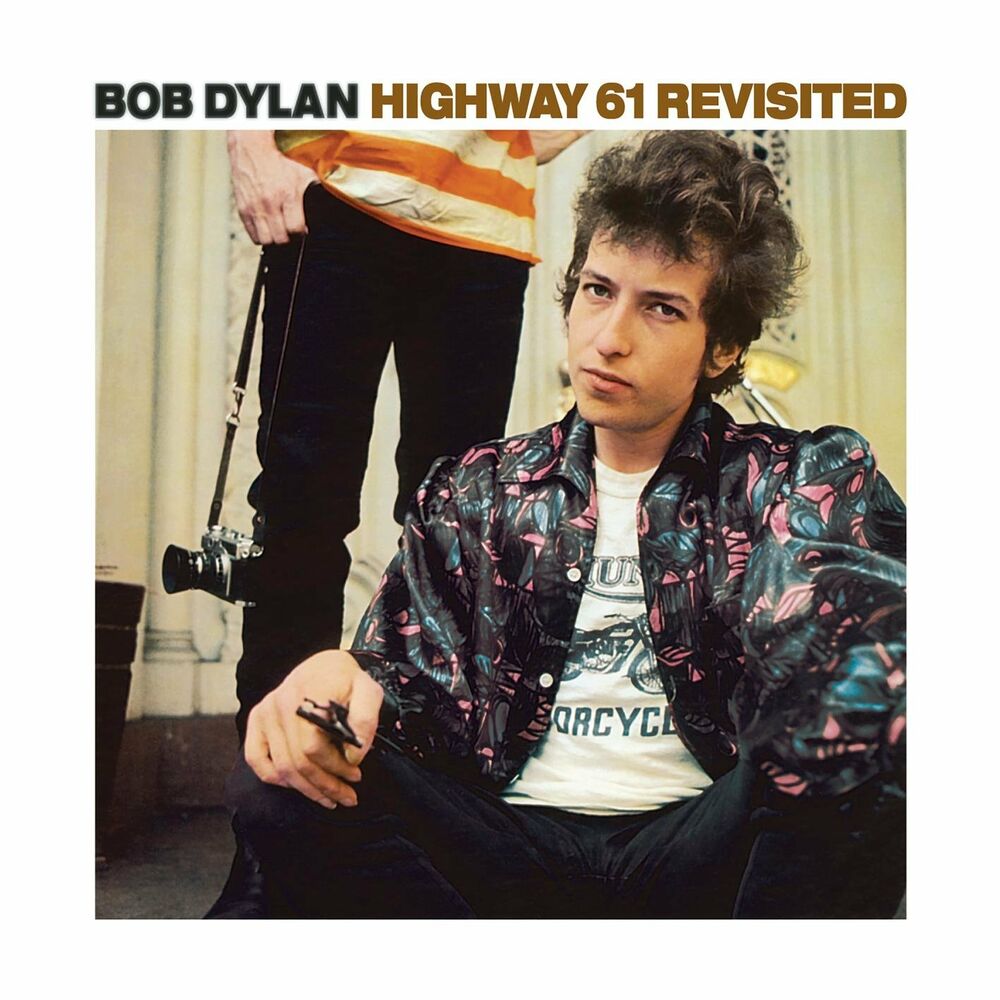
Highway 61 Revisited
- Released27 August 1965
- UK peak No. 4
- Weeks on UK chart 16
- Entered UK chart 3 October 1965
- LabelColumbia
- Tracks9 · 51 min
One track from it charted as a single. Press a flag to play it in the chart where it peaked.
Tracks
| 1 | 6:09 | ||
| 2 | Tombstone Blues | 5:55 | |
| 3 | It Takes a Lot to Laugh, It Takes a Train to Cry | 4:04 | |
| 4 | From a Buick 6 | 3:15 | |
| 5 | Ballad of a Thin Man | 5:56 | |
| 6 | Queen Jane Approximately | 5:27 | |
| 7 | Highway 61 Revisited | 3:25 | |
| 8 | Just Like Tom Thumb's Blues | 5:27 | |
| 9 | Desolation Row | 11:20 |
About the album
Highway 61 Revisited is the sixth studio album by the American singer-songwriter Bob Dylan, released on August 30, 1965, by Columbia Records. Dylan continued the musical approach of his previous album Bringing It All Back Home (1965), using rock musicians as his backing band on every track of the album in a further departure from his initial acoustic folk sound, except for the closing track, the 11-minute ballad "Desolation Row". Critics have focused on Dylan's innovative use of driving, blues-based music and subtle poetry to create songs that captured the political and cultural climate of contemporary America. Author Michael Gray argued that, in an important sense, the 1960s "started" with this album.
Led off by "Like a Rolling Stone", a hit single released ahead of the album, Highway 61 Revisited includes songs that Dylan has continued to perform live over his long career, including "Ballad of a Thin Man" and the title track. He named the album after the major American highway that connected his birthplace of Duluth, Minnesota, to southern cities famed for their musical heritage, including St. Louis, Memphis, New Orleans, and the Delta blues area of Mississippi.
Highway 61 Revisited peaked at No. 3 on the US Billboard Top LPs chart and No. 4 on the UK Albums Chart.
Background
In May 1965, Dylan returned from his tour of England feeling exhausted and dissatisfied with his material. He told journalist Nat Hentoff: "I was going to quit singing. I was very drained" and added, "[i]t's very tiring having other people tell you how much they dig you if you yourself don't dig you."
As a consequence of his dissatisfaction, Dylan wrote 20 pages of verse he later described as a "long piece of vomit". He reduced this to a song with four verses and a chorus—"Like a Rolling Stone". He told Hentoff that writing and recording the song washed away his dissatisfaction, and restored his enthusiasm for creating music. Describing the experience to Robert Hilburn in 2004, nearly 40 years later, Dylan said: "It's like a ghost is writing a song like that ... You don't know what it means except the ghost picked me to write the song."
Highway 61 Revisited was recorded in two blocks of recording sessions that took place in Columbia's Studio A, located on Seventh Avenue in Midtown Manhattan.
Recording sessions, June 15–16
In the first recording session on June 15 Dylan was backed by Bobby Gregg on drums, Joe Macho Jr. on bass, Paul Griffin on piano, and Frank Owens on guitar. For lead guitar, the singer recruited Michael Bloomfield of the Paul Butterfield Blues Band. The musicians began the session by recording a fast version of "It Takes a Lot to Laugh, It Takes a Train to Cry" and the song "Sitting on a Barbed Wire Fence", which was omitted from the album. Dylan and the musicians next attempted to record "Like a Rolling Stone"; at this early stage, Dylan's piano dominated the backing, which was in 3/4 time. "Sitting on a Barbed Wire Fence", the fast version of "It Takes a Lot to Laugh", and an early take of "Like a Rolling Stone" were eventually released on The Bootleg Series Volumes 1–3 (Rare & Unreleased) 1961–1991.
The musicians returned to Studio A the following day, when they devoted almost the entire session to recording "Like a Rolling Stone". Present on this occasion was Al Kooper, a young musician invited by Wilson to observe, but who wanted to play on the session.
Recording sessions, July 29 – August 4
To create the material for Highway 61 Revisited, Dylan spent a month writing in his new home in the Byrdcliffe artists' colony of Woodstock in upstate New York. When he returned to Studio A on July 29, he was backed by the same musicians, except Harvey Brooks replaced Joe Macho on bass and his producer had changed from Tom Wilson to Bob Johnston.
Their first session together was devoted to three songs. After recording several takes each of "Tombstone Blues", "It Takes a Lot to Laugh" and "Positively 4th Street", masters were successfully recorded. "Tombstone Blues" and "It Takes a Lot to Laugh" were included in the final album, but "Positively 4th Street" was issued as a single-only release. At the close of the July 29 session, Dylan attempted to record "Desolation Row", accompanied by Al Kooper on electric guitar and Harvey Brooks on bass. There was no drummer, as the drummer had gone home. This electric version was eventually released in 2005, on The Bootleg Series Vol. 7.
On July 30, Dylan and his band returned to Studio A and recorded three songs.
Artwork and packaging
The cover artwork was photographed by Daniel Kramer several weeks before the recording sessions. Kramer captured Dylan sitting on the stoop of the apartment of his manager, Albert Grossman, located in Gramercy Park, New York, placing Dylan's friend Bob Neuwirth behind Dylan "to give it extra color". Only the lower half of Neuwirth is visible and he holds a Nikon SP camera. Dylan wears a Triumph motorcycle T-shirt under a blue and purple silk shirt, holding his Ray-Ban sunglasses in his right hand. Photographer Kramer commented in 2010 on the singer's expression: "He's hostile, or it's a hostile moodiness.
Reception and legacy
In the British music press, initial reviews of Highway 61 expressed both bafflement and admiration for the record. New Musical Express critic Allen Evans wrote: "Another set of message songs and story songs sung in that monotonous and tuneless way by Dylan which becomes quite arresting as you listen." The Melody Maker LP review section, by an anonymous critic, commented: "Bob Dylan's sixth LP, like all others, is fairly incomprehensible but nevertheless an absolute knock-out." The English poet Philip Larkin, reviewing the album for The Daily Telegraph, wrote that he found himself "well rewarded" by the record: "Dylan's cawing, derisive voice is probably well suited to his material ... and his guitar adapts itself to rock ('Highway 61') and ballad ('Queen Jane').