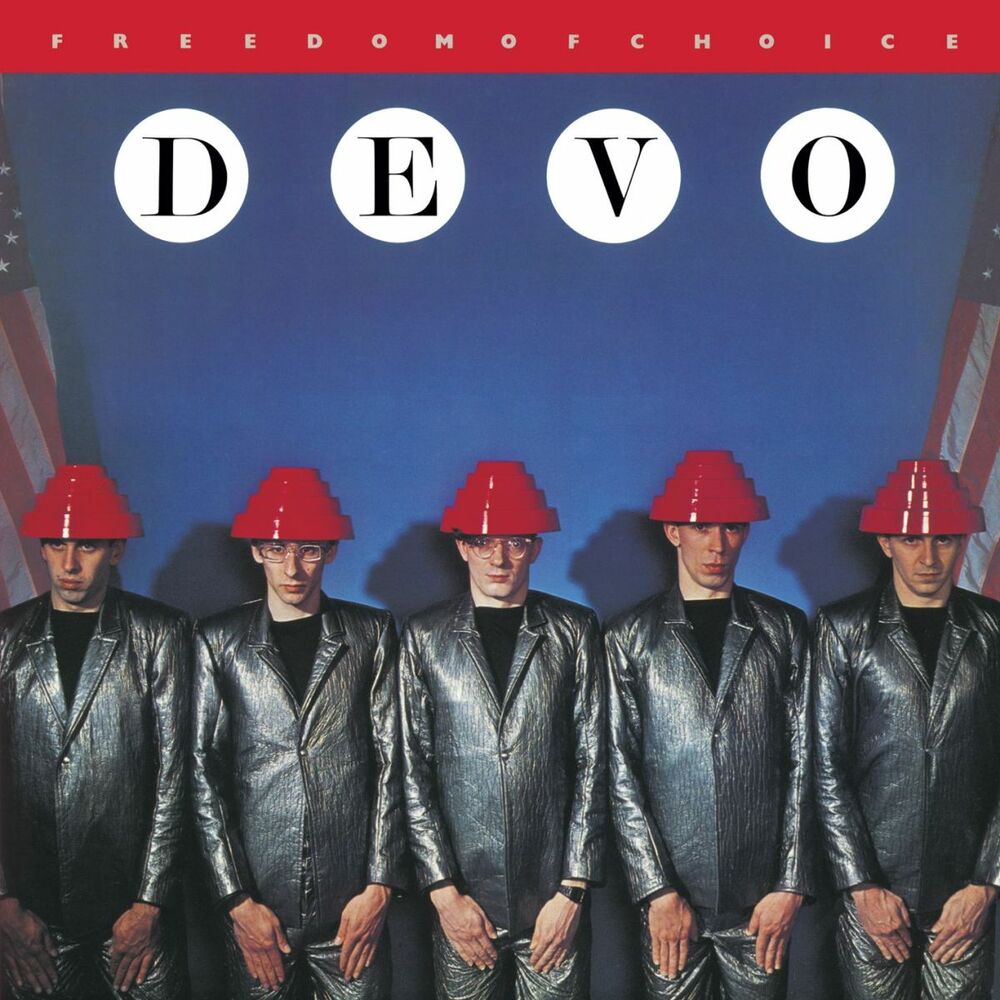
Freedom of Choice (2009 Remaster; Deluxe Edition)
- Released15 May 1980
- UK peak No. 47
- Weeks on UK chart 5
- Entered UK chart 18 May 1980
- LabelWarner Records
- Tracks18 · 50 min
2 tracks from it charted as singles. Press a flag to play it in the chart where it peaked.
Tracks
| 1 | Girl U Want (2009 Remaster) | 2:57 | |
| 2 | It's Not Right (2009 Remaster) | 2:23 | |
| 3 | 2:39 | ||
| 4 | Snowball (2009 Remaster) | 2:29 | |
| 5 | Ton O' Luv (2009 Remaster) | 2:30 | |
| 6 | Freedom of Choice (2009 Remaster) | 3:28 | |
| 7 | Gates of Steel (2009 Remaster) | 3:28 | |
| 8 | Cold War (2009 Remaster) | 2:31 | |
| 9 | Don't You Know (2009 Remaster) | 2:15 | |
| 10 | That's Pep! (2009 Remaster) | 2:19 | |
| 11 | Mr. B's Ballroom (2009 Remaster) | 2:47 | |
| 12 | Planet Earth (2009 Remaster) | 2:46 | |
| 13 | Freedom of Choice Theme Song (Live) | 2:44 | |
| 14 | 2:45 | ||
| 15 | Girl U Want (Live) | 3:01 | |
| 16 | Gates of Steel (Live) | 3:37 | |
| 17 | Be Stiff (Live) No. 71 · 1978 | 2:55 | |
| 18 | Planet Earth (Live) | 2:37 |
About the album
Freedom of Choice is the third studio album by the American new wave band Devo, released in May 1980 on Warner Bros. Records. The album contained their biggest hit, "Whip It", which hit No. 8 and No. 14 on the Billboard Club Play Singles and Pop Singles charts, respectively. Freedom of Choice peaked at No. 22 on the Billboard Pop Albums chart.
Background
Devo had amassed a sizeable following after the release of their first two studio albums with Warner Bros. However, after the band's second album Duty Now for the Future (1979) was not as well received, the label presented the band with a "make or break" ultimatum for their forthcoming third album. Warner Bros. told the band that if sales did not increase with the new album's release, the label would terminate their contract. Devo frontman Mark Mothersbaugh later contended that Warner Bros. threatened the band's manager Elliot Roberts with litigation if Devo did not achieve chart success with the album.
While the material on Devo's first two albums mostly consisted of old songs written between 1974 and 1977, the band decided to compose all new material for the upcoming crucial third album. The songs were written after the band had completed their second world tour.
The creation of Freedom of Choice saw the band now living in Los Angeles and choosing to start from scratch.
Composition
Freedom of Choice was informed by bassist Gerald Casale's and guitarist Bob Mothersbaugh's mutual love of R&B music. The band decided that heading in a more funk-oriented direction with their new songs would satisfy both themselves and Warner Bros. DJ Pangburn of Sound on Sound later observed that the album "is far from R&B, although it's funky and moves in a way that its two predecessors do not." The band members all fully committed to the new artistic direction and were later in agreement that it was their best album, strongest set of songs and most enjoyable experience in the studio, due to their positive working relationship. However, Casale has said that the band's fanbase were very critical of this stylistic departure.
The songs on Freedom of Choice were more mainstream and accessible than its two predecessors. Casale recalled that "This was a self-imposed challenge. Can we write songs? Because we always thought that was a little bit beneath [who] Devo was, but in the end, not really.
Production
Devo had not enjoyed the experience of working with their previous producer, Ken Scott, and after the band's sales decreased with the resulting album, Duty Now for the Future, they decided to find a new producer. Mark Mothersbaugh later stated that, while the band admired Bootsy Collins, Prince and Motown, they had difficulty figuring out how to reflect those influences in their own music. The band decided to approach electronic music pioneer Robert Margouleff, due to his work with Stevie Wonder and Tonto's Expanding Head Band (featuring the TONTO synthesizer), as well as in underground cinema. Mark Mothersbaugh recalled that Margouleff satisfied both his love of technology and Casale's interest in achieving a more radio-friendly sound. Pangburn observed that, "with Margouleff at the mixing desk, Devo produced a catchy synth pop album that proved to be their mainstream breakthrough."
The album was demoed at Modern Music Recording Studio in 1980, and these tracks were later released on the compilation album Recombo DNA in 2000.
Recording
Freedom of Choice was recorded and mixed in six weeks at the Record Plant in Los Angeles using a 24-track machine, with Margouleff co-producing the sessions with the band and co-engineering with Howard Seigel. Bass, drums and guitars were all recorded live together, while synths and vocals were overdubbed later. Bob Mothersbaugh recalled that Margouleff "created a good atmosphere to play live". Margouleff also encouraged the band to pursue a more raw production sound, stripping away effects and layers. He experimented with different mic placements and recording methods for every track and left the tapes constantly rolling in the hopes of capturing something spontaneous.
Margouleff paid particular focus to the sound of the rhythm section:
It was basically in the grooves, in the bottom end. ... We set up the grooves for the songs so that the songs were not self-consciously about the top end.
Artwork and title
The cover features the band wearing silver suits made of Naugahyde, designed by Casale and inspired by suits worn by Black R&B groups of the 1950s. The band's red "energy dome" hats were inspired by Art Deco light fixtures Casale remembered from the grade school he had attended, which was built in the 1920s. The hats were designed by Brent Scrivner and fashioned from vacuform ABS white plastic, spray-painted with Chinese red lacquer. The band also wore black boat neck shirts, which were popular with beach-goers in the 1960s.
The title Freedom of Choice was chosen because Mark Mothersbaugh and Casale had been fond of that track. Other proposed titles for the album included Time for Devo and You R It.
Promotion
Freedom of Choice was released on May 16, 1980.
"Girl U Want" was the initial single chosen by Warner Bros., and Nagy theorized that its similar feel to the Knack's "My Sharona" made the label think it had commercial potential. The single failed to chart, and after the band began their concert tour, Florida record promoter Kal Rudman urged southeastern DJs to play "Whip It", whose popularity then spread to New York and the rest of the U.S., including gay dance clubs. "Whip It" was formally released as a single on August 13, 1980, and became a genuine hit, peaking at No. 14 on the Billboard Hot 100 for the week of November 15, 1980. Warner Bros. then gave the band an infusion of cash to make a promo video for the song. Despite its success, Casale later expressed that the band had not viewed the song any differently than any other song on the record.
The video for "Whip It" was based on a 1962 issue of Dude magazine that Mark Mothersbaugh had found in an antique store, which contained a story about a dude ranch where the owner would whip his wife's clothes off.