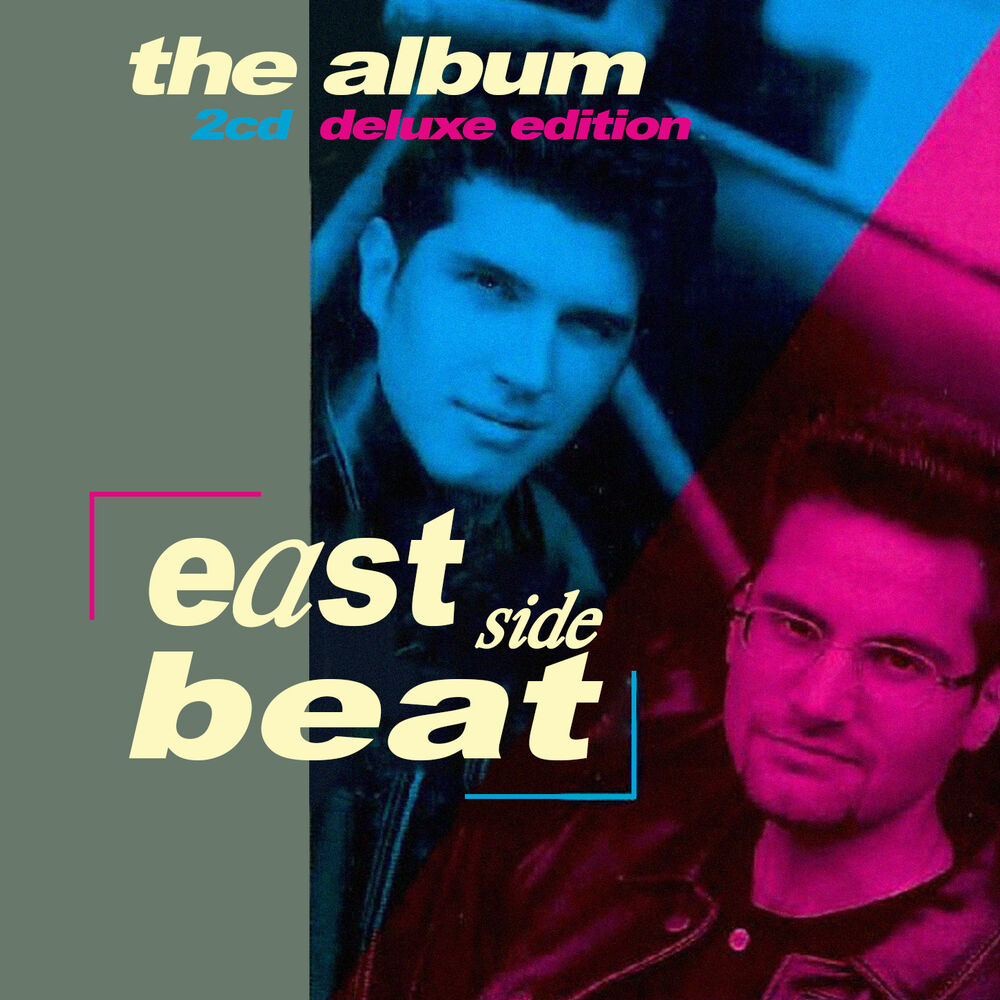
East Side Beat (The Album) Deluxe Edition
- Released17 June 2016
- LabelZYX Music
- Tracks25 · 123 min
One track from it charted as a single. Press a flag to play it in the chart where it peaked.
Tracks
| 1 | Ride Like The Wind No. 3 · 1991 | 3:52 | |
| 2 | Everybody's Got To Learn Sometime | 5:32 | |
| 3 | Break Down | 5:05 | |
| 4 | Jasmine | 4:14 | |
| 5 | Don't You (Forget About Me) | 4:48 | |
| 6 | My Girl | 3:24 | |
| 7 | I Didn't Know | 3:37 | |
| 8 | Alive 'n Kicking | 4:05 | |
| 9 | Divin' In The Beat | 3:44 | |
| 10 | Everybody Wants To Rule The World | 3:48 | |
| 11 | On My Mind | 4:06 | |
| 12 | All Right | 4:14 | |
| 13 | Fly Away | 4:54 | |
| 14 | You Are My Everything | 3:32 | |
| 15 | Ride Like The Wind No. 3 · 1991 | 6:00 | |
| 16 | Divin' In The Beat | 5:35 | |
| 17 | Alive 'n Kicking | 6:54 | |
| 18 | My Girl | 5:01 | |
| 19 | You Are My Everything | 7:02 | |
| 20 | I Didn't Know | 6:40 | |
| 21 | Broken Heart | 5:01 | |
| 22 | By The Way | 5:01 | |
| 23 | Alive 'n Kicking | 6:35 | |
| 24 | You Are My Everything | 6:15 | |
| 25 | Ride Like The Wind No. 3 · 1991 | 4:07 |
About the album
At Fillmore East is the first live album by American rock band the Allman Brothers Band, and their third release overall. Produced by Tom Dowd, the album was released on July 6, 1971, in the United States, by Capricorn Records. As the title indicates, the recording took place at the New York City music venue Fillmore East, which was run by concert promoter Bill Graham. It was recorded over the course of three nights in March 1971 (only two nights were used for the album) and features the band performing extended jam versions of songs such as "Whipping Post", "You Don't Love Me" and "In Memory of Elizabeth Reed". When first commercially released, it was issued as a double LP with just seven songs across four vinyl sides.
At Fillmore East was the band's artistic and commercial breakthrough, rapidly increasing the band's exposure and garnering them a new legion of fans. It has since been widely regarded as one of the greatest live albums of all time and the start of the band's association with the jam band school of music (although members of the band have repudiated the label, stating instead they are just "a band that jams"). It has also been ranked as one of the best albums of all time and continues to be a top seller in the band's catalog, becoming their first album to receive a Platinum certification from the Recording Industry Association of America (RIAA).
Background
Shortly after completing recording of their second album, Idlewild South, in July 1970, the Allman Brothers were playing a show in Miami. British supergroup lead guitarist Eric Clapton had formed an intentionally anonymous new band – Derek and the Dominos – and begun recording what was to become the iconic double-album Layla and Other Assorted Love Songs there. Stalled, Clapton had indicated to album producer Tom Dowd that he was interested in meeting Allman, whose session work on Wilson Pickett's 1968 cover of The Beatles' "Hey Jude" he particularly admired; in turn, Allman was a huge fan of Clapton's playing with the band Cream. The pair were introduced after the August 26 show, and jammed together until the next afternoon. "Instant soulmates", Clapton invited Allman to join the "Layla" sessions, with Allman ending up contributing memorable guitar licks to all but three songs on the album.
Recording and production
At Fillmore East was recorded over two nights, March 12 and 13, 1971, with the band playing two shows each night at $1,250 per show. Recordings from an earlier night's shows were dropped, because they had horns which were deemed unhelpful. The shows were typical performances for the band, and regarded as slightly above average by drummer Jai Johanny Johanson. Ads for the shows read: "Bill Graham Presents in New York — Johnny Winter And, Elvin Bishop Group, Extra Added Attraction: Allman Brothers." While Winter was billed as headliner, by the third night the Allman Brothers were closing the show.
Tom Dowd produced At Fillmore East; he had previously worked on the band's second studio album, Idlewild South. He had recently returned from Africa from working on the documentary film Soul to Soul, and stayed in New York several days to oversee the live recording. "It was a good truck, with a 16-track machine and a great, tough-as-nails staff who took care of business," recalled Dowd.
Writing
At Fillmore East showcases the band's eclectic mixture of blues, rock, country, and jazz. "Fusion is a term that came later, but if you wanted to look at a fusion album, it would be Fillmore East. Here was a rock 'n' roll band playing blues in the jazz vernacular. And they tore the place up," said Dowd. Stage Manager Michael Ahern opens At Fillmore East with a simple introduction: "Okay, the Allman Brothers Band." Duane Allman biographer Randy Poe describes it as "the only low-key moment over the course of the [show]." The cover of Blind Willie McTell's "Statesboro Blues" which opens the set showcases Duane Allman's slide guitar work in open E tuning. "Statesboro Blues" bears close resemblance to Taj Mahal's 1968 rendition, which had inspired Duane to pick up slide guitar playing. "Done Somebody Wrong" follows, and is introduced by Duane as "an old Elmore James song ...
Artwork
The band devised the cover idea for At Fillmore East rather than leaving it in the hands of Atlantic executives (Duane Allman was particularly disgusted with the artwork for Sam & Dave's Hold On, I'm Comin', although that album's artwork was created by Stax Records, which Atlantic had previously distributed). Initially, the album cover was to be shots of the band taken in front of the Fillmore East with their names on the marquee above them, but no one was satisfied with the results. The band's main purpose for the cover was that it be as "meat and potatoes" as the band's ethos and performing, and someone suggested the band make it a photograph of the band with their gear waiting to go onstage.
The image was shot by photographer Jim Marshall one morning in the band's home of Macon, Georgia. The group were not very happy about being woken up early to pose ("we figured it didn't make a damn bit of difference what the cover was or what time we took it," said guitarist Dickey Betts).
Release and critical reception
At Fillmore East was released in July 1971 by Capricorn Records as a double album, but reduced near the cost of a single LP. Atlantic and Atco initially rejected the idea of issuing a double album, with Jerry Wexler feeling it "ridiculous to preserve all these jams." Manager Phil Walden explained to executives that live performances, rather than making studio recordings, were most important to them. In all, the album featured seven songs spread over two vinyl discs. The album received strong initial sales. While previous albums by the band had taken months to hit the charts (often near the bottom of the top 200), the record started to climb the charts after a matter of days. At Fillmore East peaked at number thirteen on Billboard's Top Pop Albums chart, and was certified gold by the Recording Industry Association of America that October.