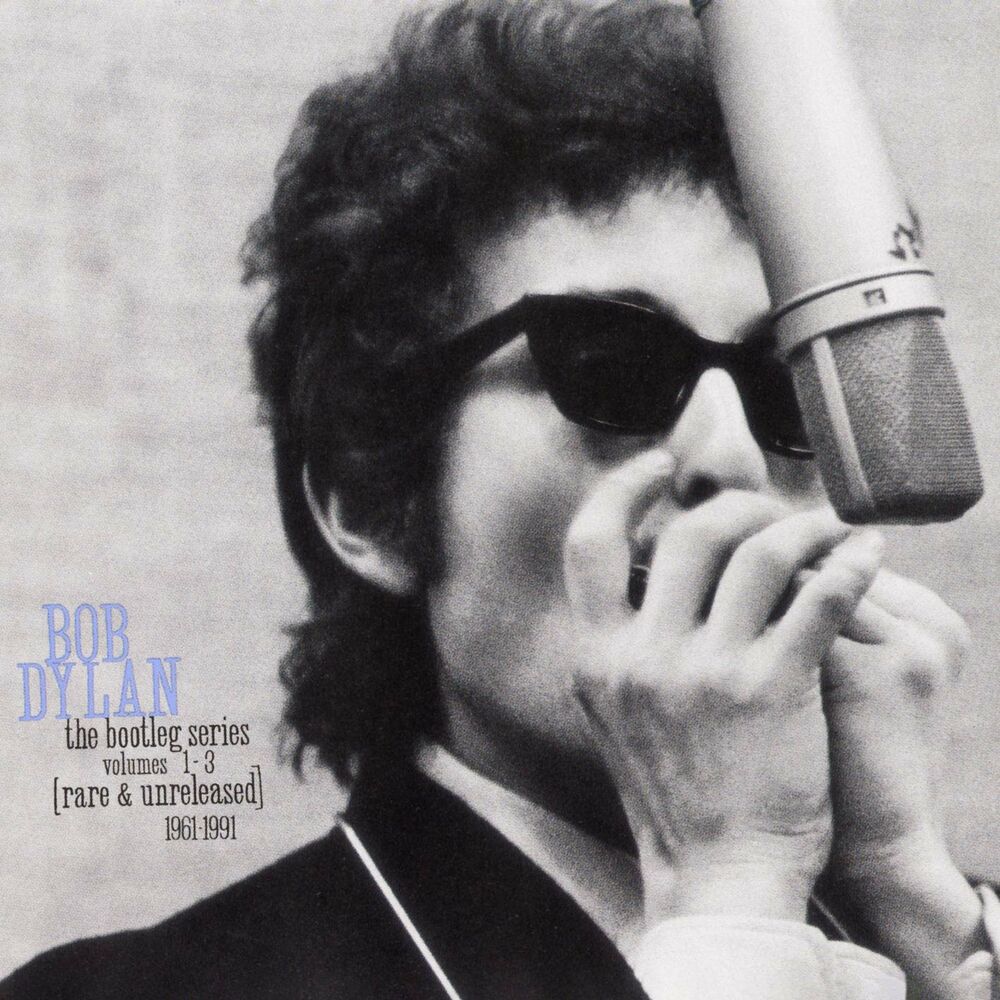
The Bootleg Series Volumes 1-3 (Rare And Unreleased) 1961-1991
- Released26 March 1991
- UK peak No. 32
- Weeks on UK chart 5
- Entered UK chart 7 April 1991
- LabelColumbia
- Tracks25 · 85 min
One track from it charted as a single. Press a flag to play it in the chart where it peaked.
Tracks
| 1 | Hard Times In New York Town (Demo - 1961) | 2:17 | |
| 2 | He Was a Friend of Mine (Take 2) | 4:02 | |
| 3 | Man On the Street (Studio Outtake - 1961) | 1:55 | |
| 4 | No More Auction Block (Live at the Gaslight Café, New York, NY - October 1962) | 3:02 | |
| 5 | House Carpenter (Take 1) | 4:07 | |
| 6 | Talkin' Bear Mountain Picnic Massacre Blues (Studio Outtake - 1962) | 3:44 | |
| 7 | Let Me Die In My Footsteps (Studio Outtake - 1962) | 3:32 | |
| 8 | Rambling, Gambling Willie (Studio Outtake - 1962) | 4:12 | |
| 9 | Talkin' Hava Negeilah Blues (Studio Outtake - 1962) | 0:51 | |
| 10 | Quit Your Low Down Ways (Studio Outtake - 1962) | 2:39 | |
| 11 | Worried Blues (Studio Outtake - 1962) | 2:38 | |
| 12 | Kingsport Town (Freewheelin' Outtake, NYC, 1962) | 3:28 | |
| 13 | Walkin' Down the Line (Demo - 1963) | 2:52 | |
| 14 | Walls of Red Wing (Studio Outtake - 1963) | 5:03 | |
| 15 | Paths of Victory (Studio Outtake - 1963) | 3:17 | |
| 16 | Talkin' John Birch Paranoid Blues (Live at Carnegie Hall, New York, NY - October 1963) | 4:25 | |
| 17 | Who Killed Davey Moore? (Live at Carnegie Hall, New York, NY - October 1963) | 3:08 | |
| 18 | Only a Hobo (Studio Outtake - 1963) | 3:28 | |
| 19 | Moonshiner (The Times They Are A-Changin' Outtake, NYC, 1963) | 5:05 | |
| 20 | When the Ship Comes In (Witmark Demo - 1963) | 2:54 | |
| 21 | The Times They Are A-Changin' (Witmark Demo - 1963) No. 9 · 1965 | 2:58 | |
| 22 | Last Thoughts on Woody Guthrie (Live at Town Hall, New York, NY - April 1963) | 7:08 | |
| 23 | Seven Curses (The Times They Are A-Changin' Outtake, NYC, 1963) | 3:47 | |
| 24 | Eternal Circle (Studio Outtake - 1963) | 2:37 | |
| 25 | Suze (The Cough Song) (Studio Outtake - 1963) | 1:57 |
About the album
The Freewheelin' Bob Dylan is the second studio album by the American singer-songwriter Bob Dylan. It was released on May 27, 1963, through Columbia Records. The record marks the beginning of Dylan's writing contemporary lyrics to traditional melodies. His debut album Bob Dylan contains only two original songs, whereas eleven of the thirteen songs on Freewheelin' are Dylan's compositions. It opens with "Blowin' in the Wind", which became an anthem of the 1960s, and an international hit for folk trio Peter, Paul and Mary soon after the release of the album. The album featured several other songs which came to be regarded as among Dylan's best compositions and classics of the 1960s folk scene: "Girl from the North Country", "Masters of War", "A Hard Rain's a-Gonna Fall" and "Don't Think Twice, It's All Right".
Dylan's lyrics embraced news stories drawn from headlines about the ongoing civil rights movement and he articulated anxieties about the fear of nuclear warfare. Balancing this political material were love songs, sometimes bitter and accusatory, and material that features surreal humor. Freewheelin' showcased Dylan's songwriting talent for the first time, propelling him to national and international fame.
Recording sessions
Neither critics nor the public took much notice of Dylan's self-titled debut album, Bob Dylan, which sold only 5,000 copies in its first year, just enough to break even. In a pointed rebuke to John Hammond, who had signed Dylan to Columbia Records, some within the company referred to the singer as "Hammond's Folly" and suggested dropping his contract. Hammond defended Dylan vigorously and was determined that Dylan's second album should be a success. The recording of Freewheelin' took place from April 1962 to April 1963, and the album was assembled from eight recording sessions at Columbia Records Studio A, located at 799 Seventh Avenue in New York City.
Recording in New York
Dylan began work on his second album at Columbia's Studio A in New York on April 24, 1962. The album was provisionally entitled Bob Dylan's Blues, and as late as July 1962, this would remain the working title. At this session, Dylan recorded four of his own compositions: "Sally Gal", "The Death of Emmett Till", "Rambling, Gambling Willie", and "Talkin' John Birch Paranoid Blues". He also recorded two traditional folk songs, "Going To New Orleans" and "Corrina, Corrina", and Hank Williams' "(I Heard That) Lonesome Whistle".
Returning to Studio A the following day, Dylan recorded his new song about fallout shelters, "Let Me Die in My Footsteps". Other original compositions followed: "Rocks and Gravel", "Talkin’ Hava Negeilah Blues", "Talkin' Bear Mountain Picnic Massacre Blues", and two more takes of "Sally Gal". Dylan recorded cover versions of "Wichita", Big Joe Williams' "Baby, Please Don't Go", and Robert Johnson's "Milk Cow's Calf's Blues".
Release
Dylan promoted his upcoming album with radio appearances and concert performances. In May 1963, Dylan performed with Joan Baez at the Monterey Folk Festival, where she joined him on stage for a duet of a new Dylan song, "With God on Our Side". Baez was at the pinnacle of her fame, having appeared on the cover of Time magazine the previous November. The performance not only gave Dylan and his songs a new prominence, it also marked the beginning of a romantic relationship between Baez and Dylan, the start of what Dylan biographer Sounes termed "one of the most celebrated love affairs of the decade".
The Freewheelin' Bob Dylan was released at the end of May. According to Scaduto, it was an immediate success, selling 10,000 copies a month and bringing Dylan an income of about $2,500 a month (equivalent to $26,300 in 2025). An article by Nat Hentoff on folk music appeared in the June issue of Playboy magazine and devoted considerable space to Dylan's achievements, calling him "the most vital of the younger citybillies".
In July, Dylan appeared at the second Newport Folk Festival.
Artwork
The album cover features a photograph of Dylan with Suze Rotolo. It was taken in February 1963—a few weeks after Rotolo had returned from Italy—by CBS staff photographer Don Hunstein as Dylan and Rotolo walked in the middle of Jones Street, approximately 50 feet from West 4th Street in the West Village, New York City, close to the apartment where the couple lived at the time. In 2008, Rotolo described the circumstances surrounding the famous photo to The New York Times: "He wore a very thin jacket, because image was all. Our apartment was always cold, so I had a sweater on, plus I borrowed one of his big, bulky sweaters. On top of that I put on a coat. So I felt like an Italian sausage. Every time I look at that picture, I think I look fat." In her memoir, A Freewheelin' Time, Rotolo analyzed the significance of the cover art:
It is one of those cultural markers that influenced the look of album covers precisely because of its casual down-home spontaneity and sensibility.
Legacy
The success of Freewheelin' transformed the public perception of Dylan. Before the album's release, he was one among many folk-singers. Afterwards, at the age of 22, Dylan was regarded as a major artist, perhaps even a spokesman for disaffected youth. As one critic described the transformation, "In barely over a year, a young plagiarist had been reborn as a songwriter of substance, and his first album of fully realized original material got the 1960s off their musical starting block." Janet Maslin wrote of the album: "These were the songs that established him as the voice of his generation—someone who implicitly understood how concerned young Americans felt about nuclear disarmament and the growing Civil Rights Movement: his mixture of moral authority and nonconformity was perhaps the most timely of his attributes".
This title of "Spokesman of a Generation" was viewed by Dylan with disgust in later years. He came to feel it was a label that the media had pinned on him, and in his autobiography, Chronicles, Dylan wrote: "The press never let up.