One track from it charted as a single. Press a flag to play it in the chart where it peaked.
Tracks
| 1 | Wolves (Intro) | 2:15 | |
| 2 | I'm a African | 3:21 | |
| 3 | They School | 5:06 | |
| 4 | Hip-Hop No. 41 · 2000 | 3:36 | |
| 5 | Police State (feat. Chairman Omali Yeshitela) | 3:40 | |
| 6 | Behind Enemy Lines | 3:04 | |
| 7 | Assassination | 2:00 | |
| 8 | Mind Sex | 4:50 | |
| 9 | We Want Freedom | 4:33 | |
| 10 | Be Healthy | 2:34 | |
| 11 | Discipline | 1:37 | |
| 12 | Psychology | 5:56 | |
| 13 | Happiness | 3:49 | |
| 14 | Animal In Man | 4:31 | |
| 15 | You'll Find a Way | 3:14 | |
| 16 | It's Bigger Than Hip-Hop (feat. Tahir And Peoples Army) | 3:54 | |
| 17 | Propaganda | 5:12 | |
| 18 | The Pistol (feat. Maintain of Illegal Tendencies) (feat. Maintain of Illegal Tendencies) | 4:25 |
About the album
Let's Get Free is the debut studio album by hip-hop duo dead prez. It was released on February 8, 2000, on Loud Records and Columbia Records. The album is mainly produced by dead prez, along with additional production from Lord Jamar of Brand Nubian, Hedrush, and Kanye West. The album is supported by its five singles: "Police State", "Hip-Hop", "It's Bigger Than Hip-Hop", "I'm a African", and "Mind Sex". The album peaked at number 73 on the U.S. Billboard 200 and number 22 on the U.S. Top R&B/Hip-Hop Albums chart.
The album dives deep into topics such as the public education system, racism, freedom of speech and police brutality. Let's Get Free was followed up with their second studio album, RBG: Revolutionary But Gangsta in 2004, but after the duo started releasing independent work and strayed away from the mainstream.
Background
During Stic.man attendance at Florida Agricultural and Mechanical University in the mid-90s, he met M-1. Once relocating to Brooklyn after FAMU, due to their mutual love for music and similar political ideology (leftist), they both formed a rap duo in 1996.
In the same year that dead prez was formed, they signed a record deal with label Loud Records.
In a 2010 interview with HipHopDX, M-1 goes in depth about the beginning of the process of recording Let's Get Free. According to me, it started when I met [stic.man]. The reason I always put it in that context is because we were soon to be revolutionaries. On the mission to make sense of what was happening inside the world, I met stic and I'd just moved to Florida to start a new chapter in my life. My family was being destroyed by crack cocaine just like [he] was and so many families were around us.
Concept
The album goes deep into topics and issues that affect the hip hop community through the duo's political view, such as the public education system, racism, freedom of speech and police brutality. Let's Get Free exposes stories such as Fred Hampton Jr having the possibility of being framed and both members relationship with Christianity.
Recording and production
Let's Get Free is mainly produced by dead prez, along with the help of producers Hedrush, Lord Jamar, and Kanye West.
Singles
The opening track of Let's Get Free, "Wolves", is centered around an metaphor by Uhuru Movement’s Chairman Omali Yeshitela related to white people distributing crack in the black community to hunters in the Arctic fooling wolves into cutting themselves and, subsequently, bleeding themselves to death. This metaphor explains how life under capitalism and white supremacy has engulfed the Black community in self-destructive cycles, and asks us to turn our attention to our true adversary, "the oppressor."
The second track, "I'm a African", embraces a clear truth that should be apparent, but through American conditioning, it is often lost in the mind of Black folks whose family lines have resided in America for generations.
Artwork
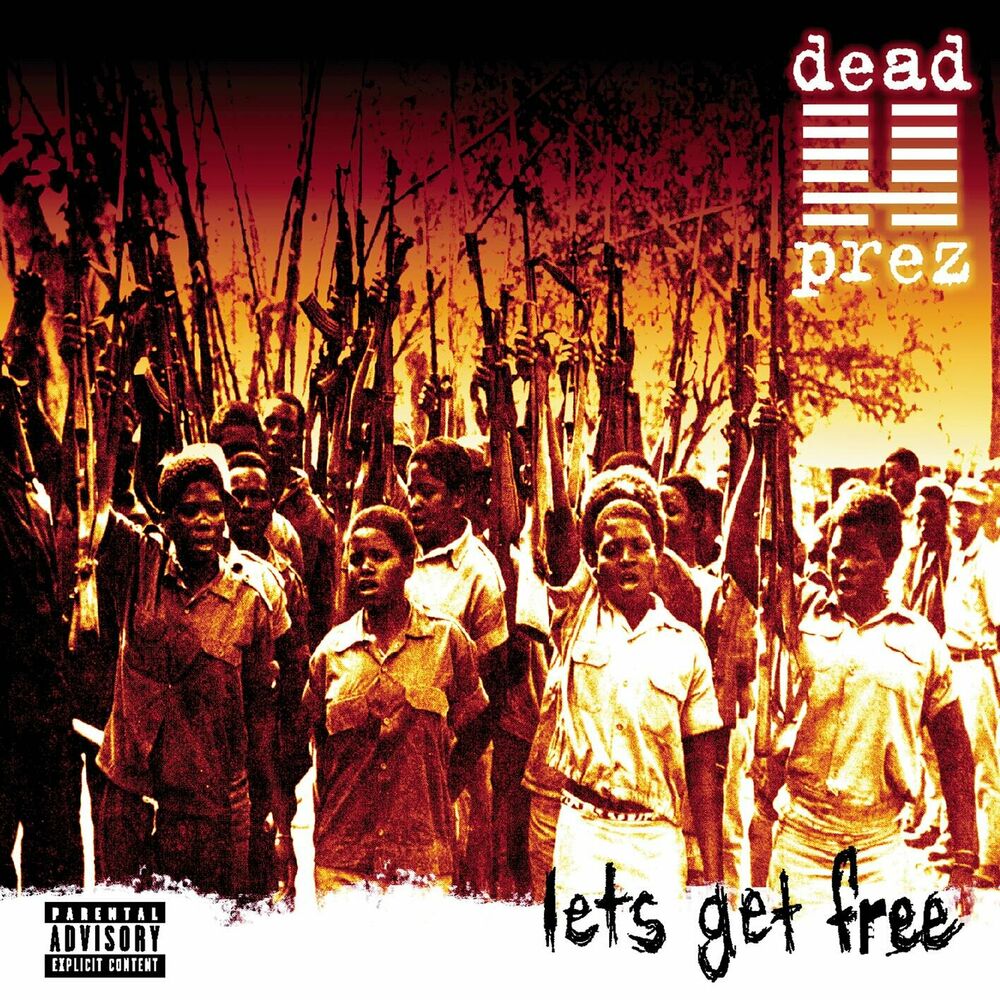
The cover art of the album depicts an open call for armed revolution by aligning "contemporary, capitalist, repressive America with colonial-era Africa in the form of an armed village preparing to strike," as stated by The Guardian. Consequently, the cover was censored in many outlets across the United States.
Critical reception
Although the production was derided by some critics as a "dull musical backdrop" (such as Dave Heaton from PopMatters), Pound wrote that Let's Get Free was called a "return to politically conscious rap." Rolling Stone gave the album four stars and lauded its equation of "classrooms with jail cells, the projects with killing fields and everything from water to television with conduits for brainwashing by the system". Rawiya Kameir from Pitchfork wrote that "Let’s Get Free wasn't built around the aesthetics of consciousness—like some of their incense-lighting, kufi-wearing peers in the late-'90s "conscious-rap" boom [...] but around the politics of liberation."
Cassie Balfour for The Michigan Daily was impressed by the album, quoting "the group's militancy, unapologetic anger and complete rejection of the commercialism — not just of hip hop (which is just a symptom of something deeper) but of American culture in general." Balfour would go on to state that "Dead Prez still isn’t to a lot of people’s tastes, and many would accuse the group of advocating violence.
Legacy
During an interview with the Juan EP Is Dead podcast, Stic.man revealed that Nipsey Hussle told him that he "wanted to redo Let’s Get Free and wanted [dead prez's] permission" one year before he was murdered.