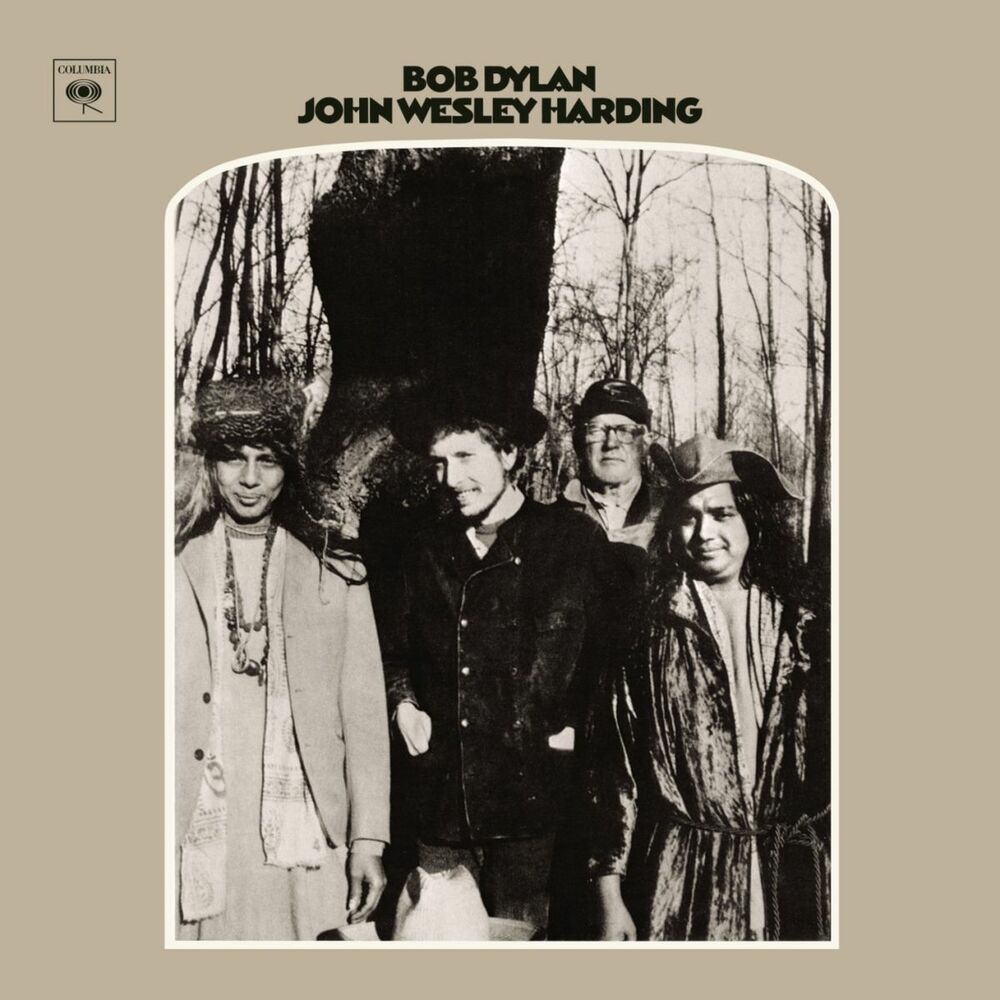
John Wesley Harding
- Released29 December 1967
- UK peak No. 1
- Weeks on UK chart 29
- Entered UK chart 25 February 1968
- LabelColumbia
- Tracks12 · 38 min
Tracks
| 1 | John Wesley Harding | 2:57 | |
| 2 | As I Went out One Morning | 2:50 | |
| 3 | I Dreamed I Saw St. Augustine | 3:54 | |
| 4 | All Along the Watchtower | 2:32 | |
| 5 | The Ballad of Frankie Lee and Judas Priest | 5:33 | |
| 6 | Drifter's Escape | 2:47 | |
| 7 | Dear Landlord | 3:15 | |
| 8 | I Am a Lonesome Hobo | 3:21 | |
| 9 | I Pity the Poor Immigrant | 4:13 | |
| 10 | The Wicked Messenger | 2:03 | |
| 11 | Down Along the Cove | 2:22 | |
| 12 | I'll Be Your Baby Tonight | 2:38 |
About the album
John Wesley Harding is the eighth studio album by the American singer-songwriter Bob Dylan, released on December 27, 1967, by Columbia Records. Produced by Bob Johnston, the album marked Dylan's return to semi-acoustic instrumentation and folk-influenced songwriting after three albums of lyrically abstract, blues-indebted rock music. John Wesley Harding was recorded around the same time as the home recording sessions with the Band known as The Basement Tapes.
John Wesley Harding was well received by critics and sold well, reaching No. 2 on the U.S. charts and topping the UK charts. Less than three months after its release, John Wesley Harding was certified gold by the RIAA. "All Along the Watchtower" became one of his most popular songs after Jimi Hendrix's rendition was released in the autumn of 1968.
The album was included in Robert Christgau's "Basic Record Library" of 1950s and 1960s recordings, published in Christgau's Record Guide: Rock Albums of the Seventies (1981). In 2003, it was ranked number 301 on Rolling Stone magazine's list of the 500 greatest albums of all time, moving to 303 in the 2012 version of that list, then to 337 in the 2020 version. It was voted number 203 in the third edition of Colin Larkin's book All Time Top 1000 Albums (2000).
The album is named after Texas outlaw John Wesley Hardin, whose name was misspelled.
Recording sessions
Dylan went to work on John Wesley Harding in the fall of 1967. By then, 18 months had passed since the completion of Blonde on Blonde. Dylan spent a substantial amount of time recording the informal basement sessions with the Band in West Saugerties, New York. During that time, he stockpiled a large number of recordings, including many new compositions. He eventually submitted nearly all of them for copyright, but declined to include any of them in his next studio release (Dylan would not release any of those recordings to the commercial market until 1975's The Basement Tapes, by which time some of them had been bootlegged, usually sourced from an easy-to-find set of publisher's demos). Instead, Dylan used a different set of songs for John Wesley Harding.
It is not known when these songs were actually written, but none of them have turned up in the dozens of basement recordings that have since surfaced. Robbie Robertson, the guitarist and principal songwriter of the Band, recalled that "it was just on a kind of whim that Bob went down to Nashville.
Packaging
The album is named after Texas outlaw John Wesley Hardin, whose name Dylan misspelled. Singer Wesley Stace, who used the stage name John Wesley Harding, said in a New York Times editorial that "no one knows why" Dylan misspelled Hardin's name in the title, and that to his knowledge, "no one’s ever bothered to ask". The cover photograph of John Wesley Harding shows a squinting Dylan flanked by brothers Luxman and Purna Das, two Bengali Bauls, Indian musicians brought to Woodstock by Dylan's manager, Albert Grossman. Behind Dylan is Charlie Joy, a local stonemason and carpenter.
Upon the album's release, rumors circulated that the faces of the Beatles were hidden on the front cover in the knots of the tree.
Release dates
Contradictory release dates have been claimed for John Wesley Harding. The liner notes to the Dylan mono box states December 17, 1967 as the original date of release. Reproduced in the liner notes to the eleventh volume of the Dylan Bootleg Series is an article by Al Aronowitz for The New York Times, date stamped December 23, 1967, in which he states that John Wesley Harding would be released "within the next two weeks". Original CD editions from the 1980s and 1990s have the copyright year of 1968. The January 20 issue of Billboard reported on the "blockbuster response" to the LP, saying: "In stores less than a week, the record is reported to have sold more than 250,000 copies." In his encyclopedia of all things Dylan, Michael Gray indicates a January 1968 release date for the LP.
In the February 3, 1968 issue of Melody Maker, the album was reviewed and announced for release in Britain on February 23.
Legacy
"I asked Columbia to release it with no publicity and no hype, because this was the season of hype," Dylan said. Clive Davis urged Dylan to pull a single, but even then Dylan refused, preferring to maintain the album's low-key profile.
In a year when psychedelia dominated popular culture, the agrarian-themed John Wesley Harding was seen as reactionary. Critic Jon Landau wrote in Crawdaddy! magazine, "For an album of this kind to be released amidst Sgt. Pepper, Their Satanic Majesties Request, After Bathing at Baxter's, somebody must have had a lot of confidence in what he was doing… Dylan seems to feel no need to respond to the predominate [sic] trends in pop music at all. And he is the only major pop artist about whom this can be said."
The critical stature of John Wesley Harding has continued to grow. As late as 2000, Clinton Heylin wrote, "John Wesley Harding remains one of Dylan's most enduring albums. Never had Dylan constructed an album-as-an-album so self-consciously.