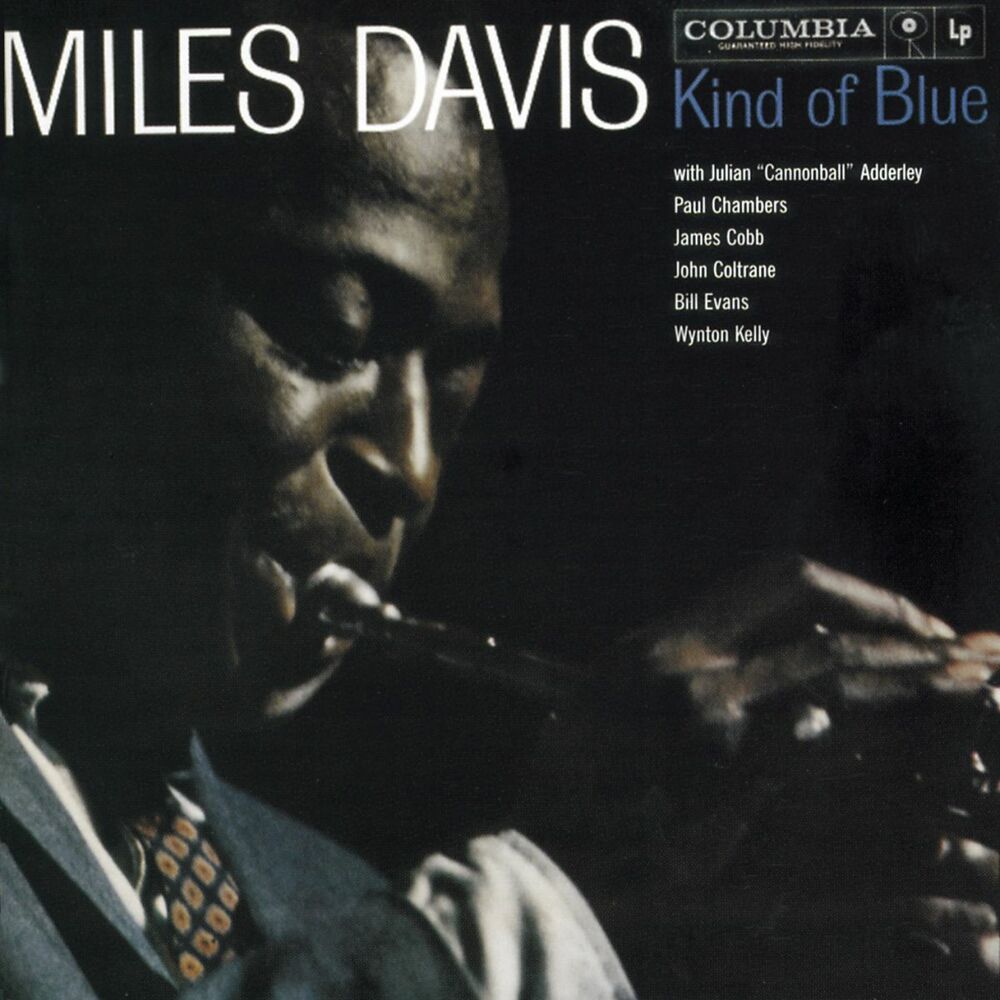
Kind Of Blue
- Released1 May 2021
- UK peak No. 63
- Weeks on UK chart 10
- Entered UK chart 13 April 1997
- LabelColumbia
- Tracks5 · 46 min
Tracks
| 1 | So What (feat. John Coltrane, Cannonball Adderley & Bill Evans) | 9:22 | |
| 2 | Freddie Freeloader (feat. John Coltrane, Cannonball Adderley, Wynton Kelly & Paul Chambers) | 9:46 | |
| 3 | Blue in Green (feat. John Coltrane & Bill Evans) | 5:37 | |
| 4 | All Blues (feat. John Coltrane, Cannonball Adderley & Bill Evans) | 11:33 | |
| 5 | Flamenco Sketches (feat. John Coltrane, Cannonball Adderley & Bill Evans) | 9:26 |
About the album
Kind of Blue is a studio album by the American jazz musician Miles Davis, released on August 17, 1959, through Columbia Records. For this album, Davis led a sextet featuring saxophonists John Coltrane and Julian "Cannonball" Adderley, pianist Bill Evans, bassist Paul Chambers, and drummer Jimmy Cobb, with new band pianist Wynton Kelly replacing Evans on "Freddie Freeloader". The album was recorded at Columbia's 30th Street Studio in New York City in two sessions on March 2 and April 22, 1959.
Influenced in part by Evans, who had been a member of the ensemble in 1958 and was called back for this album, Davis departed further from his early hard bop style in favor of greater experimentation with musical modes, as on the title track of his previous album, Milestones (1958). Basing Kind of Blue entirely on modality, Davis gave each performer a set of scales that encompassed the parameters of their improvisation and style and consequently more creative freedom with melodies; Coltrane later expanded on this modal approach in his own solo career.
Kind of Blue is regarded by many critics as Davis's masterpiece, the greatest jazz album ever recorded, and one of the greatest albums of all time. Its influence on jazz, rock, and classical music has also led writers to describe it as one of the most influential albums ever made.
Background
By late 1958, trumpeter Miles Davis employed one of the most acclaimed and profitable hard bop bands in the business. Bassist Paul Chambers had been with the group from its beginning in 1955, alto saxophonist Julian "Cannonball" Adderley joined in late 1957, and tenor saxophonist John Coltrane returned in early 1958. Drummer Jimmy Cobb replaced Philly Joe Jones in May 1958, and pianist Wynton Kelly replaced Bill Evans in November 1958.
The Davis band played a mixture of pop standards, blues, and bebop originals by composers such as Charlie Parker, Thelonious Monk, Dizzy Gillespie, Tadd Dameron, and Davis himself. As with all bebop-based jazz, Davis's groups improvised on the chord changes of a given song. Davis was one of many jazz musicians growing dissatisfied with bebop, however, and saw its increasingly complex chord changes as hindering creativity.
In 1953, the composer and theorist George Russell published his Lydian Chromatic Concept of Tonal Organization, which offered an alternative to improvisation based on chords.
Recording
Kind of Blue was recorded on three-track tape in two sessions at Columbia Records' 30th Street Studio in New York City. On March 2, 1959, the tracks "So What", "Freddie Freeloader", and "Blue in Green" were recorded for side one of the original LP, and on April 22 the tracks "All Blues" and "Flamenco Sketches" were recorded, making up side two.
As was Davis's penchant, he called for almost no rehearsal and the musicians had little idea what they were to record. As described in the original liner notes by pianist Bill Evans, Davis had only given the band sketches of scales and melody lines on which to improvise. Once the musicians were assembled, Davis gave brief instructions for each piece and then set to taping the sextet in studio. While the results were impressive with so little preparation, the persistent legend that the entire album was recorded in one pass is untrue. Only "Flamenco Sketches" yielded a complete take on the first try. That take, which is not the master, was added to the 1997 CD reissue of the album as a bonus track.
Production credit
Kind of Blue was produced by Columbia staff producer Irving Townsend. However, Davis' subsequent producer, Teo Macero, has incorrectly received partial or full credit. "In the case of Kind of Blue there were two producers: Teo Macero and Irving Townsend", said jazz historian Eric Nisenson. "Macero's role, however, was clearly that of an apprentice and observer." The recording session was also cited by Nisenson as Macero's first experience with "the highs and lows of working with Miles." From Macero's own recollection, his involvement in the recording included "box[ing] everyone in so that there would be a physical closeness among the musicians, not like today when the musicians are spread all over the place." According to High Fidelity, "though his role in Kind of Blue has been disputed", the recording was "made under the auspices" of Macero. However, it is Townsend's voice heard on the session tapes, who became Davis's producer after the departures of George Avakian and Cal Lampley.
Composition
Kind of Blue is based entirely on modality, diverging from Davis's earlier hard bop style of jazz with its complex chord progression and improvisation. The entire album was a series of modal sketches, with each performer given a set of scales that encompassed the parameters of their improvisation and style. This recording style contrasted with the typical preparation of providing musicians with the complete score or, for improvisational jazz, providing the musicians with a chord progression or series of harmonies.
Modal jazz was not unique to this album. Davis himself had previously used the same method on his 1958 Milestones album, the '58 Sessions, and Porgy and Bess (1958), on which he used modal influences for collaborator Gil Evans's third stream compositions. Modal composition, with its reliance on scales and modes, represented, as Davis called it, "a return to melody". In a 1958 interview with Nat Hentoff of The Jazz Review, Davis elaborated on this form of composition in contrast to the chord progression predominant in bebop, stating:
No chords ...
Reception and legacy
Since its release on August 17, 1959, Kind of Blue has been regarded by critics as Davis's greatest work. It is his most acclaimed album, and became, along with Davis's 1970 album Bitches Brew, his best-selling record, cementing him as one of the most successful jazz artists in history. Music writer Chris Morris cited Kind of Blue as "the distillation of Davis's art." Cobb said the album "must have been made in heaven".
Kind of Blue has been lauded as one of the most influential albums in the history of jazz. One reviewer has called it a "defining moment of twentieth century music". Several of the pieces from the album have become jazz standards. Kind of Blue is consistently ranked among the greatest albums of all time. In a review of the album, AllMusic senior editor Stephen Thomas Erlewine stated:
Kind of Blue isn't merely an artistic highlight for Miles Davis, it's an album that towers above its peers, a record generally considered as the definitive jazz album, a universally acknowledged standard of excellence.