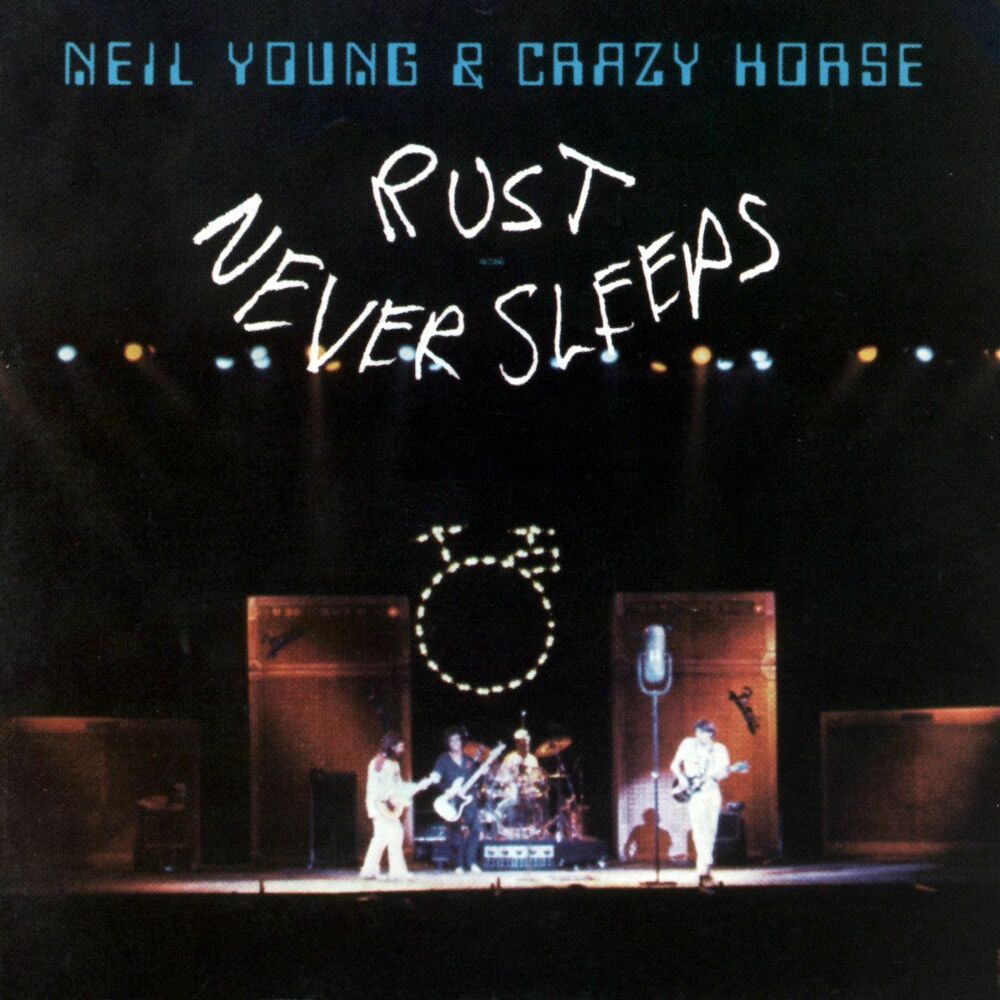
Rust Never Sleeps
- Released27 June 1979
- UK peak No. 13
- Weeks on UK chart 12
- Entered UK chart 8 July 1979
- LabelReprise
- Tracks9 · 38 min
One track from it charted as a single. Press a flag to play it in the chart where it peaked.
Tracks
| 1 | My My, Hey Hey (Out of the Blue) (2016 Remaster) | 3:47 | |
| 2 | Thrasher (2016 Remaster) | 5:39 | |
| 3 | Ride My Llama (2016 Remaster) | 2:30 | |
| 4 | Pocahontas (2016 Remaster) | 3:24 | |
| 5 | Sail Away (2016 Remaster) | 3:47 | |
| 6 | Powderfinger (2016 Remaster) | 5:30 | |
| 7 | Welfare Mothers (2016 Remaster) | 3:49 | |
| 8 | Sedan Delivery (2016 Remaster) | 4:39 | |
| 9 | Hey Hey, My My (Into the Black) (2016 Remaster) No. 79 · 1979 | 5:12 |
About the album
Rust Never Sleeps is the tenth album by Canadian American singer-songwriter Neil Young and his third with American band Crazy Horse. It was released on June 22, 1979, by Reprise Records and features both studio and live tracks. Most of the album was recorded live, then overdubbed in the studio, while other songs originated in the studio. Young used the phrase "rust never sleeps" as a concept for his tour with Crazy Horse to avoid artistic complacency and try more progressive, theatrical approaches to performing live.
The album peaked at No. 8 on the Billboard 200 album chart and spawned the hit single "Hey Hey, My My (Into the Black)" that peaked at No. 79 on the US Billboard Hot 100 chart. It also included one of Young's most popular and critically acclaimed songs, the enigmatic "Powderfinger". The album, along with Young's 1990 release Ragged Glory, has widely been considered a precursor of grunge music with the bands Nirvana and Pearl Jam having cited Young's heavily distorted and abrasive guitar style on the B side of the album as an inspiration.
Background
The album was recorded in May 1978 during solo acoustic performances at The Boarding House in San Francisco and in October 1978 during the "Rust Never Sleeps" tour, in which Young played a wealth of new material. The concert tour was divided into a solo acoustic set and an electric set with Crazy Horse. Two new songs, the acoustic "My My, Hey Hey (Out of the Blue)" and electric "Hey Hey, My My (Into the Black)" were the centerpiece of the new material. The overdubbed live tracks are complemented with two outtakes from Young's previous album, Comes a Time.
Writing
The album sees Young reunited with Crazy Horse, his first credited to the band since 1975's Zuma. Four of the album's eight songs date from the sessions from that previous album: "Pocahontas", "Ride My Llama", "Powderfinger" and "Sedan Delivery". Studio attempts at each of these songs from the summer of 1975 have since been released through Young's Archives series. Young explains in his memoir, Waging Heavy Peace: "The album Zuma is the first album we made with Crazy Horse after Poncho joined the band. We kept playing day after day and partying at night. We did the original "Powderfinger" and held it back. We did "Sedan Delivery" and held it back. "Ride My Llama" was completely finished and mixed and held back. Today I like listening to all of those tracks together in a compilation I call Dume that is in The Archives Volume 2."
The album's title, Rust Never Sleeps, takes its name from the song that bookends the album, titled "My My, Hey Hey (Out of the Blue)" and "Hey Hey, My My (Into the Black)".
Recording
The acoustic portions of the album including, "My My, Hey Hey (Out of the Blue)", "Thrasher" and "Ride My Llama" were recorded live in San Francisco at the Boarding House between May 24 and 28, 1978. Young played ten acoustic sets over five days. Young used the occasion to play several songs in concert for the first time. In addition to the three tracks on the album he also debuted "Powderfinger", "Shots" and "The Ways of Love" and played the rarities "Out of My Mind" and "I Believe in You" on piano. "Shots" would later appear on Re·ac·tor in 1981; "The Ways of Love" would first surface on Freedom in 1989. The concert takes were overdubbed in the studio. For example, Young would later double the guitar part to "Ride My Llama" in the studio.
Two songs from the album were not recorded live: "Pocahontas" had been recorded solo in August 1976 during the Hitchhiker session, with later overdubs in September 1977 at Triiad studios for the album Oceanside/Countryside, an early version of Comes a Time.
Critical reception
Reviewing for The Village Voice in 1979, Robert Christgau called Rust Never Sleeps Young's best album yet and said although his melodies are unsurprisingly simple and original, his lyrics are surprisingly and offhandedly complex. "He's wiser but not wearier", Christgau wrote, "victor so far over the slow burnout his title warns of".
Paul Nelson, writing in Rolling Stone, found its first side "virtuosic" because of how Young "transcends the songs' acoustic settings with his commanding performance" and was "impressed by its themes of personal escape and exhaustion, the role of rock music, and American violence." Nelson would write that "Rust Never Sleeps tells me more about my life, my country and rock & roll than any music I've heard in years."
Rust Never Sleeps was voted the second best album of 1979 in The Village Voice's annual Pazz & Jop critics poll. Christgau, the poll's creator, ranked it second on his own list for the poll, as did fellow critic Greil Marcus. The album also won Rolling Stone magazine's 1979 critics poll for Album of the Year.