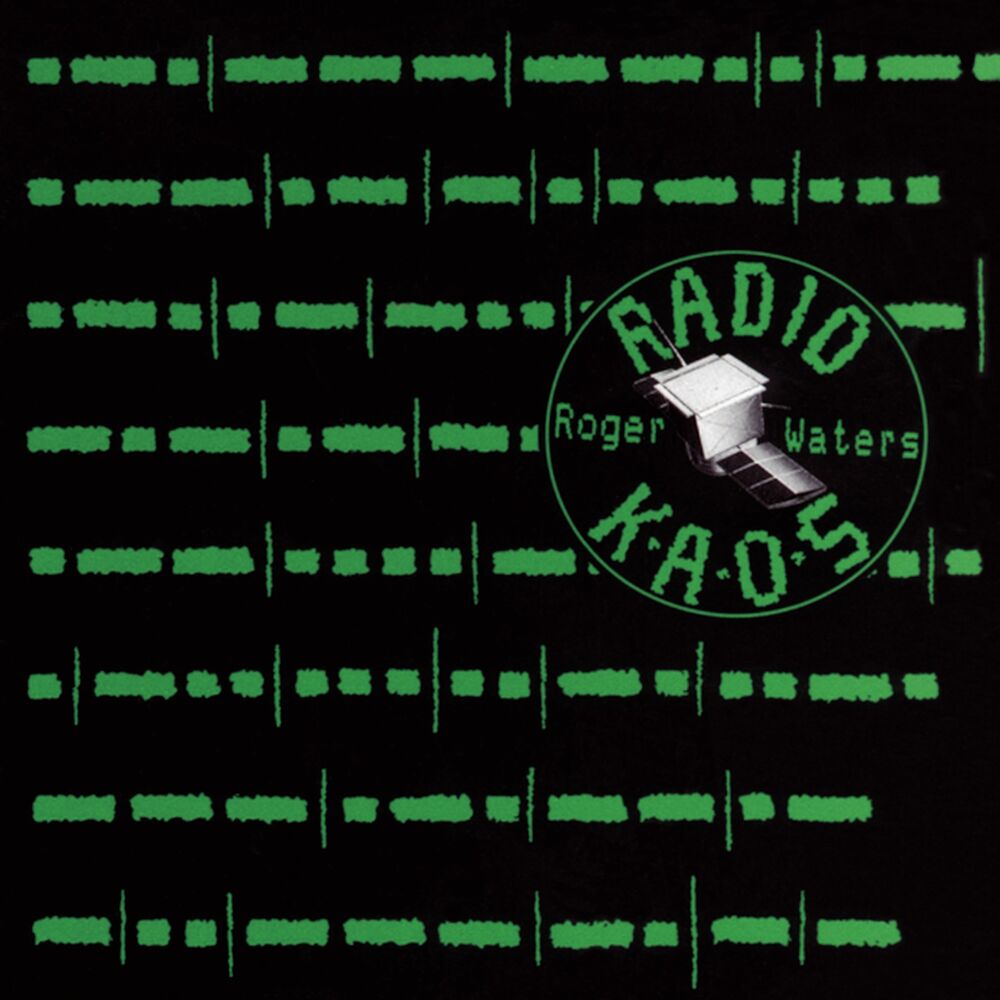
Radio K.A.O.S.
- Released16 June 1987
- UK peak No. 25
- Weeks on UK chart 7
- Entered UK chart 21 June 1987
- LabelColumbia
- Tracks8 · 41 min
2 tracks from it charted as singles. Press a flag to play it in the chart where it peaked.
Tracks
| 1 | Radio Waves No. 74 · 1987 | 5:05 | |
| 2 | Who Needs Information | 5:49 | |
| 3 | Me or Him | 5:24 | |
| 4 | The Powers That Be | 4:36 | |
| 5 | Sunset Strip | 4:25 | |
| 6 | Home | 6:39 | |
| 7 | Four Minutes | 3:39 | |
| 8 | The Tide Is Turning (After Live Aid) No. 54 · 1987 | 5:44 |
About the album
Radio K.A.O.S. is the second solo studio album by the English singer-songwriter Roger Waters. Released on 15 June 1987 in the United Kingdom and 16 June in the United States, it was Waters' first solo studio album after his formal departure from the band Pink Floyd in 1985. Like his previous and future studio albums and many works of his during his time with Pink Floyd, the album is a concept album, based on a number of key topical subjects of the late 1980s, including monetarism and its effect on citizens, popular culture of the time, and the events and consequences of the Cold War. It also makes criticisms of Margaret Thatcher's government, much like Pink Floyd's The Final Cut (1983), another album conceived by Waters.
The album follows Billy, a mentally and physically disabled man from Wales, forced to live with his uncle David in Los Angeles after his brother Benny is sent to prison following an act intended to support striking coal miners which results in the death of a taxi driver, and his dismissal from his mining job due to "market forces". The album explores Billy's view of the world through an on-air conversation between him and Jim, a disc jockey (DJ) at a fictitious local radio station named Radio KAOS.
Background and inspiration
In 1979, Waters met American disc jockey Jim Ladd for a radio documentary on The Wall album, beginning a friendship which remained until Ladd's death in 2023. Ladd was an inspiration as he brought some light into Waters's dim view of L.A. life, initially through listening to the bizarre Fish Report from KMET. Waters became increasingly interested in Ladd's plight with his radio station KMET, and his eventual sacking to change the programming format of the station in search of market-researched profits. In 1985, Waters wrote a song called "Get Back to Radio," which seemed to be partly based on the experiences of Ladd, and partly from childhood memories – Waters fondly remembers listening to Radio Luxembourg well into the night as a child.
An event from the 1985 miners' strike in Britain where a striking worker threw a concrete block off a motorway bridge, killing a taxi driver who was taking a strikebreaker to his job, seemed to register in Waters's subconscious, emerging in the second song written, "Who Needs Information" and later, "Me or Him." The album, with a working title of Hom
Concept
Billy is a 23-year-old Welshman from the South Wales Valleys. He is mentally and physically disabled as a result of cerebral palsy, uses a wheelchair and is only able to work his upper body. Though he is perceived as mentally challenged, his disability has actually made him not only a genius, but also superhuman, as he also has the ability to literally hear radio waves throughout all frequencies without aid.
Billy was living with his twin brother Benny, who was a coal miner, wife Molly, and their children. Unfortunately, Benny has lost his job in the mines due to the "market forces." One night, Benny and Billy are out on a pub crawl when they pass a shop full of TV screens broadcasting Margaret Thatcher's "mocking condescension." Benny vents his anger on this shop and steals a cordless phone. Next, drunk and looking for fun, Benny poses on a footbridge and considers dropping a cinder block on the passing cars, but they decide against it ("Who Needs Information" - track 2).
Recording
The album was recorded at Waters' own personal studio in London called The Billiard Room and mixed at Odyssey Studios in London.
Recording was done with the aid of Roger Waters' backing band the Bleeding Heart Band.
Packaging
Morse code is a central theme in the art and style of the album, visually and audibly. The artwork for the album, designed by Kate Hepburn, are written Morse code sentences in green imprinted on a black background. The translation spans both the front and the back of the sleeve. The front cover reads ROGER/WATERS/RADIO/KAOS/WHONE/EDSINF/ORMA/TIONTH. The back cover reads EPOWE/RSTHAT/BEHO/METHETI/DEISTU/RNING/RADIO/WAVES. When translated as a whole, the artwork spells out the name of the artist, the album, and five tracks from the album. It reads: Roger Waters, Radio K.A.O.S., "Who Needs Information," "The Powers That Be," "Home," "The Tide Is Turning" and "Radio Waves." The code on the artwork is also heard throughout the album itself, most notably at the beginning and end of the album, book-ending the piece in the same manner as the heartbeat from Pink Floyd's The Dark Side of the Moon (1973) and the Bleeding Heart Band from The Wall (1979).
Singles
Aside from eight songs that were used on the released album, additional songs appeared as B-sides.
The lead single from the album, "Radio Waves", was released on 11 May 1987 as a 7" single, a 12" extended play single, and a CD single. The b-side was a non-album track called "Going to Live in L.A.". "Radio Waves" briefly went into both the American and British charts in the month of release, reaching No. 74 on the UK singles chart and No. 12 on the US Billboard Mainstream Rock chart.
"Sunset Strip" was released as the second single in September 1987. The B-side included a demo of the song "Get Back to Radio" and a live version of Pink Floyd's "Money". Despite "Sunset Strip" not being released as a promo to American and British radio stations, and competing against Waters's former band whose single "Learning to Fly" was topping the US Billboard Mainstream Rock chart, it managed to go as high as No. 15.
"The Tide Is Turning" was released as the third single in the United Kingdom and Australia.
Promotion
The record was first announced via a press release from EMI on 6 April 1987, confirming Waters's new album, its details and release date. The press release mentioned that the project was conceived to be a full-out rock opera, complete with a stage show, film and live album, much like Waters's original vision for the album.
Waters also made a Video EP for this album featuring the songs "Radio Waves," "Sunset Strip," "Fish Report," "Four Minutes" and "The Tide Is Turning (After Live Aid)."
Critical reception
Released on 15 June 1987 in the United Kingdom and the United States, the album was met with mixed reviews. It peaked at number 25 in the United Kingdom, 33 in Australia, and 50 in the United States.
J. D. Considine of Rolling Stone magazine gave a positive review, describing the album as "by no means perfect" but "powerful". Although the themes and style of the album were criticised, he deemed it an improvement on its predecessor The Pros and Cons of Hitch Hiking (1984).
Robert Christgau from The Village Voice wrote: "In which Waters's wheelchair-bound version of the deaf, dumb and blind boy learns to control the world's computers with his cordless phone, then simulates impending nuclear holocaust just to scare the shit out of the powers that be. I have serious reservations about any record that can't be enjoyed unless you sit there reading the inner sleeve, but this is not without its aural rewards – a coverable song or two and some nice comping on shakuhachi, as well as the deep engineering that made Floyd famous.