Boys for Pele (Deluxe Edition)
- Released18 November 2016
- UK peak No. 2
- Weeks on UK chart 7
- Entered UK chart 28 January 1996
- LabelRhino Atlantic
- Tracks25 · 102 min
4 tracks from it charted as singles. Press a flag to play it in the chart where it peaked.
Tracks
| 1 | Beauty Queen / Horses (2016 Remaster) | 6:08 | |
| 2 | Blood Roses (2016 Remaster) | 3:56 | |
| 3 | Father Lucifer (2016 Remaster) | 3:42 | |
| 4 | Professional Widow (2016 Remaster) No. 1 · 1997 | 4:31 | |
| 5 | Mr. Zebra (2016 Remaster) | 1:07 | |
| 6 | Marianne (2016 Remaster) | 4:09 | |
| 7 | 4:25 | ||
| 8 | Muhammad My Friend (2016 Remaster) | 3:49 | |
| 9 | Hey Jupiter (2016 Remaster) No. 20 · 1996 | 5:11 | |
| 10 | Way Down (2016 Remaster) | 1:13 | |
| 11 | Little Amsterdam (2016 Remaster) | 4:29 | |
| 12 | Talula (2016 Remaster) No. 22 · 1996 | 4:08 | |
| 13 | Not the Red Baron (2016 Remaster) | 3:50 | |
| 14 | Agent Orange (2016 Remaster) | 1:25 | |
| 15 | Doughnut Song (2016 Remaster) | 4:20 | |
| 16 | In the Springtime of His Voodoo (2016 Remaster) | 5:33 | |
| 17 | Putting the Damage On (2016 Remaster) | 5:10 | |
| 18 | Twinkle (2016 Remaster) | 3:13 | |
| 19 | Hey Jupiter (Dakota Version; 2016 Remaster) No. 20 · 1996 | 6:05 | |
| 20 | To the Fair Motormaids of Japan | 4:18 | |
| 21 | That's What I Like Mick (The Sandwich Song) (2016 Remaster) | 3:00 | |
| 22 | Fire-Eater's Wife / Beauty Queen (Demo; 2016 Remaster) | 3:15 | |
| 23 | Professional Widow (Armand's Star Trunk Funkin' Mix; Radio Edit; 2016 Remaster) No. 1 · 1997 | 3:49 | |
| 24 | Sugar (Live) | 5:32 | |
| 25 | Alamo | 5:12 |
About the album
Boys for Pele is the third studio album by American singer-songwriter and pianist Tori Amos. Preceded by the first single, "Caught a Lite Sneeze", by three weeks, the album was released on January 22, 1996, in the United Kingdom, on January 23 in the United States, and on January 29 in Australia. Despite the album being Amos's least radio friendly material to date, Boys for Pele debuted at number two on both the US Billboard 200 and the UK Albums Chart, making it her biggest simultaneous transatlantic debut, her first Billboard top-10 debut, and the highest-charting album of her career in the US to date.
Boys for Pele was recorded in rural Ireland and Louisiana and features 18 songs that incorporate harpsichord, clavichord, harmonium, gospel choirs, brass bands and full orchestras. Amos wrote all of the tracks, and for the first time, she served as sole producer for her own album. For Amos, the album was a step into a different direction, in terms of singing, songwriting, and recording, and is experimental in comparison to her previous work.
Background
During the recording of her previous album, Under the Pink (1994), Amos's longtime professional and romantic relationship with Eric Rosse, who co-produced a considerable amount of her pre-Pele work, disintegrated. That loss, combined with a few subsequent encounters with men during the Under the Pink promotional tour, forced Amos to re-evaluate her relationship with men and masculinity. Amos explained, "In my relationships with men, I was always musician enough, but not woman enough, I always met men in my life as a musician, and there would be magic, adoration. But then it would wear off. All of us want to be adored, even for five minutes a day, and nothing these men gave me was ever enough."
Songs began appearing in fragments, often while on stage during the Under the Pink tour. After a trip to Hawaii during which Amos learned about legendary volcano goddess Pele, the album began taking shape; Amos conceived of the songs as representing stealing fire from the men in her life as well as a journey to finding her own fire as a woman. From there, Amos explained, the songs just came.
Production
Boys for Pele is Amos' first self-produced album; she would continue producing her own albums ever since. Given that the album deals with the role of women in religion and relationships, and particularly in light of her breakup with Rosse, who had served as producer for her previous two albums, Amos felt that it was appropriate to take complete control over producing Boys for Pele, as a "bid for independence". Of producing the album herself, Amos said, "I was at the point I could not answer to anybody. I'd been answering my whole life to some patriarchal figure."
Recording
Amos had initially planned to record the entire album in the American South because "there's a hiddenness about the South, and I wanted to go back there because it was similar to how I felt in my relationships with men," but the bulk of the record was recorded in a church in Delgany, County Wicklow, Ireland, as well as in New Orleans, Louisiana. Given her religious upbringing, Amos was drawn to record in a church, not in anger, but "with the intention of wholeness and of bringing a fragmented woman back to freedom."
Amos chose to record the album in a church because it was about searching for an energy current,
about claiming the passionate aspect of womanhood that the church teaches is wrong, "the idea of speaking my truth, no censorship, in a place that did not honor anyone's truth unless it was the church's truth," "so I figured if I was going to claim my womanhood, my passion, and sing this record – which, for me, was claiming fragments that I had suppressed for a long time – then I was going to go back to a church, back to the old world, to do it."
Amos' sound engineer came up w
Artwork
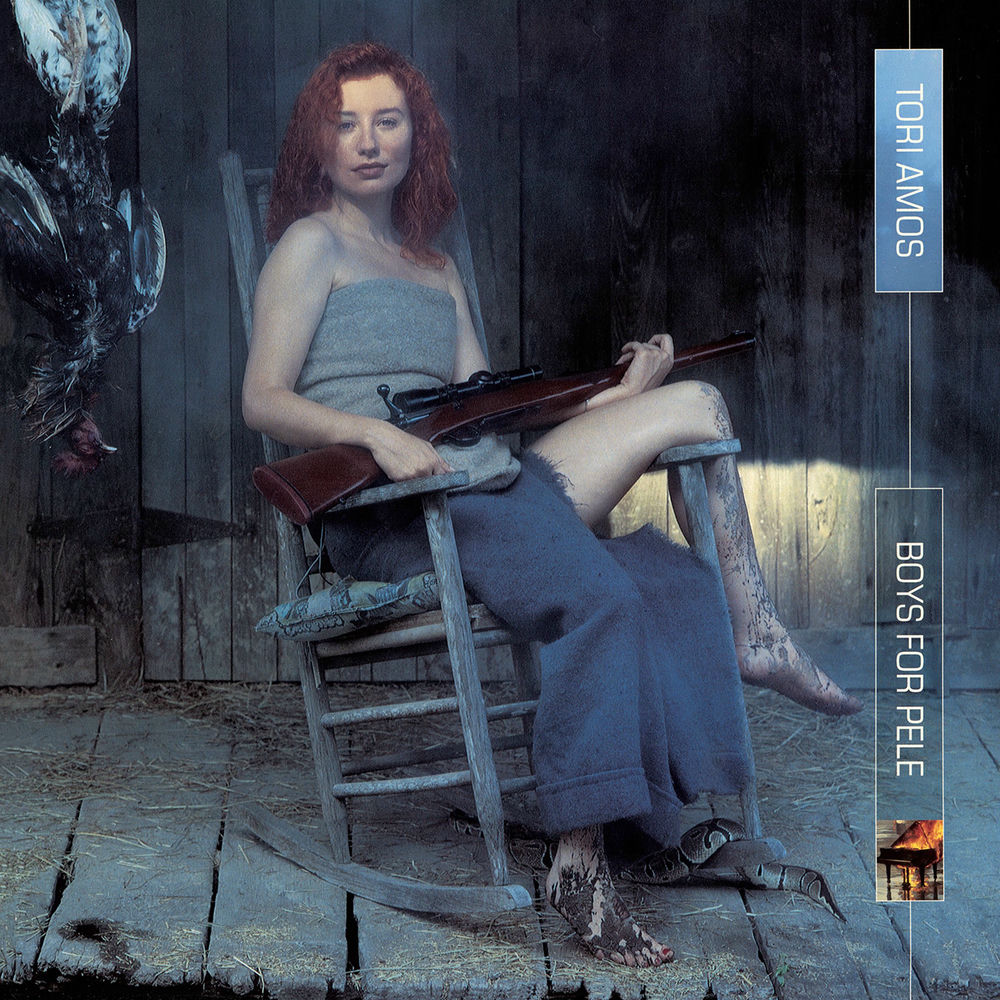
The album's cover is a photo of Amos holding a large rifle, sitting in a rocking chair on the porch of an old wooden building. One of her legs is out of her pants and flung over the side of the chair. A snake coils around the chair and a large rooster hangs from the roof of the porch. The image is a nod to her song "Me and a Gun," which appears on the album Little Earthquakes and recounts a rape she suffered. "Well, it's [the cover of the album] a reference to 'Me and a Gun', a song I wrote that was on Little Earthquakes. And the idea that there's a dead cock on my right and a live snake on my left. And the idea is that death and life ... creation ... what it's taken me to get here with men, and I don't want to be angry anymore. And you turn it over and you put the gun down, but I'm not pretending what it's taken to get me here. But no more resentment." [Live105 San Francisco (radio) – February 7, 1996] It was taken by Cindy Palmano in October 1995 in New Orleans.
Promotion
In late 1995, Atlantic released a promotional-only CD in Germany and America simply titled Tori Amos, under catalog number PRCD-6535-2. "New Music from Tori Amos ..." appeared on the front cover, and upon opening the jewel case, "... is coming soon" appears on the back of the insert. The release is a 9-track promotional compilation of Amos's singles from her first two solo albums, meant for radio stations to play to generate interest in the forthcoming album. The track "Precious Things" is mislabeled as "These Precious Things" on both the CD and the back cover, while "Crucify (Remix)" is listed when in fact the album version of the song is included.
The album's first single, "Caught a Lite Sneeze", was released commercially and to radio stations on January 2, 1996, three weeks prior to the album's release.
Amos's marketing team made use of the internet to market and promote Boys for Pele. Some reviews provided links to the Atlantic homepage or to Amos's homepage to listen to audio clips from the album, while others provided telephone numbers to call to listen to audio clips.
Critical reception
Critics overall praised the album's expanded instrumentation, and the acoustics that recording the album in a church afforded, but otherwise reaction to the album was polarized, particularly with regard to the lyrics. Boys for Pele is more lyrically dense than Amos's two previous albums, taking poetic obscurity to new heights. Some critics praised its ultra-personal lyrics while others panned what they called its overt and excessive self-indulgence and "ozone-layer lyrics" described as unfathomable, impenetrable, and personally opaque. One scathing review suggested skipping the album, instead reading something "a little bit more intelligible—like maybe Gravity's Rainbow written in Greek", while Rolling Stone went as far to bluntly say that most of the album's lyrics are "ultimately mystifying and, well, bad".