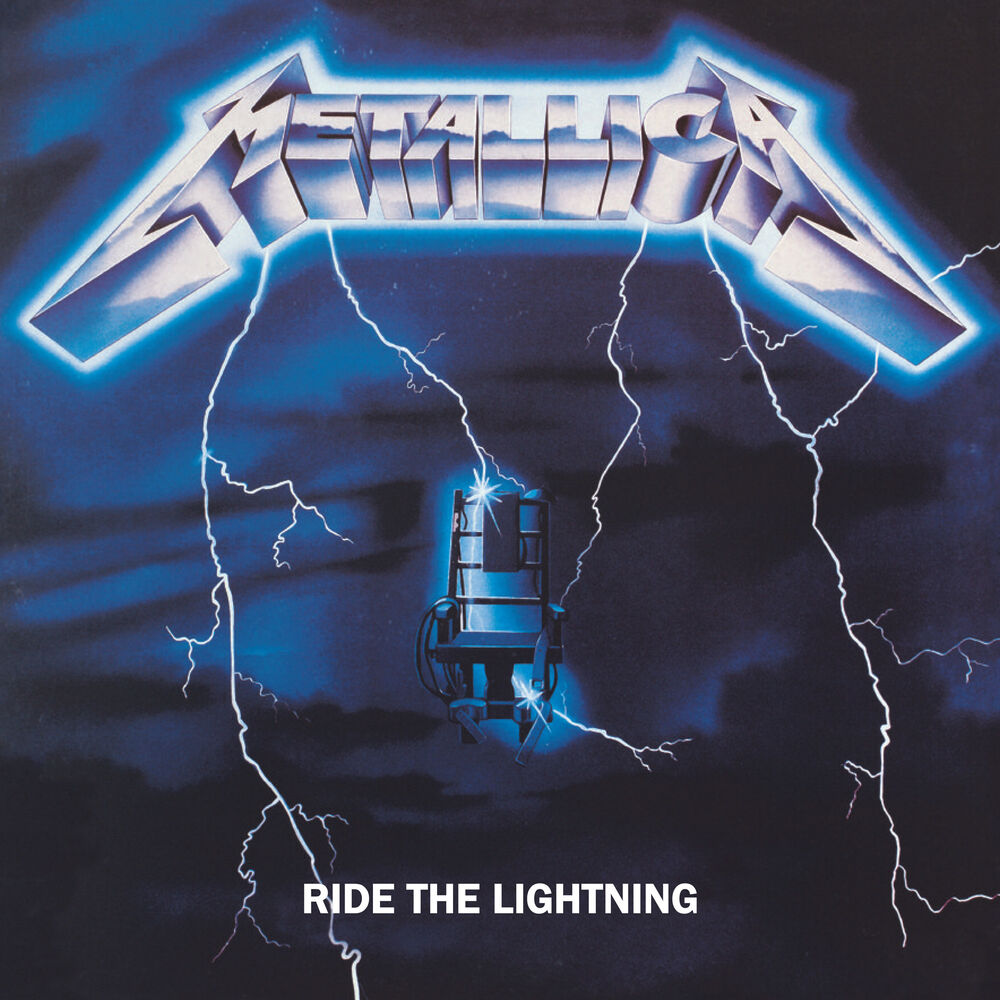
Ride The Lightning (Deluxe Remaster)
- Released27 July 1984
- UK peak No. 87
- Weeks on UK chart 2
- Entered UK chart 5 August 1984
- LabelBlackened Recordings
- Tracks25 · 141 min
Tracks
| 1 | Fight Fire With Fire (Remastered) | 4:44 | |
| 2 | Ride The Lightning (Remastered) | 6:36 | |
| 3 | For Whom The Bell Tolls (Remastered) | 5:09 | |
| 4 | Fade To Black (Remastered) | 6:57 | |
| 5 | Trapped Under Ice (Remastered) | 4:04 | |
| 6 | Escape (Remastered) | 4:23 | |
| 7 | Creeping Death (Remastered) | 6:35 | |
| 8 | The Call Of Ktulu (Remastered) | 8:53 | |
| 9 | The Ecstasy of Gold (Ennio Morricone) | 1:35 | |
| 10 | Fight Fire With Fire (Live at The Hollywood Palladium, Los Angeles, CA – March 10th, 1985) | 4:38 | |
| 11 | Ride The Lightning (Live at The Hollywood Palladium, Los Angeles, CA – March 10th, 1985) | 7:08 | |
| 12 | Phantom Lord (Live at The Hollywood Palladium, Los Angeles, CA – March 10th, 1985) | 5:04 | |
| 13 | (Anesthesia) – Pulling Teeth (Live at The Hollywood Palladium, Los Angeles, CA – March 10th, 1985) | 3:34 | |
| 14 | For Whom The Bell Tolls (Live at The Hollywood Palladium, Los Angeles, CA – March 10th, 1985) | 4:29 | |
| 15 | No Remorse (Live at The Hollywood Palladium, Los Angeles, CA – March 10th, 1985) | 6:23 | |
| 16 | Fade To Black (Live at The Hollywood Palladium, Los Angeles, CA – March 10th, 1985) | 7:14 | |
| 17 | Seek & Destroy (Live at The Hollywood Palladium, Los Angeles, CA – March 10th, 1985) | 7:05 | |
| 18 | Creeping Death (Live at The Hollywood Palladium, Los Angeles, CA – March 10th, 1985) | 5:54 | |
| 19 | Am I Evil? (Live at The Hollywood Palladium, Los Angeles, CA – March 10th, 1985) | 3:39 | |
| 20 | Motorbreath (Live at The Hollywood Palladium, Los Angeles, CA – March 10th, 1985) | 3:18 | |
| 21 | Am I Evil? (Remastered) | 7:50 | |
| 22 | Blitzkrieg (Remastered) | 3:36 | |
| 23 | Ride The Lightning (Studio Demo) | 6:47 | |
| 24 | When Hell Freezes Over (The Call of Ktulu) (Studio Demo) | 8:41 | |
| 25 | Creeping Death (Studio Demo) | 7:10 |
About the album
Ride the Lightning is the second studio album by the American heavy metal band Metallica, released on July 27, 1984, by the independent record label Megaforce Records. The album was recorded in three weeks with producer Flemming Rasmussen at Sweet Silence Studios in Copenhagen, Denmark. The artwork, based on a concept by the band, depicts an electric chair being struck by lightning flowing from the band logo. The title was taken from a passage in Stephen King's novel The Stand, in which a character uses the phrase to refer to execution by electric chair.
Although rooted in the thrash metal genre, the album showcased the band's musical growth and lyrical sophistication. Bassist Cliff Burton introduced the basics of music theory to the band and had more input in the songwriting. Beyond the fast tempos of its debut Kill 'Em All, Metallica broadened its approach by employing acoustic guitars, extended instrumentals, and more complex harmonies. The overall recording costs were paid by Metallica's European label Music for Nations because Megaforce was unable to cover it. It is the last album to feature songwriting contributions from former lead guitarist Dave Mustaine, and the first to feature contributions from successor Kirk Hammett.
Ride the Lightning received a highly positive response from music critics, who saw it as a more ambitious effort than its predecessor.
Background and recording
Metallica released its debut album, Kill 'Em All, on the independent label Megaforce Records on July 25, 1983. The album helped to establish thrash metal, a heavy metal subgenre defined by its brisk riffs and intense percussion. After finishing its promotional tour, Metallica began composing new material, and from September, began performing the songs that were to make up Ride the Lightning at concerts. Because the band had little money, its members often ate one meal a day and stayed at fans' homes while playing at clubs across the United States. An incident occurred when part of Metallica's gear was stolen in Boston, and Anthrax lent Metallica some of its equipment to complete the remaining dates. When not gigging, the band stayed in a rented house in El Cerrito, California, called the Metallica Mansion.
Hetfield gradually built confidence as lead vocalist and kept his original role. Metallica started recording on February 20, 1984, at Sweet Silence Studios in Copenhagen, Denmark. The album was co-produced by Flemming Rasmussen, the founder of Sweet Silence Studios.
Music and lyrics
Music writers opine that Ride the Lightning exhibits greater musical maturity, with sonically broader songs than Kill 'Em All, which was noted for its one-dimensional sound. This development is partially because of bassist Cliff Burton's knowledge of music theory. He showed Hetfield how to augment core notes with complementary counter-melodies and how basic guitar harmony works, which reflected on the song compositions. Hetfield developed more socially aware lyrics, as well as ominous and semi-philosophical references. Ulrich explained that Metallica opted not to rely strictly on fast tempos as on the previous album, but to explore other musical approaches that sounded powerful and heavy. Grinder magazine's Kevin Fisher summarized the album as "ultimate thrash, destruction and total blur" that reminded him of the speed and power of Kill 'Em All. Music journalist Martin Popoff observed that Ride the Lightning offered "sophistication and brutality in equal measure" and was seen as something new at the time of its release.
Release
Ride the Lightning was released on July 27, 1984. Megaforce initially pressed 75,000 copies of the album for the US market, while Music for Nations serviced the European market. By late 1984, 85,000 copies of Ride the Lightning had been sold in Europe, resulting in Metallica's first cover story for Kerrang! in its December issue. The album peaked at number 100 on the Billboard 200 with no radio exposure. Ride the Lightning went gold by November 1987 and in 2012 was certified 6× platinum by the Recording Industry Association of America (RIAA) for six million copies shipped in the US.
After signing Metallica, Elektra released the single "Creeping Death" in a sleeve depicting a bridge and a skull painted grey and green. The single appeared with a B-side titled Garage Days Revisited made up of covers of Diamond Head's "Am I Evil?" and Blitzkrieg's "Blitzkrieg". Elektra also released "For Whom the Bell Tolls" and "Fade to Black" as promotional singles in 1984; the former in two versions, an edit on side A and the album version on side B, and the latter only the album version.
Reception and legacy
Ride the Lightning received widespread acclaim from music critics. According to Q magazine, the album confirmed Metallica's status as the leading heavy metal band of the modern era. The magazine credited the group for redefining the norms of thrash metal with "Fade to Black", the genre's first power ballad. British rock magazine Kerrang! stated that the album's maturity and musical intelligence helped Metallica expand heavy metal's boundaries. Greg Kot of the Chicago Tribune described Ride the Lightning as a more refined extension of the group's debut. In a retrospective review, Sputnikmusic's Channing Freeman named it as one of the few albums that can be charming and powerful at the same time. He praised Hetfield's vocal performance and concluded that Metallica was "firing on all cylinders". AllMusic's Steve Huey saw the album as a more ambitious and remarkable effort than Kill 'Em All.