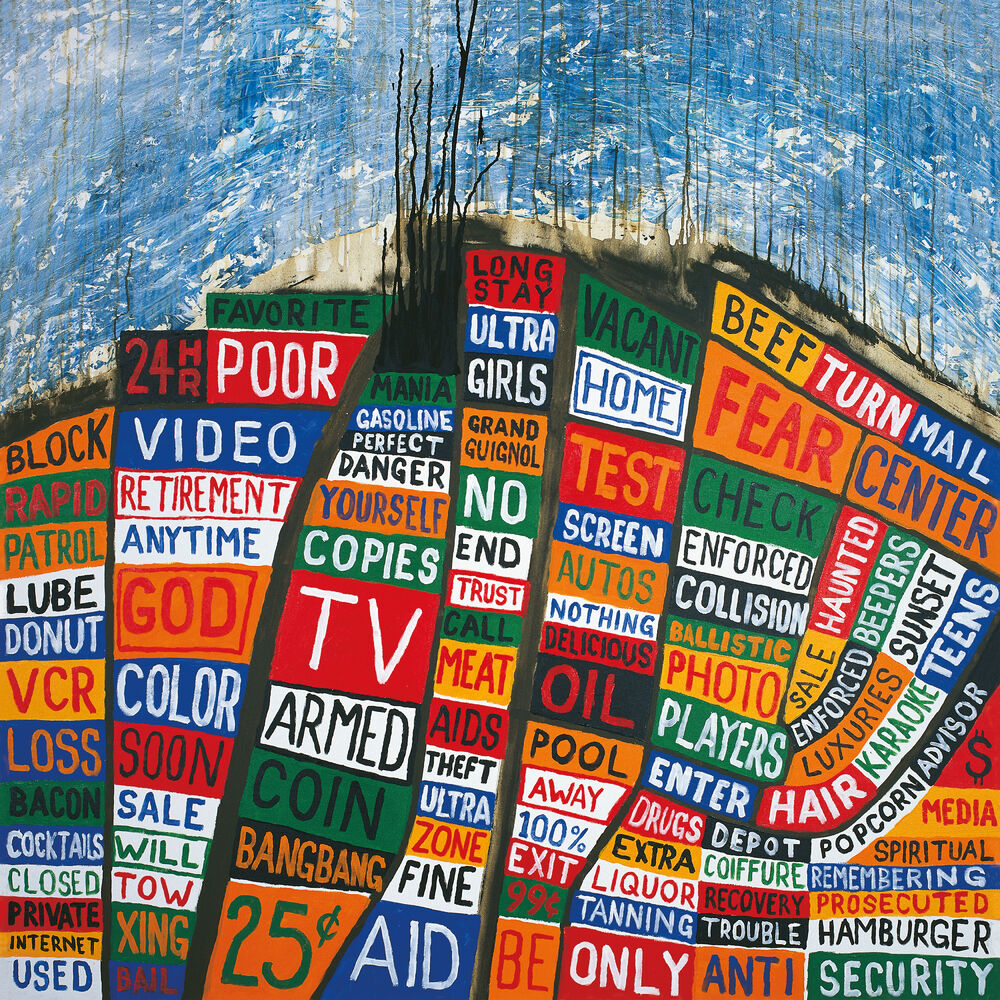
Hail To the Thief
- Released9 June 2003
- UK peak No. 1
- Weeks on UK chart 17
- Entered UK chart 15 June 2003
- LabelXL Recordings
- Tracks14 · 56 min
3 tracks from it charted as singles. Press a flag to play it in the chart where it peaked.
Tracks
| 1 | 2 + 2 = 5 No. 15 · 2003 | 3:19 | |
| 2 | Sit Down. Stand Up | 4:19 | |
| 3 | Sail To The Moon | 4:18 | |
| 4 | Backdrifts | 5:22 | |
| 5 | Go To Sleep No. 12 · 2003 | 3:21 | |
| 6 | Where I End and You Begin | 4:29 | |
| 7 | We Suck Young Blood | 4:56 | |
| 8 | The Gloaming | 3:32 | |
| 9 | There, There No. 4 · 2003 | 5:23 | |
| 10 | I Will | 1:59 | |
| 11 | A Punch Up at a Wedding | 4:57 | |
| 12 | Myxomatosis | 3:52 | |
| 13 | Scatterbrain | 3:21 | |
| 14 | A Wolf At the Door | 3:21 |
About the album
Hail to the Thief is the sixth studio album by the English rock band Radiohead. It was released on 9 June 2003 through Parlophone internationally, and through Capitol Records in the United States on 10 June. It was the last album released under Radiohead's record contract with EMI, the parent company of Parlophone and Capitol.
After transitioning to a more electronic style on their albums Kid A (2000) and Amnesiac (2001), which were recorded through protracted studio experimentation, Radiohead sought to work more spontaneously, combining electronic and rock music. They recorded most of Hail to the Thief in two weeks in Ocean Way Recording, Los Angeles, with their longtime producer, Nigel Godrich, focusing on live takes rather than overdubs. The singer, Thom Yorke, wrote lyrics in response to the election of the US president George W. Bush and the unfolding war on terror. He took phrases from political discourse and combined them with elements from fairy tales and children's literature. The title is a play on the American presidential anthem, "Hail to the Chief".
Following a high-profile internet leak of unfinished material ten weeks before release, Hail to the Thief debuted at number one on the UK Albums Chart and number three on the US Billboard 200 chart. It was certified platinum in the UK and Canada and gold in several countries.
Background
With their previous albums Kid A (2000) and Amnesiac (2001), recorded simultaneously, Radiohead replaced their guitar-led rock sound with a more electronic style. For the tours, they learned how to perform the music live, combining synthetic sounds with rock instrumentation. The singer, Thom Yorke, said: "Even with electronics, there is an element of spontaneous performance in using them. It was the tension between what's human and what's coming from the machines. That was stuff we were getting into." Radiohead did not want to make a "big creative leap or statement" with their next album.
In early 2002, after the Amnesiac tour had finished, Yorke sent his bandmates CDs of demos. The CDs, titled The Gloaming, Episcoval and Hold Your Prize, comprised electronic music alongside piano and guitar sketches. Radiohead had tried to record some of the songs, such as "I Will", for Kid A and Amnesiac, but were not satisfied with the results. They spent May and June 2002 arranging and rehearsing the songs before performing them on their tour of Spain and Portugal in July and August.
Recording
In September 2002, Radiohead moved to Ocean Way Recording in Hollywood, Los Angeles, with their longtime producer, Nigel Godrich. The studio was suggested by Godrich, who had used it to produce records by Travis and Beck and thought it would be a "good change of scenery" for Radiohead. Yorke said: "We were like, 'Do we want to fly halfway around the world to do this?' But it was terrific, because we worked really hard. We did a track a day. It was sort of like holiday camp." Godrich later said his clearest memory of the sessions was Yorke repeatedly saying how much he hated Los Angeles.
Kid A and Amnesiac were created through a years-long process of recording and editing that the drummer, Philip Selway, described as "manufacturing music in the studio". For their next album, Radiohead sought to capture a more immediate, "live" sound. Most electronic elements were not overdubbed, but recorded live in the studio.
The band integrated computers into their performances with other instruments. Yorke said "everything was about performance, like staging a play".
Lyrics and themes
Pitchfork described the lyrics as "almost unrelentingly bleak, a violent dispatch bursting with Orwellian zombies, automatons incapable of seeing warning signs, 'accidents waiting to happen''". The lyrics were influenced by what Yorke called "the general sense of ignorance and intolerance and panic and stupidity" following the 2000 election of the US president George W. Bush. He took words and phrases from discourse around the unfolding war on terror, which he described as Orwellian euphemisms, and used them in the lyrics and artwork. Yorke said the "emotional context of those words had been taken away" and that he was "stealing it back". Though Yorke denied any intent to make a political statement, he said: "I desperately tried not to write anything political, anything expressing the deep, profound terror I'm living with day to day. But it's just fucking there, and eventually you have to give it up and let it happen."
Yorke, a new father, adopted a strategy of distilling the political themes into "childlike simplicity".
Music
Hail to the Thief incorporates alternative rock, art rock, experimental rock and electronic rock. It features more conventional rock instrumentation and less digital manipulation than Radiohead's previous albums Kid A and Amnesiac, with prominent use of live drums, guitar and piano, and Yorke's voice is less manipulated with effects. The Spin critic Will Hermes found that Hail to the Thief "seesaws between the chill of sequencers and the warmth of fingers on strings and keys". Rolling Stone said Hail to the Thief was "more tuneful and song-focused". Several tracks use the "Pixies-like" quiet-to-loud building of tension Radiohead had employed on previous albums.
Yorke denied that Hail to the Thief was a "guitar record". It retains electronic elements such as synthesisers, drum machines and sampling. Selway said the combination of rock and electronic music covered "the two hemispheres of the Radiohead brain". Radiohead saw Hail to the Thief as a "sparkly, shiny pop record. Clear and pretty." O'Brien felt it captured a new "swaggering" sound, with "space and sunshine and energy".
Artwork
The Hail to the Thief artwork was created by the longtime Radiohead collaborator Stanley Donwood, who joined them during the recording in Hollywood. Donwood initially planned to create artwork based on photographs of phallic topiary, but the idea was rejected by Yorke. Instead, the cover art is a roadmap of Hollywood, with words and phrases taken from roadside advertising in Los Angeles, such as "God", "TV" and "oil". Donwood said advertising was designed to be attractive, but that there was something "unsettling" about being sold something. He took the advertising slogans out of context to "remove the imperative" and "get to the pure heart of advertising".
Other words in the artwork were taken from Yorke's lyrics and political discussion surrounding the war on terror. Among them is "Burn the Witch", the title of a song Radiohead did not complete until their ninth album, A Moon Shaped Pool (2016). Other artworks included with the album refer to cities relevant to the war, including New York, London, Grozny and Baghdad.