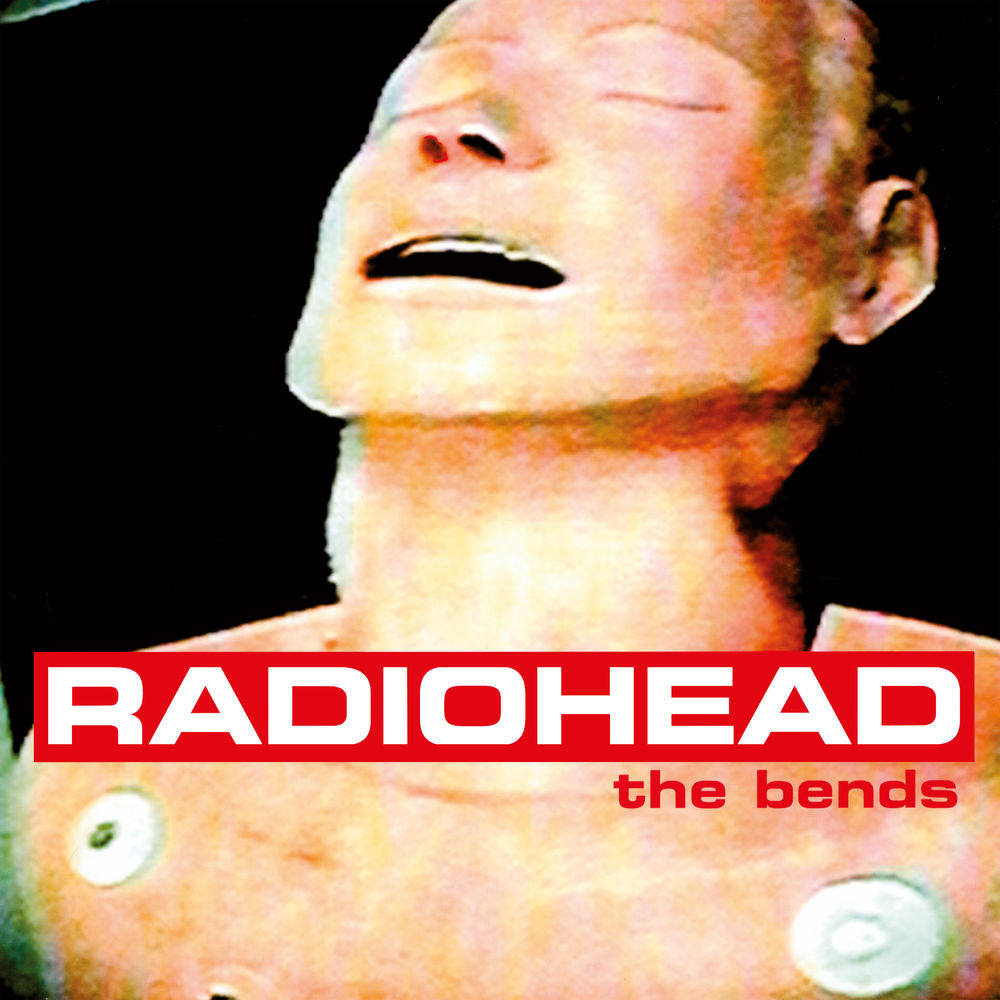
The Bends
- Released1 November 1994
- UK peak No. 4
- Weeks on UK chart 204
- Entered UK chart 19 March 1995
- LabelXL Recordings
- Tracks12 · 49 min
4 tracks from it charted as singles. Press a flag to play it in the chart where it peaked.
Tracks
| 1 | Planet Telex | 4:19 | |
| 2 | The Bends | 4:06 | |
| 3 | 4:17 | ||
| 4 | Fake Plastic Trees No. 20 · 1995 | 4:50 | |
| 5 | Bones | 3:09 | |
| 6 | (Nice Dream) | 3:53 | |
| 7 | Just No. 19 · 1995 | 3:54 | |
| 8 | My Iron Lung | 4:36 | |
| 9 | Bullet Proof ... I Wish I Was | 3:28 | |
| 10 | Black Star | 4:07 | |
| 11 | Sulk | 3:42 | |
| 12 | Street Spirit (Fade Out) No. 5 · 1996 | 4:13 |
About the album
The Bends is the second studio album by the English rock band Radiohead, released on 13 March 1995 by Parlophone. It was produced by John Leckie, with extra production by Radiohead, Nigel Godrich and Jim Warren. The Bends combines guitar songs and ballads, with more restrained arrangements and cryptic lyrics than Radiohead's debut album, Pablo Honey (1993).
Work began at RAK Studios, London, in February 1994. Tensions were high, with pressure from Parlophone to match sales of Radiohead's debut single, "Creep", and progress was slow. After an international tour in May and June, Radiohead resumed work at Abbey Road in London and the Manor in Oxfordshire. The Bends was the first Radiohead album recorded with Godrich and the artist Stanley Donwood, who have worked on every Radiohead album since.
Several singles were released: "My Iron Lung", the double A-side "High and Dry / Planet Telex", "Fake Plastic Trees", "Just", and Radiohead's first top-five entry on the UK singles chart, "Street Spirit (Fade Out)". "The Bends" was also released as a single in Ireland. A live video, Live at the Astoria, was released on VHS. Radiohead toured extensively for The Bends, including US tours supporting R.E.M. and Alanis Morissette.
The Bends reached number four on the UK Albums Chart. It sold slowly in the US, but sales grew through word of mouth, positive reviews and distinctive music videos.
Background
Radiohead released their debut album, Pablo Honey, in 1993, featuring the hit single "Creep". They felt pressured by the success and mounting expectations. Following the world tour for Pablo Honey, the singer, Thom Yorke, became ill and Radiohead cancelled an appearance at the 1993 Reading Festival. He told NME: "Physically I'm completely fucked and mentally I've had enough."
According to some reports, Radiohead's record company, EMI, gave them six months to "get sorted" or be dropped. EMI's A&R head, Keith Wozencroft, denied this, saying: "Experimental rock music was getting played and had commercial potential. People voice different paranoias, but for the label [Radiohead] were developing brilliantly from Pablo Honey."
After Radiohead finished recording Pablo Honey, Yorke played the co-producer Paul Q. Kolderie a demo tape of new material with the working title The Benz. Kolderie was shocked to find the songs were "all better than anything on Pablo Honey". The guitarist Ed O'Brien said later: "After all that touring on Pablo Honey ...
Recording
EMI gave Radiohead nine weeks to record the album, planning to release it in October 1994. Work began at RAK Studios in London in February 1994. Yorke would arrive at the studio early and work alone at the piano; according to Leckie, "New songs were pouring out of him." The band praised Leckie for demystifying the studio environment. The guitarist Jonny Greenwood said: "He didn't treat us like he had some kind of witchcraft that only he understands. There's no mystery to it, which is so refreshing." Leckie said Radiohead were "very democratic" and that each member's opinion was valid, which slowed the recording process.
Whereas Pablo Honey was mostly written by Yorke, The Bends saw greater collaboration. Previously, all three guitarists had often played identical parts, creating a "dense, fuzzy wall" of sound. Their Bends roles were more divided, with Yorke generally playing rhythm, Greenwood lead and O'Brien providing effects. O'Brien described the Boss DD-5, a delay pedal, as important to the album's sound.
Music
The Bends has been described as alternative rock, indie rock, art rock, and post-grunge. Like Pablo Honey, it features guitar-oriented rock songs, but its songs are "more spacey and odd", according to The Gazette's Bill Reed. The music is more eclectic than Pablo Honey, and Colin Greenwood said The Bends better represented their style. Pitchfork wrote that it contrasts warmth and tension, riffs and texture, and rock and post-rock. Several critics identified it as a Britpop album, though Radiohead disliked Britpop, seeing it as a "backwards-looking" pastiche.
The critic Simon Reynolds wrote that The Bends brought an "English art rock element" to the fore of Radiohead's sound. According to Kolderie, "The Bends was neither an English album nor an American album. It's an album made in the void of touring and travelling. It really had that feeling of, 'We don't live anywhere and we don't belong anywhere.'" Reed described it as "intriguingly disturbed" and "bipolar".
Artwork
The Bends was the first Radiohead album with artwork by Stanley Donwood, who has worked with Yorke to create all of Radiohead's artwork since. Donwood met Yorke while they were students at the University of Exeter, and first created artwork for Radiohead for the My Iron Lung EP. For The Bends, Yorke and Donwood entered John Radcliffe Hospital in Oxford with a video camera to film an iron lung, but found it visually boring. Instead, they filmed a CPR mannequin, displayed the footage on a television and photographed the screen. They stretched the image to distort it and exaggerate the expression. In 2025, the Paste critic Sean Edgar wrote that the image was "a fitting metaphor for a band on the cusp of escaping the corporeal restraints of traditional music to explore an uncharted sonic wilderness".
Release
The Bends was released at the height of Britpop, when the British music charts were dominated by bands such as Oasis and Blur, and initially made little impact. It was released in Japan on 8 March 1995 by EMI, and in the UK on 13 March by Parlophone Records. It spent 16 weeks on the UK Albums Chart, reaching number four. On the same day as the UK release, Radiohead's performance at the London Astoria in May 1994 was released on VHS as Live at the Astoria, including several Bends tracks.
In the US, The Bends was released on 4 April by EMI's North American subsidiary, Capitol Records. According to the journalist Tim Footman, Capitol almost refused to release it, feeling it lacked hit singles. It debuted at the bottom of the US Billboard 200 in the week of 13 May and reached number 147 in the week of 24 June. However, its US sales slowly improved. It re-entered the chart in the week of 17 February 1996, and reached number 88 on 20 April, almost exactly a year after its release. On 4 April, The Bends was certified gold in the US for sales of half a million copies.