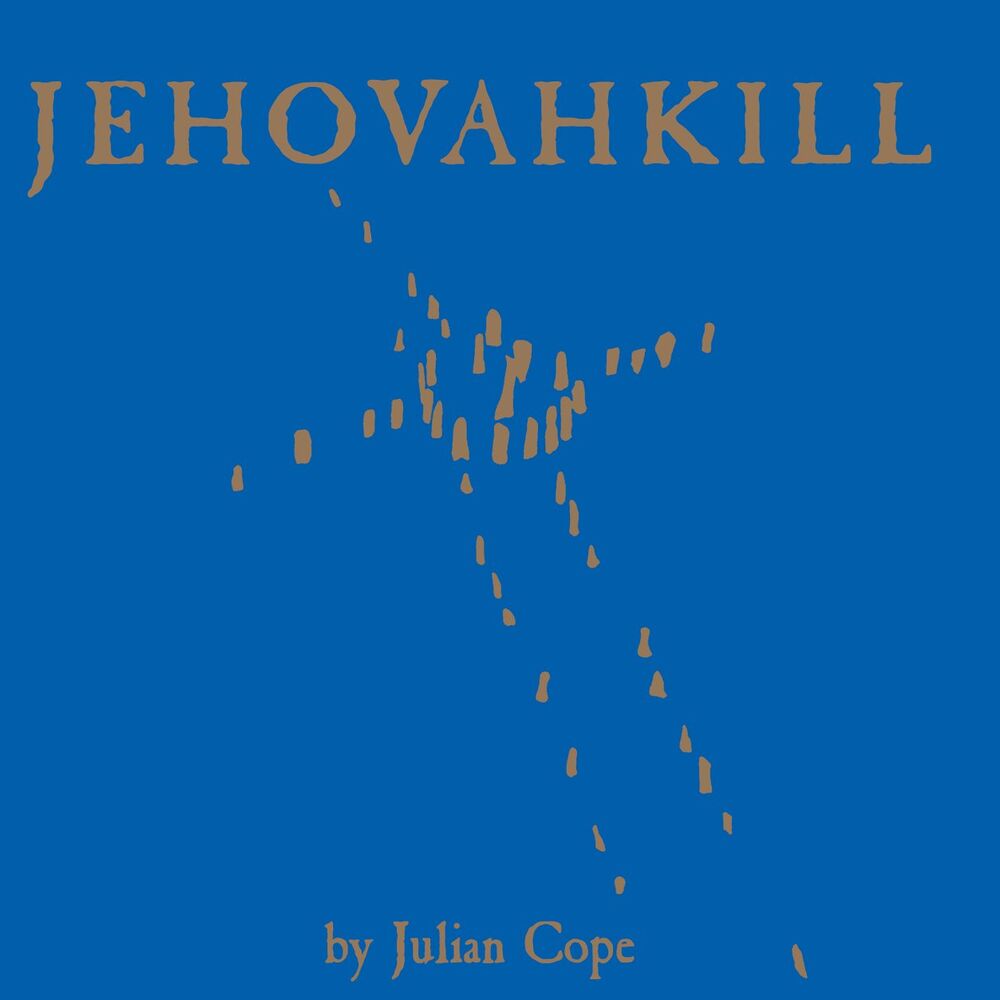
Jehovahkill
- Released1 January 2006
- LabelUMC (Universal Music Catalogue)
- Tracks25 · 103 min
One track from it charted as a single. Press a flag to play it in the chart where it peaked.
Tracks
| 1 | Soul Desert | 3:54 | |
| 2 | No Hard Shoulder To Cry On | 2:44 | |
| 3 | Akhenaten | 2:50 | |
| 4 | The Mystery Trend | 4:16 | |
| 5 | Upwards At 45 Degrees | 5:45 | |
| 6 | Cut My Friends Down | 3:16 | |
| 7 | Necropolis | 4:39 | |
| 8 | Slow Rider | 2:17 | |
| 9 | Gimme Back My Flag | 5:33 | |
| 10 | Poet Is Priest... | 6:22 | |
| 11 | Julian H. Cope | 2:47 | |
| 12 | The Subtle Energies Commission | 7:49 | |
| 13 | Fa-Fa-Fa-Fine | 2:25 | |
| 14 | Fear Loves This Place No. 42 · 1992 | 4:15 | |
| 15 | The Tower | 10:16 | |
| 16 | Peggy Suicide Is Missing | 0:41 | |
| 17 | Nothing | 2:01 | |
| 18 | I Have Always Been Here Before | 4:37 | |
| 19 | This Is My Kin | 4:18 | |
| 20 | Michael Rother | 4:37 | |
| 21 | Gogmagog | 2:48 | |
| 22 | Gone | 4:58 | |
| 23 | Vivien | 2:57 | |
| 24 | You Gotta Show | 4:39 | |
| 25 | Sqwubbsy The Olmec | 1:46 |
About the album
Jehovahkill is the eighth album by Julian Cope, released in 1992. After the critical success of Peggy Suicide (1991), Cope's idea for Jehovakill was to incorporate a krautrock attitude into his music. He began recording the album with musicians Rooster Cosby and Donald Ross Skinner, while co-producing it with the latter. The sessions yielded what Cope considered to be his most sonically experimental material to date. Originally titling the record Julian H. Cope, he sent an eleven track version to Island Records, who initially rejected its release, but gave Cope extra recording sessions for the album. During the extra sessions, in which six extra songs were recorded, the album became harder and was retitled Jehovahkill.
Inspired by prehistoric monuments, the album features ancient, pre-Christian heathen and pagan themes, while commenting on "the destructiveness of mainstream religion." The theme spread to the packaging, with the cover depicting the Callanish Stones, a site with a cruciform layout that predates Christ by at least 2,000 years. Musically, the album combines krautrock with a dark folk sound. Upon release, it reached number 20 on the UK Albums Chart, although Island Records dropped him soon after its release, leading to outrage in the music press. The album proved to be one of Cope's biggest critical successes.
Recording and development
Julian Cope's seventh album and fifth album for Island Records, Peggy Suicide (1991), concerned itself with environmental issues, and was a critical comeback for Cope, if not quite a commercial one. During the world tour in promotion of Peggy Suicide, Julian Cope, his guitarist, drummer and saxophonist Rooster Cosby and guitar technician Rizla Deutsch, all of whom listened to krautrock in the early 1970s, had debated "the psychie mix that had created krautrock's singular take on Western music," and reached the conclusion that they could distill "the krautrock psyche" into a complete attitude which they would then apply to Cope's new album, much like that had with the R&B and Detroit soul styles on Peggy Suicide.
After the world tour in promotion of Peggy Suicide ended in August 1991, Julian Cope entered the studio to record his next album with Cosby, Deutsch and keyboardist Donald Ross Skinner, with Cope and Skinner co-producing the album. Cope biographer Mick Houghton said that most of the album was recorded at the in-house studios of Island Records.
Themes
Cope would later describe Jehovahkill as the second instalment of an album trilogy that concerns Mother Earth, with the first being Peggy Suicide and the third being Autogeddon; in particular, Jehovahkill departs from the environmental concerns of Peggy Suicide and instead celebrates ancient, pre-Christianity heathen impulses, while noting what Cope, a self-described Odinist, believed to be "the destructiveness of mainstream religion." As a result, the prehistoric landscape was a big influence on Jehovahkill. Cope said at the time of the release that his interest in such subjects "just seemed to start from my life, I just found myself staggering towards it, really.
Release
Jehovahkill was released on 19 October 1992 by Island Records; its CD release was pressed onto a single-disc, while the LP was packaged as a double album pressed onto only three sides, one for each "Phase", with the fourth side showing an etching instead. A double disc special edition with an extra disc entitled Jehovahkill Companion, comprising outtakes from the sessions, was also issued. The ballad "Fear Loves This Place" was issued as the album's only single, and reached number 42 on the UK Singles Chart in October. The album debuted at number 20 on the UK Albums Chart two weeks later, before falling to number 39 the following week.
Critical reception
Jehovahkill was well received by music critics. Cope biographer Mick Houghton reflected that some critics called it Cope's best album since Fried and "a deeply fascinating work," while Uncut said "it was arguably Cope’s biggest critical success." Dave DiMartino of Entertainment Weekly wrote that "Jehovahkill sounds like a guy with great taste having an orgy in a recording studio — and echoing everybody he's ever liked in the process. Bless his burnt-out heart." Andy Gill of The Independent called it "one of the week's more inspired albums" and noted "an odd wholeness to the project, the kind of result only possible when an artist takes a flier and pursues his personal vision, heedless of fashion," while David Cavanagh of Select wrote: "Spend the rest of your life making sense of Jehovahkill, ye Kelts and Krauts alike, and salute the soul of Julian H Cope."
Describing the album as a "strange but soothing act of rebellion," Alec Foege of Spin felt Jehovahkill was the musician's most consistent record to date, saying Cope "pontificates less and crafts better melodies" and figured his "m