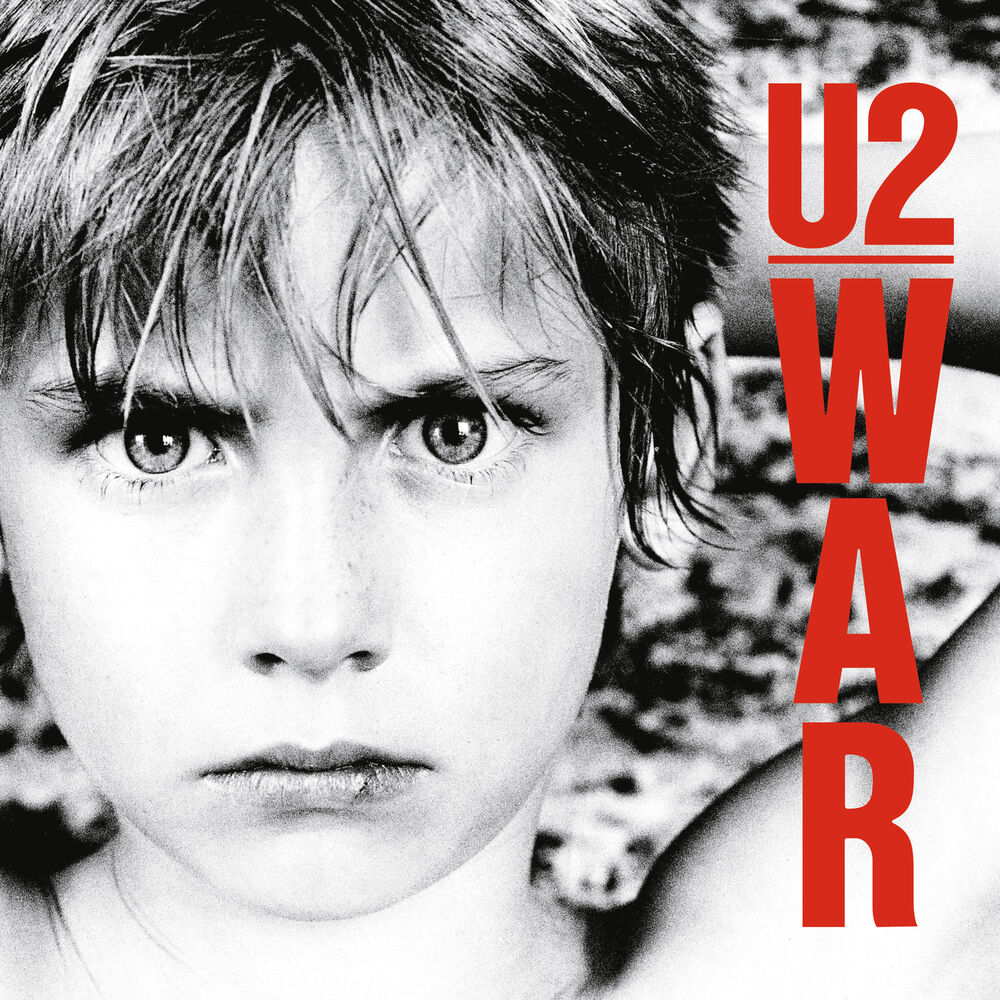
War (Remastered)
- Released22 July 2008
- UK peak No. 1
- Weeks on UK chart 148
- Entered UK chart 6 March 1983
- LabelUniversal-Island Records Ltd.
- Tracks10 · 42 min
2 tracks from it charted as singles. Press a flag to play it in the chart where it peaked.
Tracks
| 1 | Sunday Bloody Sunday (Remastered 2008) | 4:39 | |
| 2 | Seconds (Remastered 2008) | 3:11 | |
| 3 | 5:34 | ||
| 4 | Like A Song... (Remastered 2008) | 4:47 | |
| 5 | Drowning Man (Remastered 2008) | 4:14 | |
| 6 | The Refugee (Remastered 2008) | 3:40 | |
| 7 | Two Hearts Beat As One (Remastered 2008) No. 18 · 1983 | 4:02 | |
| 8 | Red Light (Remastered 2008) | 3:44 | |
| 9 | Surrender (Remastered 2008) | 5:32 | |
| 10 | "40" (Remastered 2008) | 2:38 |
About the album
War is the third studio album by Irish rock band U2. It was produced by Steve Lillywhite, and was released on 28 February 1983 on Island Records. The album is regarded as U2's first overtly political album, in part because of songs like "Sunday Bloody Sunday" and "New Year's Day", as well as the title, which stems from the band's perception of the world at the time; lead vocalist Bono stated that "war seemed to be the motif for 1982."
Recorded from September to November 1982 at Windmill Lane Studios, it was produced by Lillywhite and is the group's third consecutive album developed at the studio with the producer. While the central themes of U2's previous albums Boy and October were adolescence and spirituality, respectively, War focused on both the physical aspects of warfare, and the emotional after-effects. Musically, it is also harsher than the band's previous releases.
War was a commercial success, knocking Michael Jackson's Thriller from the top of the UK charts to become U2's first number-one album there. In the United States, it reached number 12 and became the band's first album certified gold. War received generally favourable reviews, although some British journalists criticised it. The band supported the album with the War Tour through the end of 1983. In 2008, a remastered edition of War was released.
Recording
In August 1982, Bono and his wife Alison Hewson honeymooned in Jamaica. It has been noted that it was not a typical honeymoon, as Bono reportedly worked on the lyrics for the upcoming album. The lyrics to "New Year's Day" had its origins in a love song Bono wrote for his wife, but the song was reshaped and inspired by the Polish Solidarity movement. The band began recording the album in September 1982 at Windmill Lane Studios in Dublin with producer Steve Lillywhite, their third consecutive record at the studio with the producer.
The album's opener, "Sunday Bloody Sunday", an ardent protest song, stems from a guitar riff and lyric written by the Edge in 1982. Following an argument with his girlfriend, and a period of doubt in his own song-writing abilities, the Edge – "feeling depressed... channeled [his] fear and frustration and self-loathing into a piece of music." Early versions of the song opened with the line, "Don't talk to me about the rights of the IRA, UDA". After Bono had reworked the lyrics, the band recorded the song.
Composition
The sound of War is arguably harsher than that of the band's other albums. A major reason for this is that the Edge uses far less delay and echo than in previous and subsequent works.
War opens with the protest song "Sunday Bloody Sunday". The song describes the horror felt by an observer of The Troubles in Northern Ireland, specifically Bloody Sunday. Already a departure from the themes of innocence and spirituality displayed on the group's first two albums, "Sunday Bloody Sunday" introduces the album with a startling, military-esque drum beat by Larry Mullen, Jr., a fuming solo by the Edge that segues into staccato bursts reminiscent of machine gun fire, and pointed lyrical couplets such as: "And today the millions cry / We eat and drink while tomorrow they die." The album as a whole is more direct than the ambient October. Bono said in 1983, A lot of the songs on our last album were quite abstract, but War is intentionally more direct, more specific. But you can still take the title on a lot of different levels. We're not only interested in the physical aspects of war.
Release
The album was first released on 28 February 1983. The original cassette release contains the entire album on each side.
Packaging and title
The album was titled War for several reasons; in 1982, Bono said, "War seemed to be the motif for 1982," adding that "Everywhere you looked, from the Falklands to the Middle East and South Africa, there was war. By calling the album War we're giving people a slap in the face and at the same time getting away from the cosy image a lot of people have of U2." The Edge said that "It's a heavy title. It's blunt. It's not something that's safe, so it could backfire. It's the sort of subject matter that people can really take a dislike to. But we wanted to take a more dangerous course, fly a bit closer to the wind, so I think the title is appropriate." The boy on the cover is Peter Rowen (brother of Bono's friend, Guggi). He also appears on the covers of Boy, Three, The Best of 1980–1990, Early Demos and many singles. Bono described the reasoning behind the cover: "Instead of putting tanks and guns on the cover, we've put a child's face. War can also be a mental thing, an emotional thing between loves.
Singles
In January 1983, "New Year's Day" was released internationally as the album's lead single. The single reached the top ten in the UK, and was the first release by the band to chart on the Billboard Hot 100. In March 1983, "Two Hearts Beat as One" and "Sunday Bloody Sunday" were released as singles in different regions. "Two Hearts Beat as One", a single in the US, UK, and Australia, reached number 18 on the UK Singles Chart; "Sunday Bloody Sunday", released in Germany and the Netherlands, reached number 3 on the Netherlands' charts. "40" was not released as a commercial single, but rather as a promotional single in Germany.
Reception
In a favourable review in Rolling Stone, J. D. Considine said, "the album's musical strengths are largely the product of well-honed arrangements and carefully balanced dynamics". He added, "the songs here stand up against anything on the Clash's London Calling in terms of sheer impact, and the fact that U2 can sweep the listener up in the same sort of enthusiastic romanticism that fuels the band's grand gestures is an impressive feat. For once, not having all the answers seems a bonus." Critic Dave Marsh said that despite not "match[ing] the pure chilling intensity" of Boy and Lillywhite's production not giving the guitars enough prominence, War was a "solid set". He complimented War for its "passion and commitment" and potent songs, calling it "as good as any post-new wave rock around".