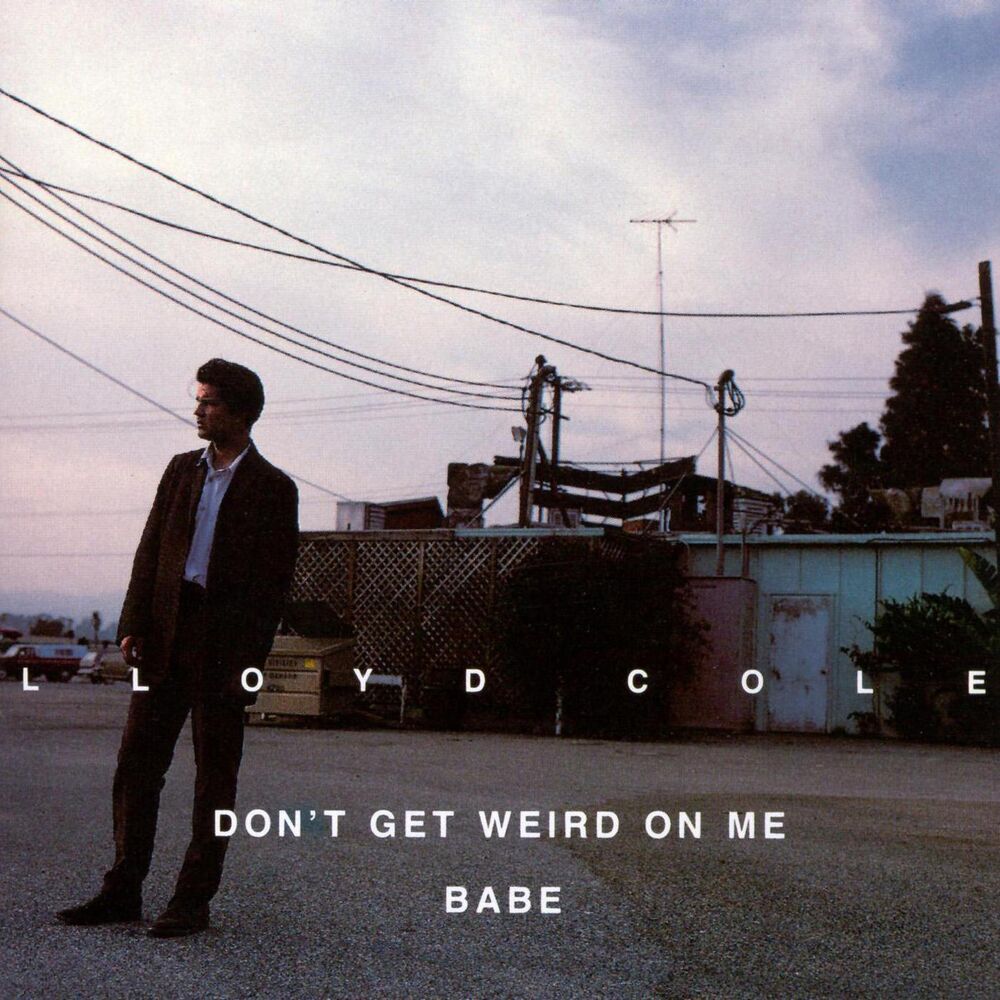
Don't Get Weird On Me, Babe
- Released3 March 2003
- UK peak No. 21
- Weeks on UK chart 3
- Entered UK chart 22 September 1991
- LabelCapitol Records
- Tracks12 · 48 min
One track from it charted as a single. Press a flag to play it in the chart where it peaked.
Tracks
| 1 | Tell Your Sister | 3:29 | |
| 2 | Weeping Wine | 2:38 | |
| 3 | To The Lions | 2:40 | |
| 4 | Pay For It | 6:20 | |
| 5 | The One You Never Had | 2:30 | |
| 6 | She's A Girl And I'm A Man No. 55 · 1991 | 4:13 | |
| 7 | Butterfly | 3:01 | |
| 8 | There For Her | 4:04 | |
| 9 | Margo's Waltz | 4:02 | |
| 10 | Half Of Everything | 7:03 | |
| 11 | Man Enough | 4:02 | |
| 12 | What He Doesn't Know | 4:05 |
About the album
Don't Get Weird on Me Babe is the second solo album by the English musician Lloyd Cole, released in 1991. The title comes from a Raymond Carver expression. Unlike the original release, the American version of the album leads with the "rock" half and ends with the orchestral songs.
The album peaked at No. 40 on Billboard's Heatseekers Albums chart. It peaked at No. 21 on the UK Albums Chart. Cole promoted the album by touring with Robert Forster and Grant McLennan.
Production
The album was produced by Cole, Fred Maher, and Paul Hardiman. The string parts were arranged by Paul Buckmaster. Robert Quine, Matthew Sweet, and Maher joined Cole on the "rock" half of the album.
Critical reception
Upon its release, Jon Wilde of Melody Maker felt the album provided "reason enough for some kind of modest assessment" of Cole's work, commenting, "Divided between orchestral arrangements and more familiar chastened rockers, it somewhat surprisingly offers some of his sharpest, smartest-writing since Rattlesnakes." He noted that the first side "suggests that Cole might yet venture where Iggy Pop feared to tread after the disintegration of The Stooges" and is characterised by the "lush string arrangements" of Paul Buckmaster. He considered side two to be "more uneven" with a mix of "chunky-knit rockers and picked-clean guitar pop". Stuart Maconie of NME described it as "a great pop record featuring Lloyd's perennial concerns all set to great, big-screen arrangements" and that the "prevalent mood of the record is tousle-haired, whiskey flavoured, a dog-eared Salinger paperback of a thing".