White Blood Cells
- Released3 July 2001
- UK peak No. 55
- Weeks on UK chart 39
- Entered UK chart 12 August 2001
- LabelLegacy Recordings
- Tracks16 · 40 min
3 tracks from it charted as singles. Press a flag to play it in the chart where it peaked.
Tracks
| 1 | Dead Leaves and the Dirty Ground No. 25 · 2002 | 3:03 | |
| 2 | Hotel Yorba No. 26 · 2001 | 2:10 | |
| 3 | I'm Finding It Harder To Be a Gentleman | 2:54 | |
| 4 | Fell In Love With a Girl No. 21 · 2002 | 1:50 | |
| 5 | Expecting | 2:03 | |
| 6 | Little Room | 0:50 | |
| 7 | The Union Forever | 3:25 | |
| 8 | The Same Boy You've Always Known | 3:09 | |
| 9 | We're Going to Be Friends | 2:22 | |
| 10 | Offend In Every Way | 3:06 | |
| 11 | I Think I Smell a Rat | 2:04 | |
| 12 | Aluminum | 2:17 | |
| 13 | I Can't Wait | 3:37 | |
| 14 | Now Mary | 1:46 | |
| 15 | I Can Learn | 3:28 | |
| 16 | This Protector | 2:12 |
About the album
White Blood Cells is the third studio album by American rock duo the White Stripes. It was released by Sympathy for the Record Industry on July 3, 2001 and reissued by V2 Records in 2002. Produced by guitarist and lead vocalist Jack White, the album was recorded at Easley-McCain Recording in Tennessee over three days and was their first work to be mastered in a studio. The process cost $5,000 and was rushed in order to capture a "real tense feeling" and the band's raw energy.
Following their success within the Detroit music scene, the White Stripes began to shift from their blues-inspired roots to a garage rock sound. The album contains lyrics about love, hope, betrayal, and paranoia, while its name and cover art reference the band's disillusionment with fame and the mainstream music industry. For promotion, they played a trio of shows in Detroit and released "Hotel Yorba", "Fell in Love with a Girl", and "Dead Leaves and the Dirty Ground" as singles.
White Blood Cells charted in nine countries, reaching number 61 on the US Billboard 200 and number 55 on the UK Albums Chart, and earned platinum certifications in both countries. The album received widespread acclaim and propelled Jack and Meg White to the forefront of the 2000s indie and garage rock movements. Since its release, it has been ranked by several critics among the best albums of all time.
Background and recording
The White Stripes previously sought success in the Detroit music scene, releasing two albums between 1999 and 2000. In the interim, bandmates Jack and Meg White divorced; however Meg insisted that they continue working together. They had still been living in the house purchased from Jack's parents and lived within their means, having had no inkling of the mainstream success that would greet them with this album. With De Stijl (2000), they were content to tour modestly, come home, and go back to their respective normal day jobs as the word "success" meant no longer having to work one. That goal became a reality with the tour: Jack closed his upholstery studio and Meg eventually left her restaurant job. Paradoxically, Meg kept her uniforms out of the superstitious belief that throwing them away would bring such bad luck that it would lead her back to working a day job.
Prior to White Blood Cells, the White Stripes had no interest in working with a major label for fear of losing artistic freedom and the horror stories associated with the mainstream music industry.
Composition and sound
Continuing the stripped-down garage rock nature of the White Stripes, White Blood Cells features less of the band's blues rock influences, instead displaying a more raw, basic, and primitive rock and roll sound. Shortly before the release of White Blood Cells, Jack asserted that "There's no blues on the new record. We're taking a break from that. There's no slide work, bass, guitar solos, or cover songs. It's just me and Meg, guitar, drums and piano." It is one of two White Stripes albums to not feature any covers of other artists.
The lyrics in White Blood Cells explore love, hope, betrayal, and paranoia, brought on by the increasing media attention the duo began receiving. Most if not all of the songs were written in the band's early years, or inspired by other side-projects of Jack. Jack said being able to utilize his older works was "cool because a lot of things had been sitting around for a long time, stuff I had written on piano that had been just sitting around not doing anything.
Artwork and packaging
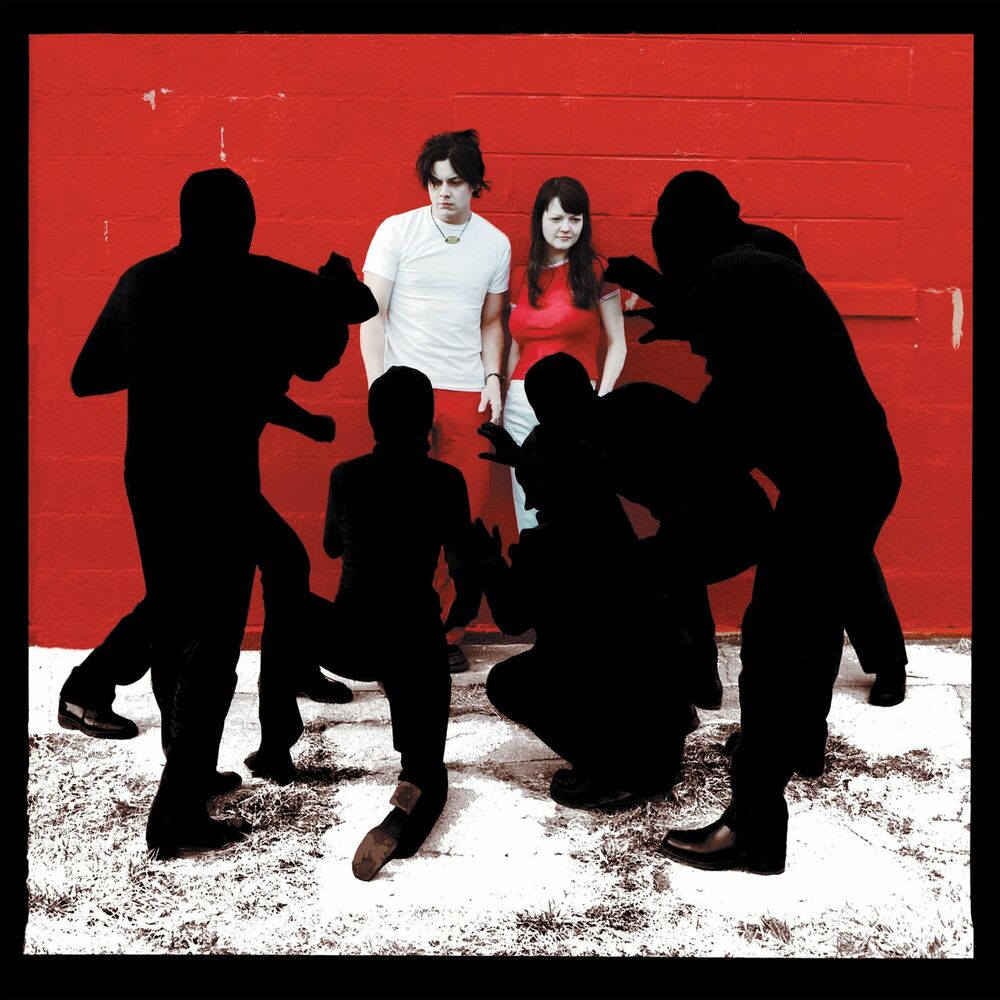
The name White Blood Cells was chosen as "this idea of bacteria coming at us, or just foreign things coming at us, or media, or attention on the band." Its cover art was photographed on a wall by the former Tiger Stadium. It depicts Jack and Meg surrounded by people wielding television and video cameras, which was intended to both comment on and satirize the music industry. The people portraying the silhouetted figures were The White Stripes' now-former friends in The Von Bondies and The Waxwings. Jack said in a 2001 interview before the album's release: "When does music become a business and why do we have to be suckered into it? Why do we have to buy a cell phone, you know what I mean? A lot of that stuff upsets me. It gets annoying." In 2003, he elaborated that not being perpetually accessible to their manager via cell phone was his way of maintaining his own sanity.
Reception
Three weeks before the release of the album, the White Stripes performed three well-received shows in Detroit at the Gold Dollar, the Magic Bag, and the Magic Stick. Twice released on July 3, 2001 by Sympathy and in 2002 by V2, White Blood Cells was the band's first mainstream success. The album entered the UK Albums Chart on August 18, 2001, peaking at 55 and spending 39 weeks on the chart. It debuted on the Billboard 200 at 185 on March 23, 2002, remaining on the charts for 53 weeks and peaking at 61 on April 20, 2002. It went on to receive platinum certifications in the United Kingdom and the United States, and gold certifications in Australia and Canada.
White Blood Cells received widespread acclaim. Review aggregating website Metacritic reports a normalized score of 86 out of 100 based on 16 reviews, indicating "universal acclaim". This makes White Blood Cells the White Stripes' second highest-scoring album on the website as of 2024.
Legacy
White Blood Cells propelled the band to the forefront of the 2000s indie rock revival and garage rock revival, and is considered a defining album of the period. Retrospectively, it has been cited as one of the band's best works, and among the best albums of all time. Jon Lusk of BBC believed the album solidified their success thanks to "the crunching, insistent simplicity of Meg White's drumming, which sticks like glue to Jack White's intense, rhythmic, blues-based riffing; a broad, knowing sense of pop history, and of course their by now well-established red/white branding imagery." Paul Travers of Louder called it "one of the first great albums of the 21st century" and their best album. NPR rated White Blood Cells as one of the most important recordings of the decade, describing it as the band's "finest hour: a flawless slice of fuzzed-out, frenetic, trichromatic hip-shaking."
By the end of the 2000s, it was ranked as the best album of the decade by The A.V. Club and Uncut.