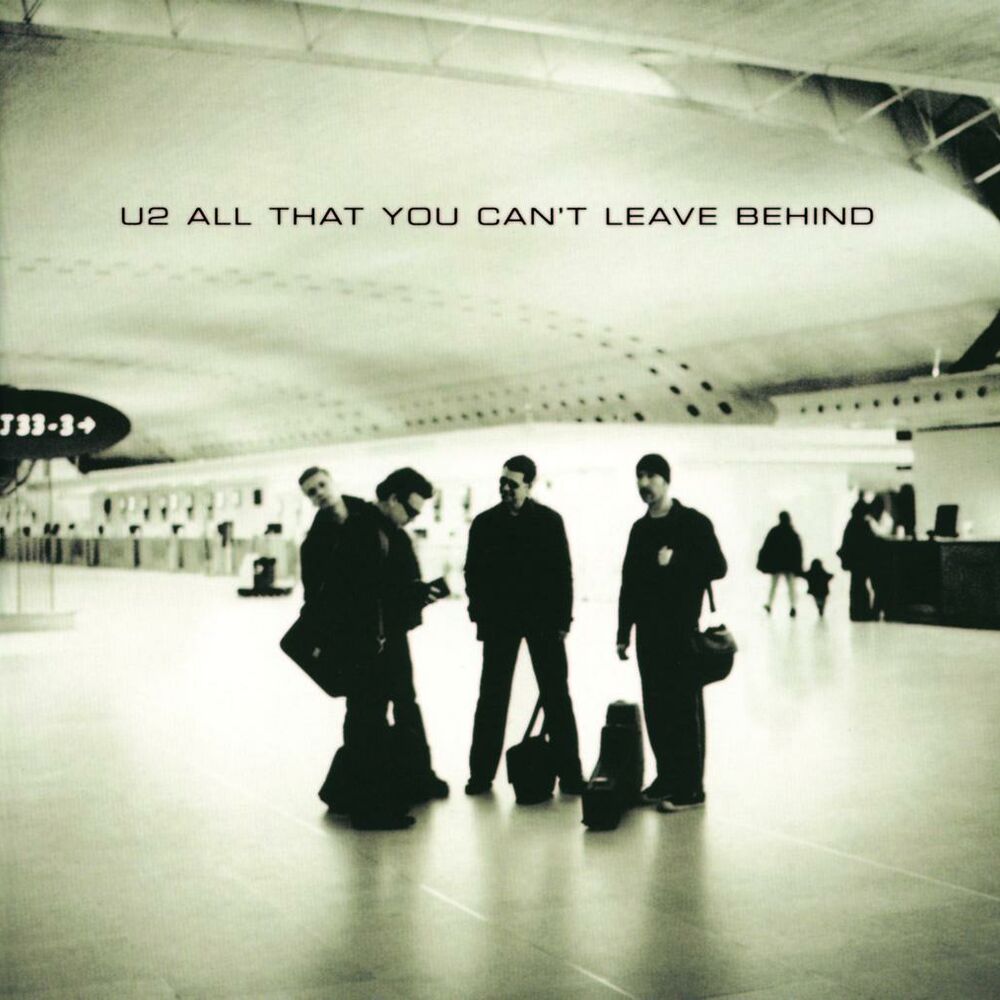
All That You Can't Leave Behind
- Released30 October 2000
- UK peak No. 1
- Weeks on UK chart 73
- Entered UK chart 5 November 2000
- LabelUniversal-Island Records Ltd.
- Tracks11 · 49 min
4 tracks from it charted as singles. Press a flag to play it in the chart where it peaked.
Tracks
| 1 | 4:06 | ||
| 2 | 4:32 | ||
| 3 | Elevation No. 3 · 2001 | 3:46 | |
| 4 | Walk On No. 5 · 2001 | 4:55 | |
| 5 | Kite | 4:23 | |
| 6 | In A Little While | 3:37 | |
| 7 | Wild Honey | 3:45 | |
| 8 | Peace On Earth | 4:46 | |
| 9 | When I Look At The World | 4:15 | |
| 10 | New York | 5:28 | |
| 11 | Grace | 5:31 |
About the album
All That You Can't Leave Behind is the tenth studio album by Irish rock band U2. It was produced by Brian Eno and Daniel Lanois, and was released on 30 October 2000 through Island Records worldwide and through Interscope Records in the United States. After the band's experimentation with alternative rock and dance music in the 1990s, and driven by the mixed reception to their 1997 album Pop, U2 returned to a sound more akin to their earlier records for All That You Can't Leave Behind. The group reunited with Eno and Lanois, who had produced three prior U2 albums together. The record was originally named U2000, a working title for their PopMart Tour.
The album received mostly positive reviews, reached number one in 32 countries, and sold over 12 million copies. The songs "Beautiful Day", "Walk On", "Elevation", and "Stuck in a Moment You Can't Get Out Of" were all successful singles. The record and its songs won seven Grammy Awards; it is the only album in history to have multiple tracks win the Grammy Award for Record of the Year: "Beautiful Day" at the 2001 ceremony and "Walk On" at the 2002 ceremony. In 2003, the album was ranked 139th on Rolling Stone's list of "The 500 Greatest Albums of All Time" and number 280 in its updated 2012 list. The Elevation Tour, on which U2 returned to playing arenas with a more intimate stage design, was also a critical and commercial success.
Background
Throughout the 1990s, U2 experimented with alternative rock and electronic dance music, culminating with their 1997 album Pop and the PopMart Tour. Guitarist the Edge said that with Pop, the band had "taken the deconstruction of the rock 'n' roll band format to its absolute 'nth degree". However, following the poor reception to the album and tour, U2 returned to arrangements that consisted almost entirely of guitar, bass, and drums, and quickly regrouped in the studio after the tour.
Writing and recording
For All That You Can't Leave Behind, U2 reunited with producers Brian Eno and Daniel Lanois, who also produced their albums The Unforgettable Fire (1984), The Joshua Tree (1987), and Achtung Baby (1991). Although the band wanted to write new material before beginning recording sessions, Eno convinced them to quickly write songs in the studio. For three weeks in late 1998, U2, Eno, and Lanois recorded demos in Hanover Quay Studios. One of the few quality ideas that stemmed from these brief sessions was the song "Kite". Lead singer Bono's vocals inspired everyone in the studio, particularly after he had been suffering from vocal problems for the previous few years. U2 anticipated that they could complete a new record in time for 1999. After the band's brief demo sessions, the Edge worked alone on song ideas before the band reunited at Hanover Quays. They recorded with the mentality of a "band in a room playing together", an approach that led to the album's more stripped-down sound.
Composition
The album was seen as a return to the band's traditional sound after their more experimental records of the 1990s. In many ways, however, this is an oversimplification, as the album breaks new ground by retaining the sonic nuances of their 1990s work and reconciling it with the melodic, hook-filled rock of their 1980s work. The first song (and lead single), "Beautiful Day", for instance, is an optimistic anthem that opens with a drum machine and a rhythm sequencer. The album also includes "Stuck in a Moment You Can't Get Out Of", a song written by Bono for his friend Michael Hutchence, the lead singer of INXS, who committed suicide in 1997. Clayton said the album was written "about the journey we'd been through as a band, as men in relationships, as sons of mothers and fathers.
Artwork
The photograph on the album cover was taken by long-time U2 photographer Anton Corbijn in the Roissy Hall 2F of the Charles de Gaulle Airport in Paris, France, which was also where the music video for "Beautiful Day" was shot. Contrasting with the colourful sleeves of the band's 1990s records, the cover of All That You Can't Leave Behind is a single monochrome image of the band. The designers describe the look they created as "grown up". In the original photograph, an airport sign reads "F21-36", indicating the direction of check-in desks. Per the band's request, the sleeve designers changed this to J33-3, a hidden reference to the Bible verse Jeremiah 33:3 ("Call unto me and I will answer thee great and mighty things which thou knowest not."). Bono referred to it as "God's phone number".
Release and promotion
Following the comparatively poor reception of their previous album Pop, U2 declared on a number of occasions that they were "re-applying for the job ... of best band in the world." Promotional activities for the album included a number of U2 firsts such as appearances on MTV's Total Request Live, USA Network's Farmclub.com, and Saturday Night Live. The band kicked off the release of the album by performing a short concert for about 600 people at the ManRay club in Paris, France, on 19 October 2000, as part of the promotion for the 30 October release of the album. The album was banned in Burma by SPDC because "Walk On" was dedicated to Burmese human rights activist Aung San Suu Kyi.
The album was preceded by the lead single "Beautiful Day", released on 9 October 2000. It was U2's fourth number-one single on the UK Singles Chart, their first number one in the Netherlands, and was also number one for a week in Australia. The song peaked at number 21 on the US Billboard Hot 100.
Commercial performance
The album debuted at number three on the Billboard 200 chart in the US, selling 427,826 copies in its first week. The album debuted at number one in 32 countries, including Canada where first-week sales totaled 71,470 copies. According to Nielsen SoundScan, the album has sold 4.4 million copies in the US through March 2014. All That You Can't Leave Behind is the fourth-highest-selling U2 album, with total sales of over 12 million.
Accolades
At the end of 2000, All That You Can't Leave Behind was voted the seventh-best album of the year in the Pazz & Jop annual critics poll published by The Village Voice. "Beautiful Day" finished fourth in the singles voting. Spin ranked it the 20th-best album of the year. The album and its singles earned U2 seven Grammy Awards over the course of two years. At the 43rd Annual Grammy Awards in 2001, "Beautiful Day" won Song of the Year, Best Rock Performance by a Duo or Group with Vocal, and Record of the Year. In the 44th Annual Grammy Awards in 2002, "Walk On" won Record of the Year, "Elevation" won Best Rock Performance by a Duo or Group with Vocal, and "Stuck in a Moment You Can't Get Out Of" won Best Pop Performance by a Duo or Group with Vocal. The album also won Best Rock Album and was nominated for Album of the Year. All That You Can't Leave Behind is the only album ever to have two singles win Record of the Year in two consecutive years.