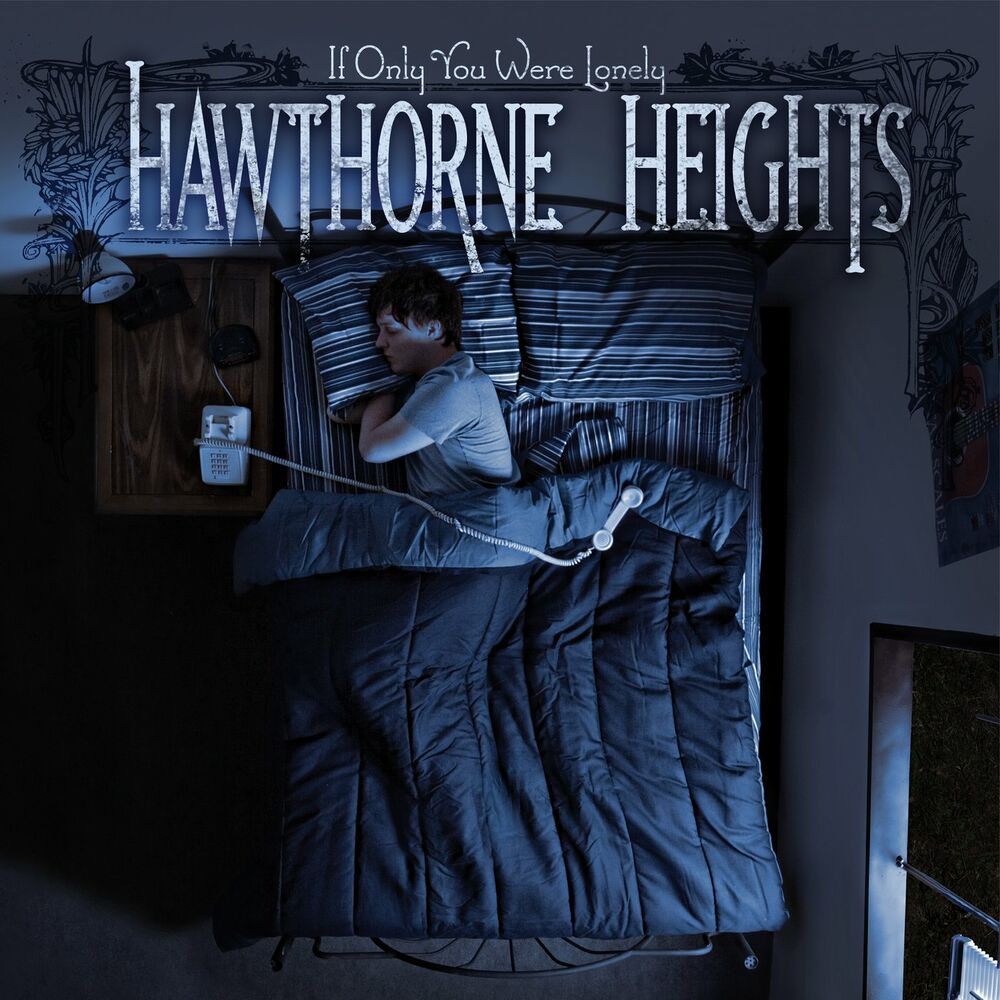
If Only You Were Lonely
- Released1 April 2021
- UK peak No. 85
- Weeks on UK chart 1
- Entered UK chart 5 March 2006
- LabelVictory Records
- Tracks12 · 44 min
One track from it charted as a single. Press a flag to play it in the chart where it peaked.
Tracks
| 1 | This Is Who We Are | 3:45 | |
| 2 | We Are So Last Year | 2:57 | |
| 3 | Language Lessons (Five Words Or Less) | 3:21 | |
| 4 | Pens And Needles | 3:15 | |
| 5 | Saying Sorry No. 87 · 2006 | 3:07 | |
| 6 | Dead In The Water | 3:51 | |
| 7 | I Am On Your Side | 4:14 | |
| 8 | Breathing In Sequence | 3:29 | |
| 9 | Light Sleeper | 3:26 | |
| 10 | Cross Me Off Your List | 3:40 | |
| 11 | Where Can I Stab Myself In The Ears | 3:42 | |
| 12 | Decembers | 4:45 |
About the album
If Only You Were Lonely is the second studio album by American rock band Hawthorne Heights, and the final album to feature rhythm guitarist and unclean backing vocalist Casey Calvert before his death on November 24, 2007. It was produced by David Bendeth. The title of the album is in reference to a B-side by the Replacements of the same name.
The name for the track "Where Can I Stab Myself in the Ears?" is derived from a post on a forum that was an announcement for Hawthorne Heights' release on the popular music news website AbsolutePunk.
Background and production
If Only You Were Lonely was recorded in September and October 2005 at Water Music in Hoboken, New Jersey, with producer David Bendeth. Dan Korneff and John Bender served as engineers, and both did digital editing, alongside Kato Khandwala. Ted Young aided them as assistant engineer. Korneff provided additional guitar production, and set up mixing, which was done by Bendeth and assistant Isaiah Abolin at Sound on Sound Studios and Right Track Studios, both in New York City in October 2005. Ted Jensen mastered the recordings at Sterling Sound.
Music and lyrics
Musically, If Only You Were Lonely features a sound similar to that on The Silence in Black and White, the band's previous album. Michael Endelman of Entertainment Weekly said the band "slickly synthesizes a bunch of post-’90s micro-genres" on the album. Scott Shetler of Slant Magazine explained: "The band again relies on slightly tempered verses, explosive choruses, and heavy guitars, rarely deviating from the formula." The album features more triple-guitar harmonies than its predecessor, drawing comparisons to English heavy metal band Iron Maiden, and some tracks, such as the album's opener "This Is Who We Are," contain elements of punk rock.
Release and promotion
In October 2005, Hawthorne Heights toured the UK with labelmates Bayside, Silverstein and Spitalfield; it led into a two-month tour of the US with those same acts, plus Aiden, dubbed the Never Sleep Again Tour. On November 23, 2005, If Only You Were Lonely was announced for release in three months' time; the album's track listing was posted online ten days later. "Saying Sorry" was made available for streaming solely on Christmas Day and Christmas Eve 2005 through their Myspace profile. This Is Who We Are, the band's first video album, was released on January 10, 2006; it included footage from the Never Sleep Again Tour, which saw the debut of three new songs, namely "Light Sleeper", "Where Can I Stab Myself in the Ears", and "This Is Who We Are".
In January 2006, Hawthorne Heights embarked on a UK tour with Still Remains, Aiden, and Bullet for My Valentine. A music video was released for "Saying Sorry" via AOL Music on January 16, 2006; it was released to radio on January 31, 2006.
Commercial performance
If Only You Were Lonely debuted at No. 3 on the Billboard 200 and #1 on the Top Independent Albums chart, spending a total of 17 weeks on the former. It is the band's highest-charting album to date. The album was certified Gold by the RIAA on March 24, 2016.
Critical reception
The album received mixed reviews. John D. Luerssen of AllMusic wrote: "The outfit's three-axe attack coupled with the distinctive pipes of J.T. Woodruff find Hawthorne Heights able to go where peers like Fall Out Boy just can't. Be it the downright winsome lilt of 'Saying Sorry' or the riotous punk of 'This Is Who We Are' -- painted with blood-curdling screams -- the group manages to walk the fine line between art and its aspirations of world domination with its credibility in check." The New York Times wrote: "Too many of the songs feel flat, despite the stormy guitars and stormier lyrics." Blender wrote: "Woodruff is never anything but coweringly passive, a trait about as appealing as it is annoying." Pop Matters wrote: "Hawthorne Heights don’t quite have the nervy energy or wit of a My Chemical Romance or Fall Out Boy yet, but their second album is a solid pop effort that reveals space for more growth."
Some critics questioned what they perceived to be the band's apparent attempt to attract fans from different audiences, and some stated their belief that the album would only appea