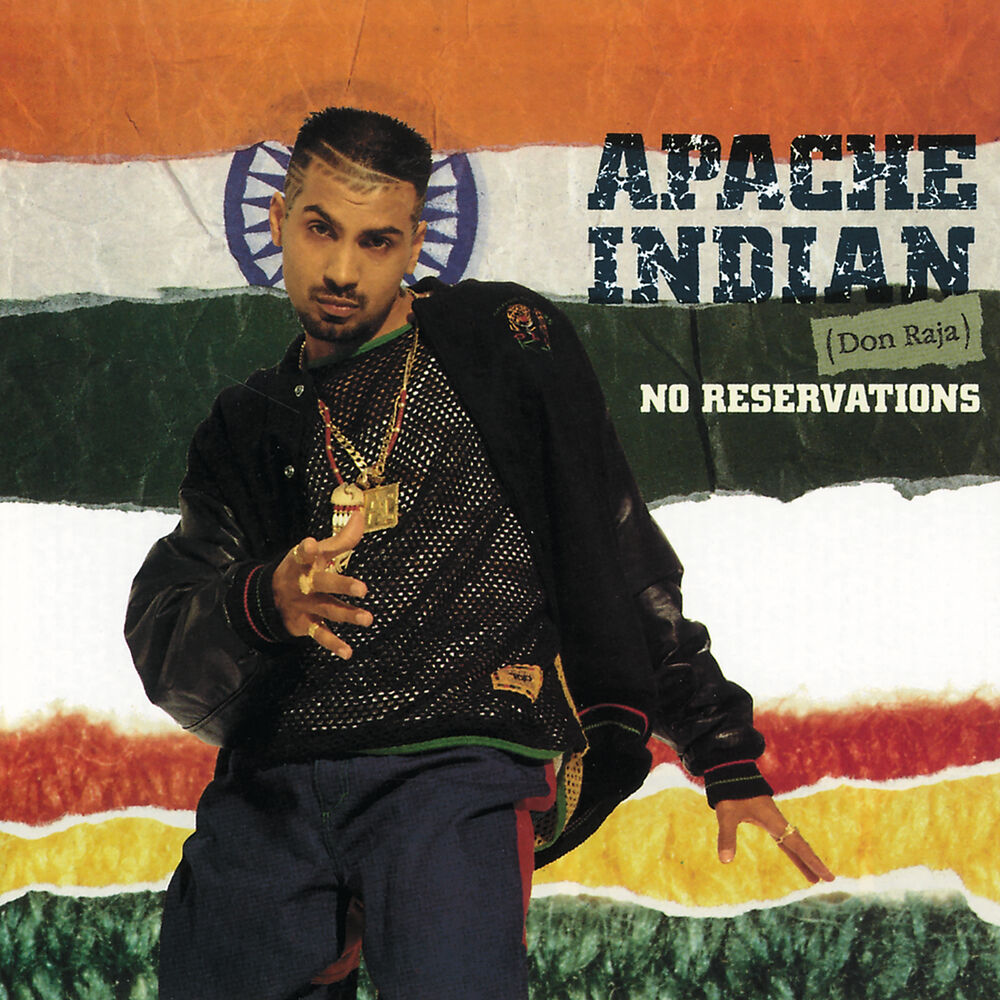
No Reservations
- Released31 October 2006
- UK peak No. 36
- Weeks on UK chart 2
- Entered UK chart 31 January 1993
- LabelUniversal-Island Records Ltd.
- Tracks15 · 61 min
One track from it charted as a single. Press a flag to play it in the chart where it peaked.
Tracks
| 1 | Don Raja (Prelude) | 0:23 | |
| 2 | Chokthere | 4:23 | |
| 3 | Fe Real | 5:03 | |
| 4 | Fix Up | 4:24 | |
| 5 | Aids Warning | 4:21 | |
| 6 | Guru | 3:47 | |
| 7 | Wan' Know Me | 4:07 | |
| 8 | Come Follow Me | 4:41 | |
| 9 | Don't Touch | 4:05 | |
| 10 | Arranged Marriage No. 16 · 1993 | 4:31 | |
| 11 | Drink Problems | 4:26 | |
| 12 | Movie Over India | 4:11 | |
| 13 | Magic Carpet | 3:59 | |
| 14 | Badd Indian | 4:33 | |
| 15 | Don Raja | 4:21 |
About the album
No Reservations is the debut studio album by British-Asian musician Apache Indian, released in January 1993 by Island Records and their subsidiary Mango. The musician and singer recorded the album primarily in Jamaica's Tuff Gong studios with producers including Simon and Diamond, Bobby Digital, Phil Chill and Sly Dunbar. It follows, and includes, Apache Indian's 1990–91 singles – "Move Over India", "Chok There" and "Don Raja" – which saw him pioneer a fusion of Jamaican ragga and Indian bhangra later known as bhangramuffin.
The album showcases Apache Indian's fusion of ragga and dancehall beats and basslines with bhangra and other forms of Indian music, such as filmi, with songs delivered in a fusion of English, Punjabi and Jamaican patois that the musician called "Indian patois". He sought to write about topics that were traditionally undiscussed in Asian communities, such as alcoholism, AIDS, the caste system and arranged marriages, and the controversial nature of the lyrics drew criticism and protest from castes. The singer named the record with reference to Indian reservations and is depicted on the artwork before a mixture of Jamaican and Indian iconography, reflecting his mix of musical styles.
On release, No Reservations drew acclaim from music critics, who saw its fusion of ragga and bhangra modes as innovative, and it reached number 36 on the UK Albums Chart.
Background
Born Steven Kapur to an Indian migrant family, Apache Indian was raised in Handsworth, a multiracial neighbourhood in Birmingham home to reggae bands Steel Pulse and UB40. He grew up enjoying roots reggae artists like Bob Marley and Burning Spear, and interest in reggae grew larger when introduced to sound system culture by a British-Caribbean man, Sheldon, who ran the local Siffa sound system. Kapur began chatting with numerous systems, and grew out dreadlocks in his teens. He later said he was the only Indian he knew who enjoyed reggae, saying "There was just something about the music. Regardless of what anybody said, it was for me." However, as Kapur would later explain, it was common for Asians in Birmingham to "[pick up] things from the black kids 'cus they're living together.
Recording
According to Apache Indian's manager, Mambo Sharma, "so much thought" went into recording No Reservations because, as the singer's debut album, it had to introduce listeners to his work effectively. Apache Indian travelled to Bob Marley's Tuff Gong Studios in Kingston, Jamaica, to record part of No Reservations. He collaborated with numerous reggae stalwarts, including Sly Dunbar, Robert Livingston and Bobby Digital, who all provided riddims for the album, as well as vocalists Frankie Paul and Maxi Priest. Most of the album, however, was produced by Simon & Diamond, with production credits for Phill Chill on "Fix Up", Bobby Digital on "Guru" and Dunbar on "Magic Carpet", with Livingston providing mixing and additional production on "Fix Up".
Music
On No Reservations, Apache Indian uses beats and basslines familiar to reggae and dancehall, incorporates styles and samples of bhangra, Hindi filmi music and Indian classical music to represent his Indian identity, and sings in a ragga style, resulting in what writer John Connell describes as "a contemporary Anglo-Indian fusion". Although described as primarily a bhangra album, critic Ken Hunt argues that the album is not bhangra itself but rather a "bhangra-related dance music." J. Poet of Trouser Press similarly felt the record to primarily showcase Kapur as a raggamuffin deejay, while Caroline Sullivan of The Guardian observed that Kapur uses Indian instruments and subject matter to flavour a "macho" ragga style derived from Super Cat. Apache Indian considered his style to be "first, and foremost, street music", explaining: "My stuff is all about the fusion of cultures and styles. I grew up with black and white people, my music is part of the people around me". The sounds of sitar and "hard-edged" tabla permeate the record.
Lyrics
The album's lyrics, written by Apache Indian, feature social commentary and themes of social realism. Colin Larkin wrote that the record moved Kapur "away from the frothier elements of his distinctive ragga-reggae and towards the role of social commentator and Anglo-Asian representative." The songs are "relevant to Indian youth identity in Britain," according to Connell, while writer Steve Tilley says they deal with concerns typical to Asian youth, and they discuss racism, AIDS, arranged marriages, divorce, alcoholism, drugs, the caste system and bridging black-Asian hostilities, often taking a cautionary stance. References to the Taj Mahal, Amritsar, Gandhi and Ravi Shankar also feature.
Many of the issues Kapur raises on the album were traditionally undiscussed within Asian communities, with the singer intending to discuss things "that haven't been talked about before". He commented that religious upbringing in Asian communities left numerous subjects "that need to be discussed among the Asian community – like arranged marriages, and AIDS...
Title and artwork
Described by author Rainer Emig as a punning statement on "segregation and integration", the title No Reservation references Indian reservations. This allusion to Native American culture is consistent with Kapur's stage name and the lyrics of songs "Fe Real" and "Badd Indian", as well as later album titles Make Way for the Indian (1995) and Wild East (1997). Natalie Sarrazin interprets the names Apache Indian and No Reservation as "signifying not only political resistance, but making light of the idea that all people of colour are lumped together in one category". George Lipsitz observed that due to Kapur's stage name and the album title, several listeners speculated that the singer was a Native American himself. Apache Indian recalled that his confluence of British, American and Native American cultures became "a problem" when No Reservations was released, as Native Americans "were fighting for no reservations at the time. But it was good in a kind of way because it helped the album.