Trespass
- Released17 March 1993
- UK peak No. 98
- Weeks on UK chart 1
- Entered UK chart 15 April 1984
- LabelUniversal Music Canada
- Tracks6 · 43 min
Tracks
| 1 | Looking For Someone (Album Version) | 7:06 | |
| 2 | White Mountain (Album Version) | 6:46 | |
| 3 | Visions Of Angels (Album Version) | 6:51 | |
| 4 | Stagnation (Album Version) | 8:45 | |
| 5 | Dusk (Album Version) | 4:15 | |
| 6 | The Knife (Album Version) | 8:55 |
About the album
Trespass is the second studio album by the English rock band Genesis. It was released on 23 October 1970 by Charisma Records, and is their last album with original guitarist Anthony Phillips and their only album with drummer John Mayhew.
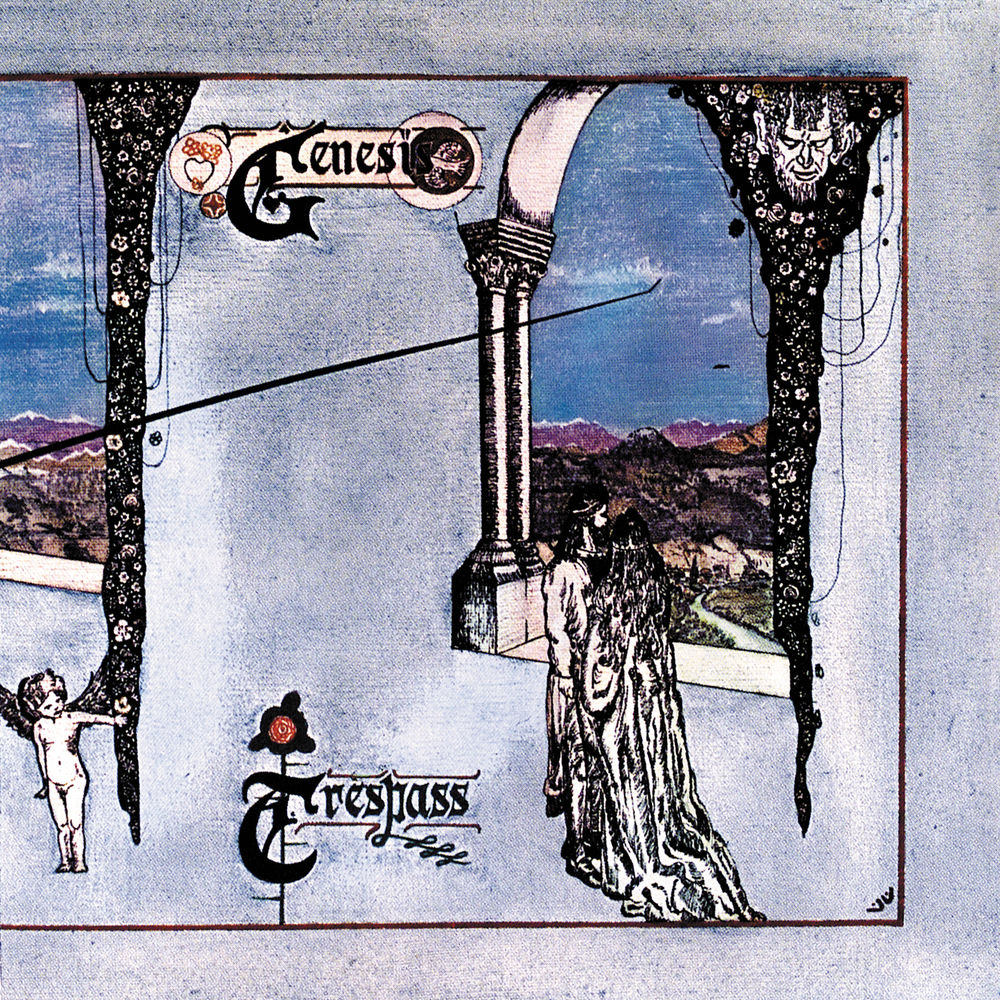
Genesis turned professional in autumn 1969, and began to rehearse intensely and play live shows. After several months of touring they secured a recording contract with Charisma Records, and entered Trident Studios in London in July 1970 to record Trespass. The music marked a departure from more pop-oriented songs, as displayed on their first album From Genesis to Revelation, towards folk-flavoured progressive rock. This ranged from light acoustic pieces with multiple twelve-string guitars such as "Dusk", to the heavier live favorite "The Knife". The sleeve, featuring a knife slash across the front, was designed by Paul Whitehead. It was the first of three covers designed by Whitehead for the band.
Shortly after recording, Phillips decided to leave the group, which almost caused Genesis to split. After discussing the situation, they agreed to continue, and replaced Mayhew with drummer and singer Phil Collins before they resumed touring.
Background and recording
In August 1969, Genesis decided to become a professional band. The founders – guitarist Anthony Phillips, bassist Mike Rutherford, vocalist and flautist Peter Gabriel, and keyboardist Tony Banks – had been joined by drummer John Silver. They split from producer Jonathan King and decided to write more complex material than the straightforward pop on their first album From Genesis to Revelation. Gabriel recalled that the group wanted to explore and mix musical styles. The group bought new equipment, including a bass guitar and a Hammond organ, and recorded songs at Regent Studios for a demo, including "White Mountain" and "Family" (which became "Dusk"). Silver then left to study in the US.
In November, Genesis played their first live shows as a professional band, touring the local university circuit, with new drummer John Mayhew. Mayhew, the oldest and most experienced musician, came from a different background from the rest of the band. Phillips recalled that, despite their efforts to make him feel comfortable, the drummer was unsure of his playing.
Artwork
The album cover was painted by Paul Whitehead and features an engraving by Hungarian illustrator Willy Pogany. Whitehead also did the covers for the band's next two albums. Wanting his work to represent the band's music, Whitehead sat in on several Genesis rehearsals to get inspiration. The cover showed two people looking out of a window at mountains, which represented the pastoral themes of some of the songs. Whitehead had finished the cover and then the band added "The Knife" to the running order. Feeling that the cover no longer fitted the mood of the album, they asked Whitehead to re-design it; when he was reluctant to do so, the band members inspired him to slash the canvas with an actual knife.
Tony Banks has said Trespass is his favorite of the three covers Whitehead did for Genesis, feeling it eloquently captured the two different sides of Genesis.
Whitehead's original illustrations for the three albums were stolen from the Charisma archives when it was sold to Virgin Records in 1983.
Release
Trespass was first released in the UK on the Charisma label in October 1970. In the US, it was first issued on ABC's jazz label, Impulse!. "The Knife" was released as single (split into two parts) in June 1971, but did not chart.
The album was reissued by the main ABC Records label in 1974; then, after MCA Records bought out ABC, it was reissued on the MCA label. It was issued on CD in 1994 as a definitive edition remaster. A SACD/DVD double disc set (including new 5.1 and Stereo mixes) was released in 2008.
Critical reception
Trespass sold 6,000 copies on its original release and helped the band build up a live following. The album charted at No. 1 in Belgium, which led to the band's first overseas concerts there in January 1971.
The album had a mixed reception by the music press at the time of its release. Jerry Gilbert, writing in Sounds, gave a positive review and singled out "Visions of Angels" and "White Mountain". A review in Melody Maker said the album was "tasteful, subtle and refined", and named it "Album of the Month", despite it being the same month as prestigious albums such as Led Zeppelin III, Atom Heart Mother, and Tumbleweed Connection. Rolling Stone printed an extremely brief but unambiguously negative review of the 1974 reissue, saying "It's spotty, poorly defined, at times innately boring, and should be avoided by all but the most rabid Genesis fans." AllMusic's later retrospective review was only slightly more forgiving, summarising that the album "is more interesting for what it points toward than what it actually does".
Aftermath
Shortly after recording Trespass, Phillips quit the group. He had confided in Rutherford (his long-time friend) that he was thinking of leaving after a concert at Kingston Polytechnic on 9 July 1970, and announced to the whole band that he was leaving at the end of a show in Haywards Heath on 18 July. According to Genesis road manager and friend Richard Macphail, the reason for Phillips's departure was the onset of acute stage fright that became so severe that Phillips began to suffer an "out of body experience on stage". Phillips confirmed, "My leaving was nothing to do with the music; it was just due to stage fright and my health, really." He initially feared that Genesis would not be able to continue without him, but with Banks gaining confidence with the organ and Rutherford having grown into a major songwriter, he ultimately recognized that the band no longer needed him.