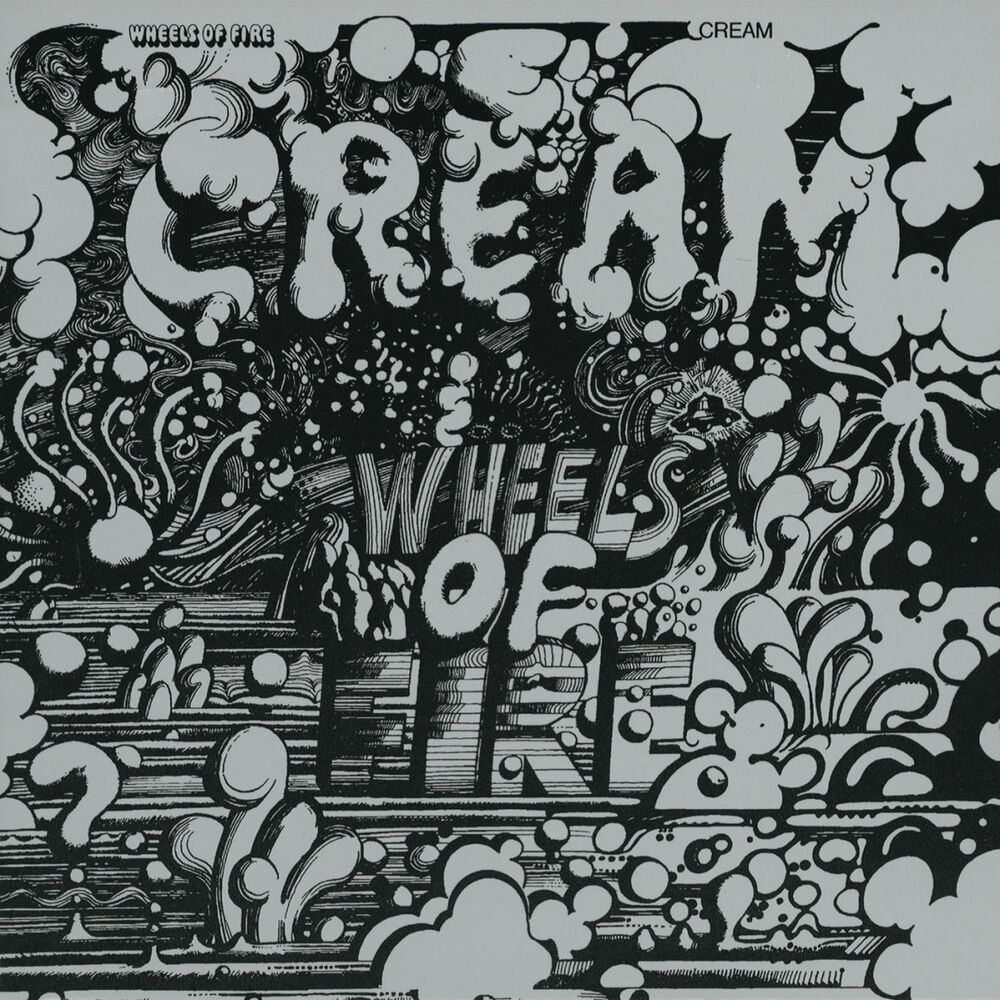
Wheels Of Fire
- Released2 March 1998
- UK peak No. 3
- Weeks on UK chart 26
- Entered UK chart 11 August 1968
- LabelPolydor Records
- Tracks13 · 80 min
2 tracks from it charted as singles. Press a flag to play it in the chart where it peaked.
Tracks
| 1 | 4:56 | ||
| 2 | Sitting On Top Of The World | 4:56 | |
| 3 | Passing The Time | 4:31 | |
| 4 | As You Said | 4:19 | |
| 5 | Pressed Rat And Warthog | 3:13 | |
| 6 | Politician | 4:11 | |
| 7 | Those Were The Days | 2:52 | |
| 8 | Born Under A Bad Sign | 3:08 | |
| 9 | Deserted Cities Of The Heart | 3:37 | |
| 10 | Crossroads (Live) No. 28 · 1969 | 4:18 | |
| 11 | Spoonful (Live) | 16:44 | |
| 12 | Traintime (Live) | 7:02 | |
| 13 | Toad (Live) | 16:15 |
About the album
Wheels of Fire is the third album by the British rock band Cream. It was released in the US on 14 June 1968 as a two-disc vinyl LP, with one disc recorded in the studio and the other recorded live. It was released in the UK in the same format on 9 August.
Background and recording
Cream's third album was planned to be a double album which would include several live performances. Unlike Disraeli Gears, which had been recorded in a matter of days, the Wheels of Fire sessions took place in small bursts over nearly a year. The recording engineers on disc one were Tom Dowd and Adrian Barber. The live performances on disc two were recorded by Bill Halverson and mixed by Adrian Barber.
Sessions with producer Felix Pappalardi began in July and August 1967 at IBC Studios in London, months before the release of Disraeli Gears, with the basic tracks for "White Room", "Sitting on Top of the World", and "Born Under a Bad Sign" put to tape. Jack Bruce expressed the band's preference for working with Pappalardi and Dowd, as well as the new unhurried atmosphere contrasted with the first two albums: "We're all temperamental but Tom...and Felix manage to get rid of that temperament...We spend a long time in the studio, so we don't have to rush. We usually talk for hours before we record anything, then we play, think and add sounds".
Composition and music
The band's drummer Ginger Baker co-wrote three songs for the album ("Passing the Time", "Pressed Rat and Warthog", and "Those Were the Days") with jazz pianist Mike Taylor. Baker later admitted that "Pressed Rat and Warthog" was an inside joke, based on the bawdy imagery referred to by its title. Bassist Jack Bruce co-wrote four songs with poet Pete Brown including "White Room", "As You Said" (the only Cream recording which does not feature Clapton), "Politician" and "Deserted Cities of the Heart". In an interview, Pete Brown revealed that the lyrics to "White Room" were condensed from an eight page poem he had written when he moved into a new white-walled apartment room with bare furnishings, where he gave up drinking and drugs. "Politician" came together quickly for a January 1968 BBC radio session when, needing one more track, Bruce came up with a riff which Brown, who was present in the studio, thought was perfect to match with lines of a poem he'd written several years earlier; the song was finished and recorded for broadcast that day.
Artwork
The artwork for the album was by Martin Sharp, who had co-written "Tales of Brave Ulysses" and "Anyone for Tennis" with Clapton and also done the artwork for Disraeli Gears. The front and back covers consisted of a silver-grey psychedelic drawing, with the inner gatefold consisting of a similar drawing, only in Day-Glo colors of orange, green, pink and yellow. The photography was by Jim Marshall.
Release and promotion
Wheels of Fire was released by Atco in the US on June 14, 1968, with a UK release on Polydor following on August 9. It was an instant blockbuster success, charting at No. 3 in the United Kingdom and No. 1 in the United States, Canada and Australia, becoming the world's first platinum-selling double album. The album's release, however, was accompanied by an announcement on July 10 that the band was going to split up by the end of the year, citing a loss of direction.
The album was also released as two single LPs, Wheels of Fire (In the Studio) and Wheels of Fire (Live at the Fillmore), with similar cover art. In the UK the studio album art was black print on aluminum foil, while the live album art was a negative image of the studio cover; In the Studio charted as high as No. 7 in that country, although it possibly took from sales of the double disc set. In Japan, the studio album art was black on gold foil, while the live album art was black on aluminium foil. In Australia, both covers were laminated copies of the Japanese releases.
Reception and legacy
In England, critical reception to the album was highly positive. In a lengthy review, Chris Welch of Melody Maker began by noting "If Cream have been disappointing on record in the past ... their long awaited double album is sufficient to restore the faith of the most errant disciple", praising the group's taste and restraint on tracks like "As You Said" and enthusing that the live disc was "electrifying". Record Mirror said the record should be subtitled "to remind us of all that was best about the Cream live and in the studio", concluding that as the band wouldn't be around for much longer, it was a must for everyone's collection. Disc & Music Echo labelled it "Best LP of the month" and "a fitting--at times superb--memorial to Britain's best live group" with the best material they had put on record.