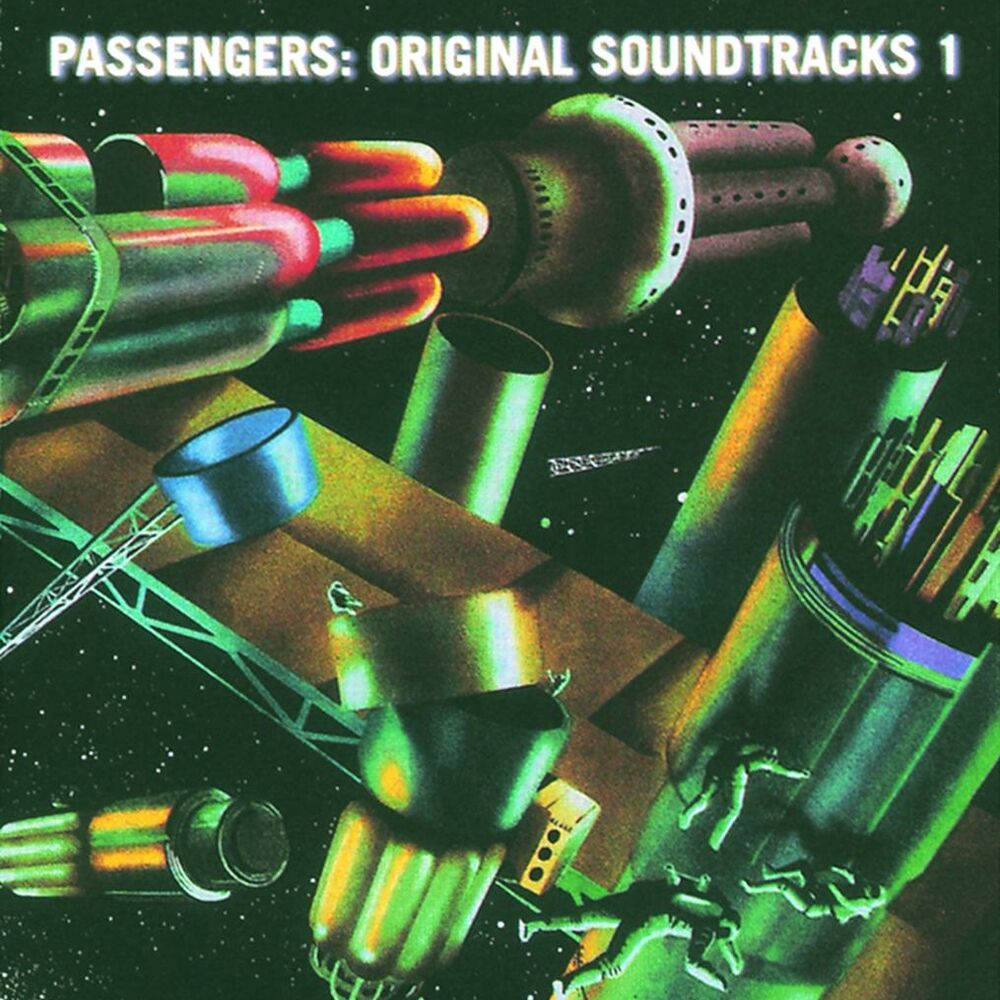
Original Soundtracks 1
- Released1 January 1995
- UK peak No. 12
- Weeks on UK chart 8
- Entered UK chart 12 November 1995
- LabelUMC (Universal Music Catalogue)
- Tracks14 · 58 min
One track from it charted as a single. Press a flag to play it in the chart where it peaked.
Tracks
| 1 | United Colours | 5:31 | |
| 2 | Slug | 4:41 | |
| 3 | Your Blue Room (From 'Beyond The Clouds') | 5:28 | |
| 4 | Always Forever Now | 6:24 | |
| 5 | A Different Kind Of Blue | 2:02 | |
| 6 | Beach Sequence | 3:32 | |
| 7 | Miss Sarajevo No. 6 · 1995 | 5:40 | |
| 8 | Ito Okashi | 3:25 | |
| 9 | One Minute Warning | 4:40 | |
| 10 | Corpse (These Chains Are Way Too Long) | 3:35 | |
| 11 | Elvis Ate America | 2:59 | |
| 12 | Plot 180 | 3:41 | |
| 13 | Theme From The Swan | 3:24 | |
| 14 | Theme From Let's Go Native | 3:07 |
About the album
Original Soundtracks 1 is a studio album recorded by the Irish rock band U2 and English producer Brian Eno as a side project under the pseudonym Passengers. Released on 6 November 1995, the album is a collection of songs written for mostly imaginary films (the exceptions being songs for Ghost in the Shell, Miss Sarajevo, and Beyond the Clouds). Owing to Eno's involvement as a full songwriting partner and the album's experimental nature, the moniker "Passengers" was chosen to distinguish it from U2's conventional albums, as it featured a far more electronic-heavy, stripped-back post-rock sound that contrasted heavily with the grander music they were usually known for. It was commercially unnoticed by the band's standards and received generally mixed reviews. Guest musicians on the record included Italian opera singer Luciano Pavarotti (on "Miss Sarajevo") and producer Howie B (on "Elvis Ate America"), who would co-produce U2's following album, Pop (1997). The art-pop single Miss Sarajevo, featuring Luciano Pavarotti, did rather successfully upon release.
Background
According to the producer Brian Eno, near the end of the recording sessions for U2's 1993 album Zooropa, the band hit "a stone wall" and were getting obsessive about small details. At that point, Eno suggested the group do some improvisation, "just turn the tape on and play, so we were working with a broad brush rather than the one-hair brushes we'd been using. It was designed to open us up a little". The resulting recording sessions were productive enough that Eno advocated the band undertake more.
Writing and recording
After U2 completed their Zoo TV Tour in December 1993, the band returned to the studio with no particular agenda or project on which to work. Their original intention was to record a soundtrack for Peter Greenaway's 1996 film The Pillow Book. Although the plan did not come to fruition, Eno suggested they continue recording music suitable for film soundtracks, as he did with his Music for Films album series. At the time, the U.S. charts were dominated by movie soundtrack albums and singles. Once Eno pointed out that the project would not be a real ploy for radio airplay but rather a spoof of one, U2 agreed to the concept.
Recording sessions for Original Soundtracks 1 began with a two-week session in November 1994 at Westside Studios in London, and continued for another five weeks in mid-1995 at Hanover Quay Studios in Dublin. Lead vocalist Bono felt that the visual suggestion from the music was more important than the story told by the lyrics, so the band tried to create visual music when recording.
Composition
About half of the album is instrumental, and the vocal tracks depart from U2’s typical style, taking a more experimental approach. While melodic elements are still present, the overall sound differs from the band’s usual work. “Miss Sarajevo,” featuring Italian tenor Luciano Pavarotti, has been noted as a standout track.
One of the tracks, "Your Blue Room", features Adam Clayton reciting the final verse. This marks only his second recorded vocal on a U2 project, the first being on "Endless Deep", the B-side to 1983's "Two Hearts Beat as One".
The album alleges to be a collection of songs written for movies, hence the title Original Soundtracks. The album's booklet contains detailed descriptions of the film for which each song was written.
Release and promotion
"Miss Sarajevo" was released as a successful single, competing in the UK for the 1995 Christmas number 1 spot but ultimately losing to Michael Jackson's "Earth Song", however; it also later appeared on U2's The Best of 1990–2000 compilation in 2002. "Your Blue Room" was intended for the second single following "Miss Sarajevo," but was cancelled after poor album sales. The song was later released as a B-side on the "Staring at the Sun" single in 1997, and on the B-sides disc of The Best of 1990–2000.
The Japanese edition release include "Bottoms (Watashitachi No Ookina Yume) (Zoo Station Remix)" as a bonus track, which is also featured as B-side to the "Miss Sarajevo" single. The track is an instrumental version of the U2 song "Zoo Station", which appears on 1991's Achtung Baby. The Japanese subtitle "Watashitachi No Ookina Yume" translates to English as "our big dream." Some UK promo copies of the album list "Bottoms" as well but the track is not actually present on the compact disc.
For Record Store Day 2025, the album was reissued as a two-disc vinyl LP for its 30th anniversary.
Reception
Because of the nature of the music and the decision to release it under another name, the album is easily the least-known and poorest-selling in the U2 catalogue. Further, critical reaction from the fans and even the band members has been mixed. Spin wrote that the album came as a "treat to Brian Eno fans" and as a "shock to U2 fans", only furthering the experimentation that was present on Zooropa into something that was U2's "most ambient and minimalistic work to date". Drummer Larry Mullen Jr. stated: "There's a thin line between interesting music and self-indulgence. We crossed it on the Passengers record." Later reflecting on the album in 2002, Mullen stated, "It hasn't grown on me. However, 'Miss Sarajevo' is a classic." Bono objected to Mullen's statement in the same documentary, claiming that "Larry just didn't like [Passengers] because we didn't let him play the drums."
However, despite the poor commercial performance of the album, it quickly became a cult classic, with many appreciating the ambient, ethereal sound of the album.