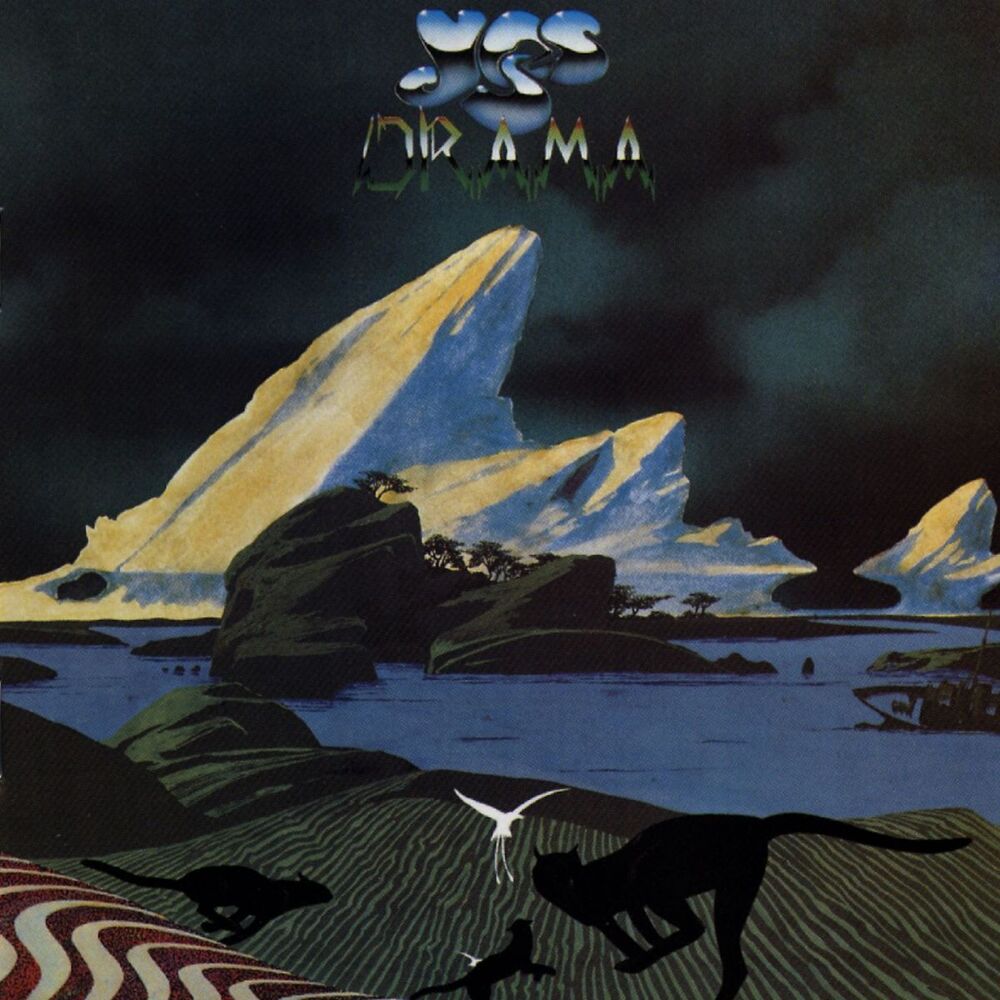
Drama
- Released22 August 1980
- UK peak No. 2
- Weeks on UK chart 8
- Entered UK chart 24 August 1980
- LabelRhino/Elektra
- Tracks6 · 37 min
Tracks
| 1 | Machine Messiah (2008 Remaster) | 10:27 | |
| 2 | Man in a White Car (2008 Remaster) | 1:21 | |
| 3 | Does it Really Happen (2008 Remaster) | 6:35 | |
| 4 | Into the Lens (2008 Remaster) | 8:32 | |
| 5 | Run Through the Light (2008 Remaster) | 4:42 | |
| 6 | Tempus Fugit (2008 Remaster) | 5:21 |
About the album
Drama is the tenth studio album by the English progressive rock band Yes, released on 22 August 1980 by Atlantic Records. The album is the band's only original studio release to feature singer Trevor Horn on lead vocals and marks the debut of keyboardist Geoff Downes. This major line-up alteration followed the sudden departures of long-time frontman Jon Anderson and keyboardist Rick Wakeman after aborted recording sessions in Paris and London failed to materialise into a new album. Because a concert tour had been booked prior to the personnel changes, the new line-up recorded Drama hurriedly at Townhouse Studios alongside initial tracking producer Eddy Offord, who also exited the project under fraught circumstances early on.
Musically, the album marked a significant stylistic evolution for Yes, blending the group's signature complex progressive rock structures with the sharp, electronic-driven new wave and synth-pop sensibilities popularised by Horn and Downes as members of The Buggles. The resulting material showcased a noticeably heavier and harder rock sound than the band's 1970s outputs, highlighted by the tracks "Machine Messiah" and "Tempus Fugit".
Background
In June 1979, the Yes line-up of Jon Anderson, Chris Squire, Steve Howe, Rick Wakeman, and Alan White completed their 1978–1979 tour in support of Tormato (1978). The five members reconvened in November 1979 to begin work on a follow-up album. Seeking to address the production issues faced during the Tormato sessions, Yes chose to record in Paris and hired producer Roy Thomas Baker to oversee the project. While Anderson and Wakeman entered the sessions enthusiastically and collaborated closely on material, the rest of the band felt the compositions were too light and folk-oriented. Consequently, Squire, Howe, and White began developing heavier, more direct arrangements. The growing internal differences—described by Anderson as a "loss of respect for each other"—led to Squire, Howe, White, and Baker arriving late to sessions. This discouraged Anderson and Wakeman; the latter occasionally refused to leave his hotel room to rehearse.
Recording
Drama was recorded over approximately three months at Townhouse Studios in London, with additional tracking split across several locations. The band members were credited collectively as producers, with Hugh Padgham handling the primary engineering duties at the Townhouse, while Gary Langan and Julian Mendelsohn served as recording engineers for sessions at Sarm East Studios. Howe independently recorded his parts over a two-week period, assisted by engineer Pete Schwier at RAK Studios and Ashley Howe at Roundhouse Recording Studios, while the remaining instrumentation was tracked at Townhouse and Sarm East. Howe recalled that he exercised complete creative freedom during his sessions, recording most of his parts alone and successfully resisting requests from other band members to alter his bright, treble-heavy guitar tones.
Initial tracking sessions originally began with Eddy Offord, who had served as the band's primary engineer and producer between 1971 and 1975. However, his tenure was cut short due to increasingly erratic behavior.
Artwork
The album's sleeve was designed and illustrated by Roger Dean, marking his first new artwork for a Yes release since the compilation album Yesterdays (1975). After being informed of the album's title prior to starting his work, Dean adopted what he described as an "intuitive approach" to the design process. Rather than relying on the overt fantasy and mysticism that characterized his previous pieces, he made a conscious effort to focus on elements found in reality, stating that he avoided creating things "that you couldn't see in the world today ... it's not in any degree fantastic." Dean sought to capture a dramatic, storm-driven sky to allow "the light playing across the landscape, so there were some bits that jumped out and very stark and bright, and other bits that are very dark—black on dark grey." He summarised that the final cover included a high density of visual components that ultimately blended together through a combination of his artistic training and good fortune. Reflecting on the sleeve painting, Dean noted it as one of his favourite personal designs.
Release
Drama was released in August 1980. It reached No. 2 in the UK and No. 18 in the US, the band's lowest charting studio release in the US since The Yes Album (1971), which peaked at No. 40. "Into the Lens" was released as the album's sole single in 1980. The band shot music videos for "Into the Lens" and "Tempus Fugit"; both of them mimed live performances with minimal visual effects.
The album has been reissued several times; the first was in 1994 by Atlantic Records. In 2004, Rhino Records issued a remastered edition with several previously unreleased tracks, including some from the band's sessions from Paris in late 1979.
Critical reception
Upon release, Drama received generally positive reviews from national music critics, many of whom focused on how the new line-up maintained the band's established sound. Robin Denselow of The Guardian wrote that Horn's lyrics were tougher than Anderson's "distinctive ramblings on the mystic fringe", praising "Machine Messiah" and "Into the Lens" as standout tracks that gave the record its distinctive identity. Writing for The New York Times, Bill Carlton observed that Yes "didn't take any chances alienating the faithful" with an overt new wave or punk direction, describing the material as "more like Yes than Yes." Carlton added that the album was "full of their tried-and-true brew of orchestral, dramatic, art-rock extrapolations" while selecting "Tempus Fugit" as his personal favorite.
Aftermath
Following the conclusion of the tour, Yes officially disbanded in early 1981. Horn subsequently pivoted toward a full-time career in record production, which eventually led to him producing the band's major commercial comeback album, 90125 (1983). Concurrently, Howe and Downes collaborated to co-found the commercially successful supergroup Asia.
Yes did not perform any material from Drama live for nearly three decades, avoiding the tracks entirely until Anderson permanently departed the touring group in 2008. For their 2016 European tour, the band revived the album to perform it live in its entirety for the first time, matching the original LP track listing order. During the Oxford and London dates of the tour, Horn joined the band on stage at the Royal Albert Hall as a guest performer to sing lead vocals on "Tempus Fugit".