2 tracks from it charted as singles. Press a flag to play it in the chart where it peaked.
Tracks
| 1 | Nights Interlude | 3:24 | |
| 2 | A Case Of Funk | 5:21 | |
| 3 | Coming Down | 5:15 | |
| 4 | Stop (Crack) | 0:44 | |
| 5 | Biofeedback | 5:24 | |
| 6 | Mega Donutz | 5:11 | |
| 7 | Playtime | 4:26 | |
| 8 | Aftermath No. 38 · 1990 | 5:58 | |
| 9 | Fun | 4:13 | |
| 10 | Back Into Time | 4:39 | |
| 11 | Dextrous No. 91 · 1990 | 4:04 | |
| 12 | BWTM | 2:19 | |
| 13 | Sal Batardes | 6:03 | |
| 14 | E.A.S.E. | 2:59 | |
| 15 | How Ya Doin | 3:13 |
About the album
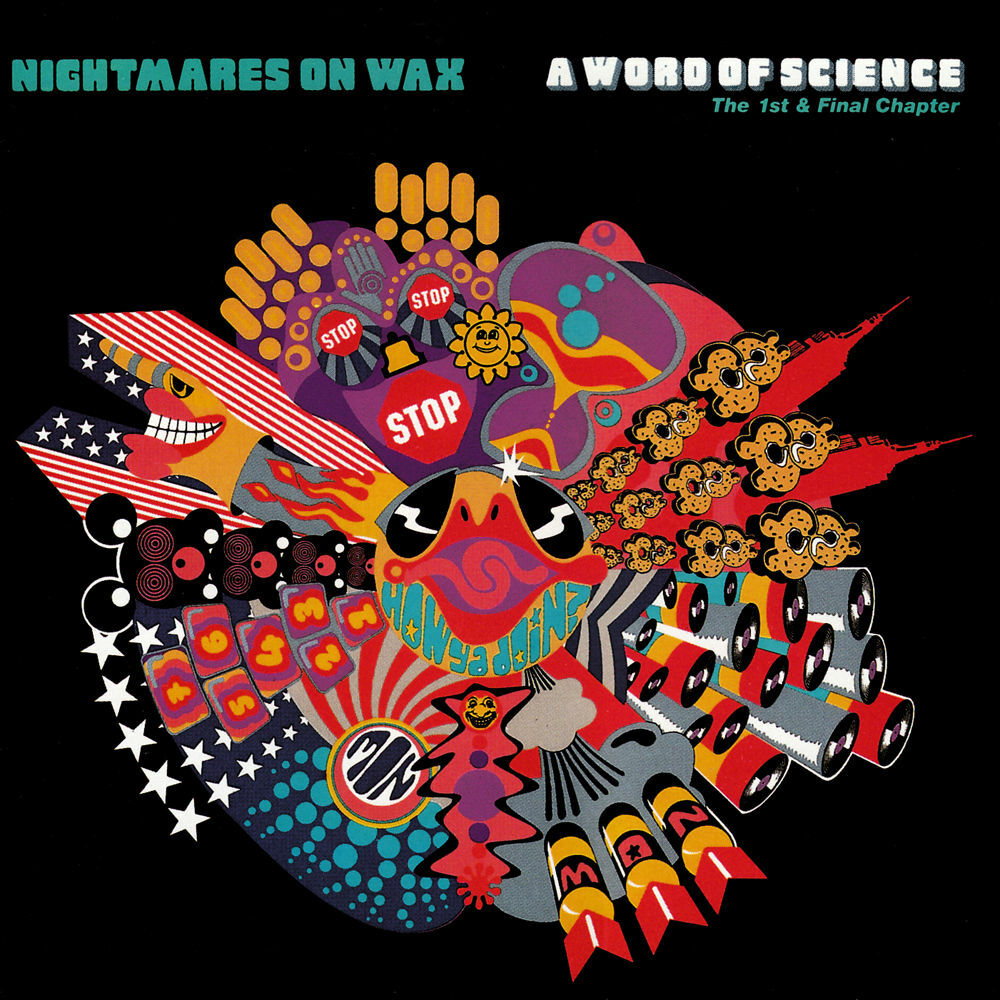
A Word of Science (subtitled The First and Final Chapter) is the debut studio album by British electronic producers Nightmares on Wax. Released by Warp Records in September 1991, it is the act's only album as a group before it became a solo vehicle for George Evelyn. Evelyn nonetheless recorded and produced the album alone, incorporating samples and elements from demo tapes he made in the late 1980s. Although Nightmares on Wax debuted with two well-received techno singles in 1989-1990, A Word of Science is eclectic and largely moves the act towards a more mellow style influenced by funk, soul and hip hop, while still incorporating techno, drum and bass, and house styles.
Upon release, A Word of Science failed to chart, but received acclaim for its fusion of disparate styles, despite alienating several listeners expecting more of the group's straightforward techno style. The album has gone on to be considered an important blueprint for the trip hop and downtempo genres that emerged in the 1990s, as well as an important milestone in electronic music intended for home listening.
Background and production
Nightmares on Wax formed in the late 1980s as a DJ-based rave act inspired by hip hop. They were originally an extension of group leader George Evelyn's b-boy crew the Soul City Rockers, and featured Kevin "Boywonder" Harper. The act's first singles, "Dextrous" and "Aftermath", were highly regarded. Both released on Warp Records, the former reached number 91 on the UK Singles Chart in December 1989, whereas the latter reached number 38 in November 1990. "Aftermath" was hailed as one of the finest examples of the propulsive style of techno recorded for Warp by Yorkshire-based acts, alongside material by LFO, Sweet Exorcist and Rob Gordon. The style became known as "Yorkshire bleep," and the single is today regarded as "an iconic British chart hit."
A Word of Science was Nightmares on Wax's first album.
Composition
A Word of Science largely abandons the "bleeps and clonks" of the group's previous material in favour of mellow grooves influenced by 1970s funk, resulting in a combination of soul, funk and hip hop. Nonetheless, the group's dark, bleep techno origins surface on the bass-heavy "A Case of Funk" and the reused singles "Aftermath" and "Dextrous." Writer John Bush writes that the other tracks "expand the sound of bleep into several intriguing directions." According to Andrew Harrison of Select, the album maintains the minimalist aspect of the group's "Brit-techno" but enriches it with the funk elements and "a perverse sense of what's now possible." According to AllMusic's Sean Cooper, the record bridges electro, New York house, acid house, Detroit techno, London rave and soul with "the burgeoning eclecticism of the years to come." The record regularly changes between musical styles and tempos, and also features a heavy emphasis on bass. Although regarded as a techno album, the sound of A Word of Science has been described as a precursor to trip hop music.
Release and reception
A Word of Science was released by Warp Records on 16 September 1991, with packaging designed by The Designer's Republic. Despite not entering the UK Albums Chart, the album was nonetheless deemed successful, and received critical acclaim for its fusion of funk, soul and hip hop. It nonetheless puzzled listeners expecting more straightforward dance music like the project's prior singles. In a contemporary review, Andrew Harrison of Select warned fans of the group's "post-Northern techno house" that the album was "about as far as you can get from the muddying techno without selling your sampler." Although he found the album to be "patchy," deriding the rap songs "Mega Donutz" and "How You Doin'", he praised how the record saw Nightmares on Wax join labelmates LFO in moving techno in "another whiplash-inducing tangent."
In a retrospective review, John Bush of AllMusic wrote that A Word of Science "rivalled any other techno debuts of the time, excepting only its immediate predecessor in the Warp catalog -- LFO's Frequencies (1991)".
Legacy
A Word of Science earned Nightmares on Wax a reputation among techno's forward-looking innovators, and is widely regarded as creating a blueprint for 1990s trip hop music in its combination of stark rhythms with funk and hip hop rhythms. The experimental-styled downtempo hip hop and electro funk of Mike Paradinas, Spacer, Luke Vibert and others have been described by Cooper as descendants of A Word of Science. Vibe contributor Aidin Vaziri regards the album as a landmark release that "changed the face of downtempo electronica," while The Fader describes the record as a "tripped-out" precursor to the "downtempo eclecticism" characteristic of record labels Mo'Wax and Ninja Tune. Colin Helms of CMJ New Music Monthly considers the album innovative for its "hip-hop-by-way-of-techno" style.