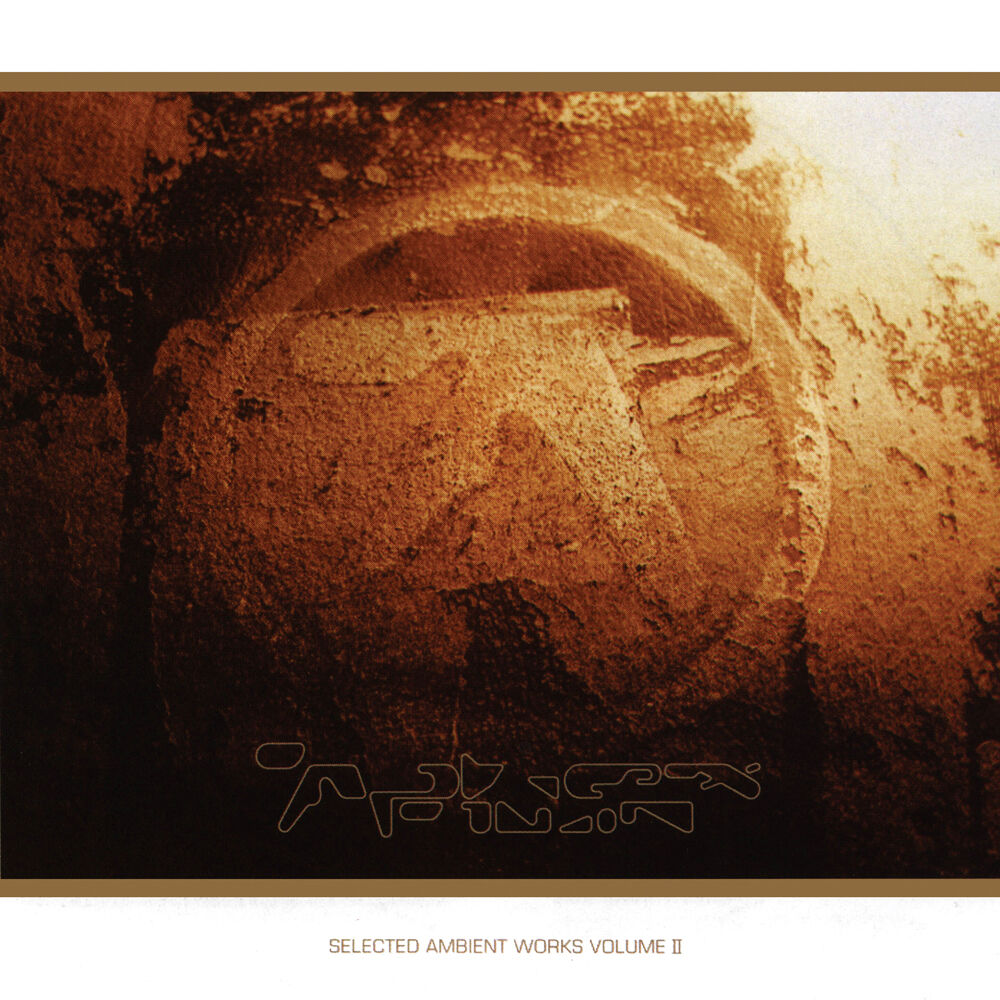
Selected Ambient Works Volume II
- Released7 March 1994
- UK peak No. 11
- Weeks on UK chart 3
- Entered UK chart 13 March 1994
- LabelWarp Records
- Tracks24 · 157 min
Tracks
| 1 | #1 | 7:27 | |
| 2 | #2 | 6:34 | |
| 3 | #3 | 7:44 | |
| 4 | #4 | 4:39 | |
| 5 | #5 | 8:55 | |
| 6 | #6 | 3:31 | |
| 7 | #7 | 8:51 | |
| 8 | #8 | 5:08 | |
| 9 | #9 | 6:54 | |
| 10 | #10 | 9:58 | |
| 11 | #11 | 7:18 | |
| 12 | #12 | 2:42 | |
| 13 | #13 | 7:20 | |
| 14 | #14 | 8:00 | |
| 15 | #15 | 5:34 | |
| 16 | #16 | 4:45 | |
| 17 | #17 | 2:05 | |
| 18 | #18 | 7:16 | |
| 19 | #19 | 5:57 | |
| 20 | #20 | 4:15 | |
| 21 | #21 | 7:09 | |
| 22 | #22 | 7:30 | |
| 23 | #23 | 11:27 | |
| 24 | #24 | 5:41 |
About the album
Selected Ambient Works Volume II (abbreviated as SAW II) is a studio album by the British electronic music artist and producer Aphex Twin. It was released on 7 March 1994 through Warp Records. Its title follows James's ambient techno debut Selected Ambient Works 85–92, but Volume II largely features purely ambient music. James was inspired by lucid dreaming and likened the album to "standing in a power station on acid." Most of the tracks on Selected Ambient Works Volume II were untitled and represented with abstract photographs and pie charts. Fan-named, unofficial titles are still widely used today.
The record entered the CIN's Dance Albums Chart at No. 1 and the Albums Chart at No. 11. The album had a polarised reception from critics upon release. Contemporary critical reviews focus on its largely beatless composition and the repetition throughout. Retrospective reviews of the album are positive, and have described its major role in the evolution of ambient music and electronica. In 2016, Pitchfork picked Selected Ambient Works Volume II as the second greatest ambient album of all time, after Brian Eno's Ambient 1: Music for Airports. A remastered and expanded reissue of the album was released in October 2024 with two bonus tracks.
Background
Richard D. James, known professionally as Aphex Twin, is an electronic music producer from Cornwall. After his first release, the 1991 acid techno EP Analogue Bubblebath, his first studio album, Selected Ambient Works 85–92, released to critical acclaim in 1992 with R&S Records. The ambient techno album was a defining factor in the evolution of electronic music and immediately garnered James an underground following. Arriving at the peak of the "house explosion", the album was in contrast to the era's "hardcore" and "aggressive" electronica and "proved that techno could be more than druggy dance music". James signed with Warp Records, where he released albums such as Surfing on Sine Waves under different aliases. He also pursued his own record label, Rephlex Records. James's EP, On, directly preceded Volume II's release.
Recording and composition
James's enigmatic persona, marked by reticent interviews and outlandish, unverifiable claims, has deepened the mystique around his life and music and blurred facts about his recording process with fiction. James has stated that most of Selected Ambient Works Volume II had been recorded in 1993, a year before the album's official release, in his London and Cornwall home studios. The track "Blue Calx" was recorded sometime between 1988 and 1990; James has said that it was the last he recorded in his older Cornwall home studio at his parents' house, during a visit back from his studies at Cornwall College. His North London home studio, built in 1993, contained a variety of old EMS, Moog, ARP, and Oberheim Matrix synthesizers. James once specified that track 23 ("Tassels") had been recorded with an EMS Synthi A Mk1 and a Studiomaster Star System. A Yamaha CS-5 was also used in the recording of the album, and was later auctioned with the album's liner notes inscribed.
Volume II differs significantly from Selected Ambient Works 85–92.
Artwork
The artwork for the album was designed by Paul Nicholson, who was credited as Prototype 21 in the liner notes.
Most of the tracks on Volume II were not given official titles; rather, each track was instead represented by a photograph in the album's artwork. Nicholson stated in an interview with Resident Advisor that the photographs were taken by James's girlfriend at the time, known only as "Sam", and that most of the photographs were taken in a flat that all three were living in together. According to James, the reason for tracks remaining untitled was due to his synesthesia. Rather than trying to affix tracks with titles, James would opt to identify each composition with colour instead; this was reflected within the artwork.
While most of the tracks were officially untitled, unofficial titles created by fan Greg Eden were adapted and are widely used today. These fan titles were derived from the photography seen throughout the record. Eden simply "wrote what the pictures looked like" with little hesitation, i.e., all within a few minutes, and no additional contemplation.
Release
Warp released Selected Ambient Works Volume II on double CD, double cassette and triple LP on 7 March 1994 in the United Kingdom, followed by 12 April on double CD through Sire in Australia, Japan and the United States. The 19th track is omitted from all versions of the original release's CD pressings due to space limitations. It entered the CIN's Dance Albums Chart at No. 1 and remained in the top five for six weeks. It entered the Albums Chart at No. 11. By July 1994 the album had sold more than 60,000 copies outside the United States.
Before its release on Volume II, the track "Blue Calx" had been featured on a 1992 compilation titled The Philosophy of Sound and Machine, published by Rephlex Records. An original version of track 2 ("Radiator") with added percussion was released as a part of 26 Mixes for Cash, under the title of "SAW2 CD1 TRK2, Original Mix". The track was later officially named "Radiator (Original Mix)" within Peel Session 2.
On 6 March 2012 Selected Ambient Works Volume II was reissued on vinyl by record label 1972 Records.
Reception
Volume II received mixed reviews from critics upon release. Spin gave the album a positive review, with critic Simon Reynolds acknowledging the album's "euphoric" and "majestically melancholy" tracks, but also describing the album's eerie aspect and that it could leave listeners "spooked out". Rolling Stone's Jon Wiederhorn wrote about how artists similar to James in sound had been producing music that lacked emotion akin to elevator music, while James was able to use the ambient genre to explore "spooky, textured sound" and to confront his "shadowy demons". Wiederhorn concluded that the album played a significant part in the evolution of ambient electronic music. Clark Collis of Select pointed out how listeners expecting an album in the style of Selected Ambient Works 85–92 would be surprised due to Volume II's beatless structure. Collis noted the album did not give into typical conventions of electronica, but worked well as an ambient album and was a record that required attention from the listener.
Other reviews were less favourable.