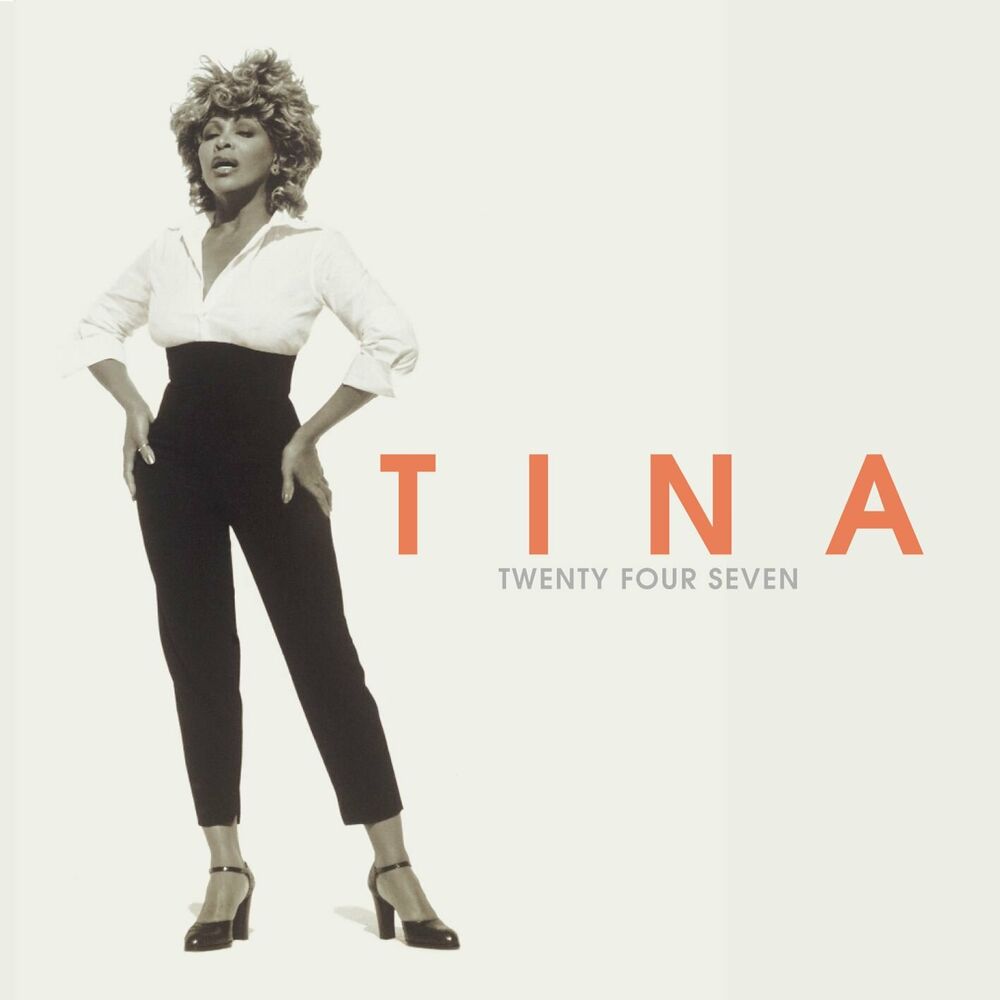
Twenty Four Seven
- Released1 November 1999
- UK peak No. 9
- Weeks on UK chart 21
- Entered UK chart 7 November 1999
- LabelParlophone UK
- Tracks11 · 47 min
2 tracks from it charted as singles. Press a flag to play it in the chart where it peaked.
Tracks
| 1 | Whatever You Need No. 27 · 2000 | 4:48 | |
| 2 | All the Woman | 4:03 | |
| 3 | When the Heartache Is Over No. 10 · 1999 | 3:45 | |
| 4 | Absolutely Nothing's Changed | 3:43 | |
| 5 | Talk to My Heart | 5:08 | |
| 6 | Don't Leave Me This Way | 4:19 | |
| 7 | Go Ahead | 4:20 | |
| 8 | Without You | 4:06 | |
| 9 | Falling | 4:21 | |
| 10 | I Will Be There | 4:37 | |
| 11 | Twenty Four Seven | 3:47 |
About the album
Twenty Four Seven is the ninth and final solo studio album by singer Tina Turner. First released by Parlophone in Europe in October 1999, it received a North American release through Virgin Records in February 2000. As with her previous album Wildest Dreams (1996), Turner worked with a small team of British producers on the album, including Mark Taylor, Brian Rawling, Johnny Douglas, Terry Britten and production team Absolute. Singer Bryan Adams appears on both the title track and "Without You".
The album received a mixed reception from music critics, many of whom praised Turner's vocal performance but found the material too formulaic. A commercial success, it topped the albums charts in Switzerland and reached the top ten on most of the charts it appeared on. In the United States, Twenty Four Seven scored Turner her biggest first week sales by then. Lead single "When the Heartache Is Over" became a top-ten dance hit, while the Twenty Four Seven Tour emerged as the highest-grossing tour of 2000. Twenty Four Seven was Turner's last full-length studio album before her death in 2023.
Promotion
Several singles were released in support of the album. Twenty Four Seven was preceded by lead single "When the Heartache Is Over", released in October 1999. Written by Graham Stack and John Reid, the dance pop song became a considerable hit both on the pop and dance charts, reaching the top ten in Finland and the United Kingdom, as well as the top twenty in Flemish Belgium, Denmark, the Netherlands, Spain, Sweden, and Switzerland. It also peaked at number three on the US Billboard Hot Dance Club Songs, becoming Turner's biggest hit on that chart since 1984's "Let's Stay Together".
Critical reception
Twenty Four Seven received mixed reviews. AllMusic editor Mark Morgenstein found that "Tina still puts Mariah Carey and Celine Dion to shame. But unfortunately, on Twenty Four Seven, the famous Turner passion is often submerged in glossy production that virtually defines "adult contemporary." In some transcendent moments, Tina reminds us of the woman who sang "River Deep, Mountain High" [...] As Tina sings in "Absolutely Nothing's Changed," she's lived to fight another day, and that's proof she ain't been broken." Rolling Stone's Anthony DeCurtis wrote that "at sixty, Turner still sounds incredible; she's lost remarkably little of her range and none of her power. She sweeps through the eleven generic tracks on this album with the force of a tornado whipping through a trailer park [...] Twenty Four Seven is the theme-park version of [a] masterful performer – evocative of the real thing but ultimately harmless, which is about the last thing Tina Turner should be."
Billboard editor Michael Paoletta called the album a "sterling collection that deftly trecks across a beat-savy terrain".
Commercial performance
Twenty Four Seven was first released in Europe in October 1999. As with her previous album, it debuted atop the album chart in Switzerland, Turner's then-new home country, leading to a Platinum certification by the International Federation of the Phonographic Industry (IFPI) of Switzerland. Elsewhere, it reached the top five in Austria, Germany, and Norway, and the top ten in Belgium, Denmark, Finland, Sweden, and the United Kingdom. It scored its biggest-sales in Germany where it was certifield triple Gold by the Bundesverband Musikindustrie (BVMI) in 2000 for shipments in excess of 450,000 units. Prior to its North American release, the album had accumulated sales of two million copies.
In the United States, Twenty Four Seven debuted and peaked at number 21 on the Billboard 200 in the week of February 19, 2000. With first week sales of 60,000 units, it scored Turner her biggest first week sales up to then. The album was certified Gold by the Recording Industry Association of America (RIAA) on March 7, 2000, and sold 300,000 copies within its first eight weeks of release.