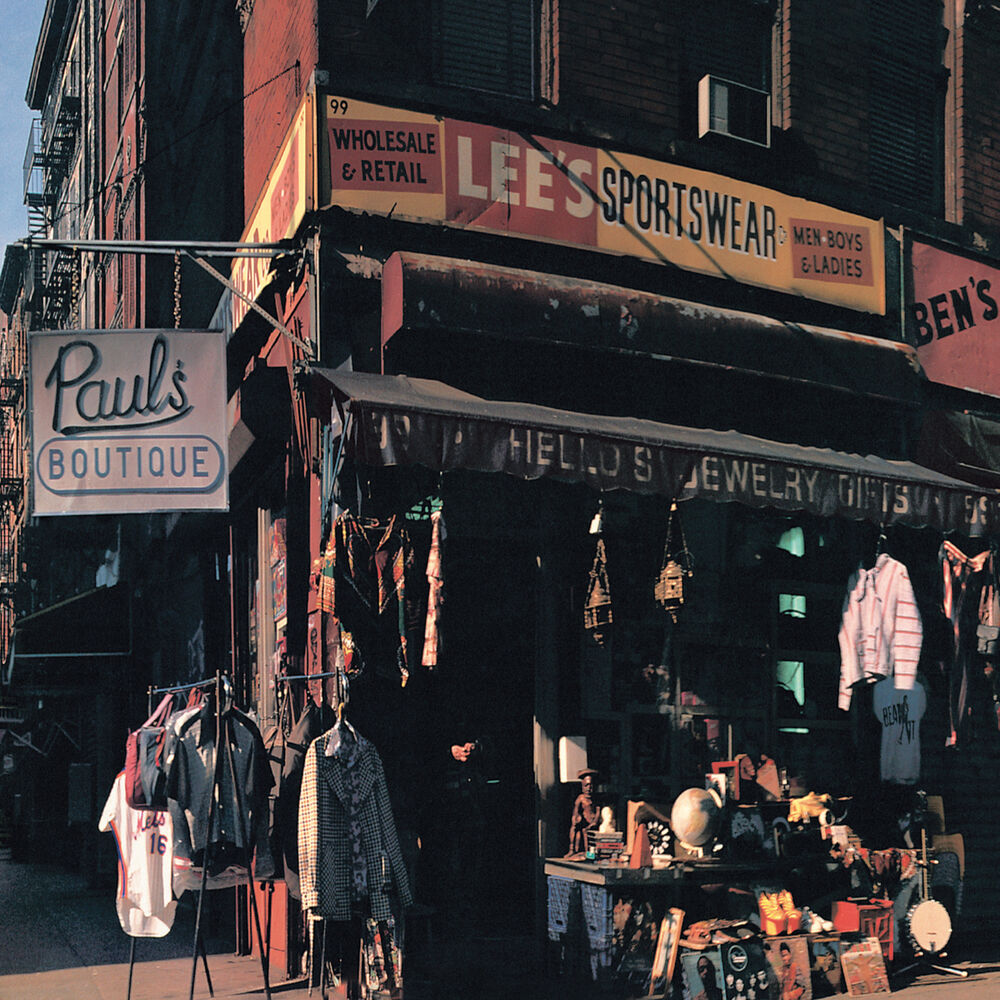
Paul's Boutique (20th Anniversary Edition / Remastered)
- Released9 February 2009
- UK peak No. 44
- Weeks on UK chart 2
- Entered UK chart 30 July 1989
- LabelCapitol Records
- Tracks23 · 53 min
One track from it charted as a single. Press a flag to play it in the chart where it peaked.
Tracks
| 1 | To All The Girls | 1:29 | |
| 2 | Shake Your Rump | 3:19 | |
| 3 | Johnny Ryall | 3:00 | |
| 4 | Egg Man | 2:57 | |
| 5 | High Plains Drifter | 4:13 | |
| 6 | The Sounds Of Science | 3:13 | |
| 7 | 3-Minute Rule | 3:39 | |
| 8 | Hey Ladies No. 36 · 1989 | 3:47 | |
| 9 | 5-Piece Chicken Dinner | 0:23 | |
| 10 | Looking Down The Barrel Of A Gun | 3:28 | |
| 11 | Car Thief | 3:39 | |
| 12 | What Comes Around | 3:07 | |
| 13 | Shadrach | 4:07 | |
| 14 | Ask For Janice | 0:11 | |
| 15 | B-Boy Bouillabaisse: 59 Chrystie Street | 0:56 | |
| 16 | B-Boy Bouillabaisse: Get On The Mic | 1:14 | |
| 17 | B-Boy Bouillabaisse: Stop That Train | 1:57 | |
| 18 | B-Boy Bouillabaisse: A Year And A Day | 2:22 | |
| 19 | B-Boy Bouillabaisse: Hello Brooklyn | 1:30 | |
| 20 | B-Boy Bouillabaisse: Dropping Names | 1:02 | |
| 21 | B-Boy Bouillabaisse: Lay It On Me | 0:54 | |
| 22 | B-Boy Bouillabaisse: Mike On The Mic | 0:48 | |
| 23 | B-Boy Bouillabaisse: A.W.O.L. | 1:47 |
About the album
Paul's Boutique is the second album by the American hip-hop group the Beastie Boys, released on July 25, 1989, by Capitol Records. Produced by the Beastie Boys and the Dust Brothers, it makes extensive use of samples drawn from genres including funk, soul, rock and jazz. It was recorded over two years in Los Angeles at Matt Dike's apartment and the Record Plant studio.
Paul's Boutique did not match the sales of the Beastie Boys' 1986 debut Licensed to Ill and was promoted minimally by Capitol. However, it became recognized as the group's breakthrough achievement, with its innovative lyrical and sonic style earning the group a position as critical favorites within the hip-hop community. Sometimes described as the "Sgt. Pepper of hip-hop", Paul's Boutique has placed on several lists of the greatest albums of all time, and is viewed by many critics as a landmark album of golden age hip-hop and a seminal work in sampledelia. It was certified gold in the US in 1989 and double platinum in 1999.
Background
The Beastie Boys released their debut album, Licensed to Ill, in 1986. It was a commercial success and was acclaimed by mainstream and hip-hop music critics, although its simple, heavy beats and humorous juvenile lyrics led to criticism as frat hip-hop. Derided as one-hit wonders and estranged from their previous producer, Rick Rubin, and their record label, Def Jam, the Beastie Boys were in self-imposed exile in Los Angeles during early 1988, after being written off by most music critics. For their second album, the Beastie Boys signed with Capitol Records and EMI Records. They focused on making an album with more creative depth and less commercial material.
Production
Paul's Boutique was produced with the Dust Brothers, whose use of sampling helped establish the practice of multi-layered sampling as an art. While the Dust Brothers were set on making a hit record, they agreed to produce a more experimental and sonically different record. In total, 105 songs are sampled, including 24 individual samples on the last track alone. The Dust Brothers produced the backing tracks with the intention of releasing an instrumental album but were persuaded by Beastie Boys to use them as the basis of their album.
Contrary to popular belief, most of the sampling for Paul's Boutique was eventually cleared but at dramatically lower costs compared to today's rates. According to Sound on Sound, most of the samples were authorized "easily and affordably, something that [...] would be 'unthinkable' in today's litigious music industry." Mario "Mario C" Caldato Jr., the engineer on the album, said, "We realized we had spent a lot of money in the studio.
Packaging
The cover art and gatefold is a photograph of Ludlow Street (as shot from 99 Rivington Street), credited to Nathanial Hörnblowér, but shot by Jeremy Shatan, who was the original bassist for Beastie Boys, when they were known as the Young Aborigines.
Release
On its initial release, Paul's Boutique was commercially unsuccessful because of its experimental and dense sampling and lyricism, in contrast to the group's previous album, Licensed to Ill. It was a commercial disappointment, peaking at number 24 on the Billboard Top R&B/Hip-Hop Albums chart, and number 14 on the Billboard 200 chart. It was certified gold in the US on September 22, 1989. In January 1999, it was certified platinum for sales of more than two million. On January 27, 2009, Paul's Boutique was rereleased in a 20th anniversary package remastered in 24-bit audio and featuring a commentary track.
Critical reception
Contemporary reviews of Paul's Boutique were uniformly positive, with the production singled out for praise. David Handelman of Rolling Stone said the songs are "buoyed by the deft interplay of the three voices and a poetic tornado of imagery", featuring "equally far-flung" musical samples on an album that is "littered with bullshit tough-guy bravado, but it's clever and hilarious bullshit". Greg Kot of the Chicago Tribune commended the Dust Brothers' "deft" production and Beastie Boys' rhymes, which he called "hilarious, vicious, surreal, snotty". David Stubbs of Melody Maker agreed, praising the Dust Brothers' production and calling the record "an outrageously funky triumph". Although he felt the group's performance did not match the quality of the production, he nevertheless considered the album a welcome return for the band after a three-year hiatus.
Legacy
Since Paul's Boutique was first released, its critical standing has improved significantly. NME critic Paul Moody found it was "still an electrifying blast of cool" in a 1994 review, viewing it as a "younger incarnation" of Ill Communication. Rob Chapman, writing for Mojo, asserted that the album "shredded the rulebook" and called it "one of the most inventive rap albums ever made". In a 2003 review for Rolling Stone, Rob Sheffield called it "a celebration of American junk culture that is still blowing minds today—even fourteen years of obsessive listening can't exhaust all the musical and lyrical jokes crammed into Paul's Boutique". In a 2009 review, Mark Kemp of Rolling Stone called the album a "hip-hop masterpiece". Nate Patrin of Pitchfork described it "a landmark in the art of sampling, a reinvention of a group that looked like it was heading for a gimmicky early dead-end, and a harbinger of the pop-culture obsessions and referential touchstones that would come to define the ensuing decades' postmodern identity".
Accolades
List of the album's rankings and listings on selected publications and top album lists:
Ranked number 5 on Slant Magazine's "Best Albums of the 1980s"
Ranked number 37 on Blender's "The 100 Greatest American Albums of All Time"
Ranked number 2 on Ego Trip's "Hip Hop's 25 Greatest Albums by Year (1980–1998)"
Ranked number 125 on "Rolling Stone's 500 Greatest Albums of All Time"
Ranked number 12 on Spin's "100 Greatest Albums, 1985–2005"
Ranked number 74 on VH1's "Top 100 Albums"
Ranked number 98 on Q's "Q Magazine Readers' 100 Greatest Albums Ever"
Ranked number 3 on Pitchfork's 2002 "Top 100 Albums of the 1980s", number 15 on its 2018 "200 Best Albums of the 1980s", and number 38 on its 2025 "100 Best Rap Albums of All Time"
Selected as one of Rolling Stone magazine's "The Essential Rock Collection"
Selected as one of TIME magazine's "100 Greatest Albums of All TIME"
Selected by Rhapsody as one of "The 10 Best Albums by White Rappers"
The album was also included in the book 1001 Albums You Must Hear Before You Die.