Tracks
| 1 | Facet Squared | 2:41 | |
| 2 | Public Witness Program | 2:04 | |
| 3 | Returning The Screw | 3:14 | |
| 4 | Smallpox Champion | 4:00 | |
| 5 | Rend It | 3:47 | |
| 6 | 23 Beats Off | 6:42 | |
| 7 | Sweet And Low | 3:34 | |
| 8 | Cassavetes | 2:30 | |
| 9 | Great Cop | 1:52 | |
| 10 | Walken's Syndrome | 3:17 | |
| 11 | Instrument | 3:44 | |
| 12 | Last Chance For A Slow Dance | 4:37 |
About the album
In on the Kill Taker is the third studio album by the American post-hardcore band Fugazi, released in June 1993 through Dischord Records. It was recorded at Inner Ear Studios and produced by the band and Ted Niceley. In on the Kill Taker captured the aggressiveness of the band's earlier releases while displaying a more diverse range of influences.
Due in part to the popularity of alternative rock in the early 1990s, In on the Kill Taker became the group's first album to debut on the Billboard charts and subsequently became the band's breakthrough album.
Recording
The recording process for the album started in the fall of 1992, when Fugazi began working with producer Steve Albini: the band initially planned to release an EP, including songs they had already been working on for a couple of years in previous practice recordings, before accepting Albini's standing invitation to do a free recording at his Electrical Audio studio, which at the time was located in the basement of his house in Chicago. The sessions ended up strengthening the friendship between the engineer and the members of Fugazi, while producing twelve songs that would eventually make the entirety of In on the Kill Taker; however, the band was unhappy with the result after hearing the rough mixes, and decided to scrap the recordings with the consent of Albini. Less than a month after those sessions, Fugazi decided to re-record the same songs at Inner Ear Studio in Washington D.C., this time with producers Don Zientara and Ted Niceley.
The Chicago sessions meant that Fugazi arrived well-prepared for the second recording.
Music and lyrics
Andy Kellman of AllMusic made note of what he considered to be "skinned-knee production values" present on In on the Kill Taker. The material on the album retained the band's aggressive and rhythmic style, but displayed more diversity as well. Fugazi downplayed any conscious efforts to make Kill Taker more experimental or diverse. According to Picciotto “I don’t really think of any of the records as being any more experimental than any of the others, because to us they were all experiments,” he said. “We were just trying to figure stuff out and push ourselves further each time. So to my ear every record sounds like a step forward, or sideways, or at least somewhere else from the one before it.” Matt Diehl of Rolling Stone labelled the album "a virtual encyclopedia of punk-derived musical styles" and recognized a large number of influences from bands such as The Ruts, U.K. Subs (for "Facet Squared" and "Public Witness Program"), Sonic Youth (for "Smallpox Champion"), Gang of Four (for "Cassavetes"), Pylon, "early" R.E.M.
Artwork
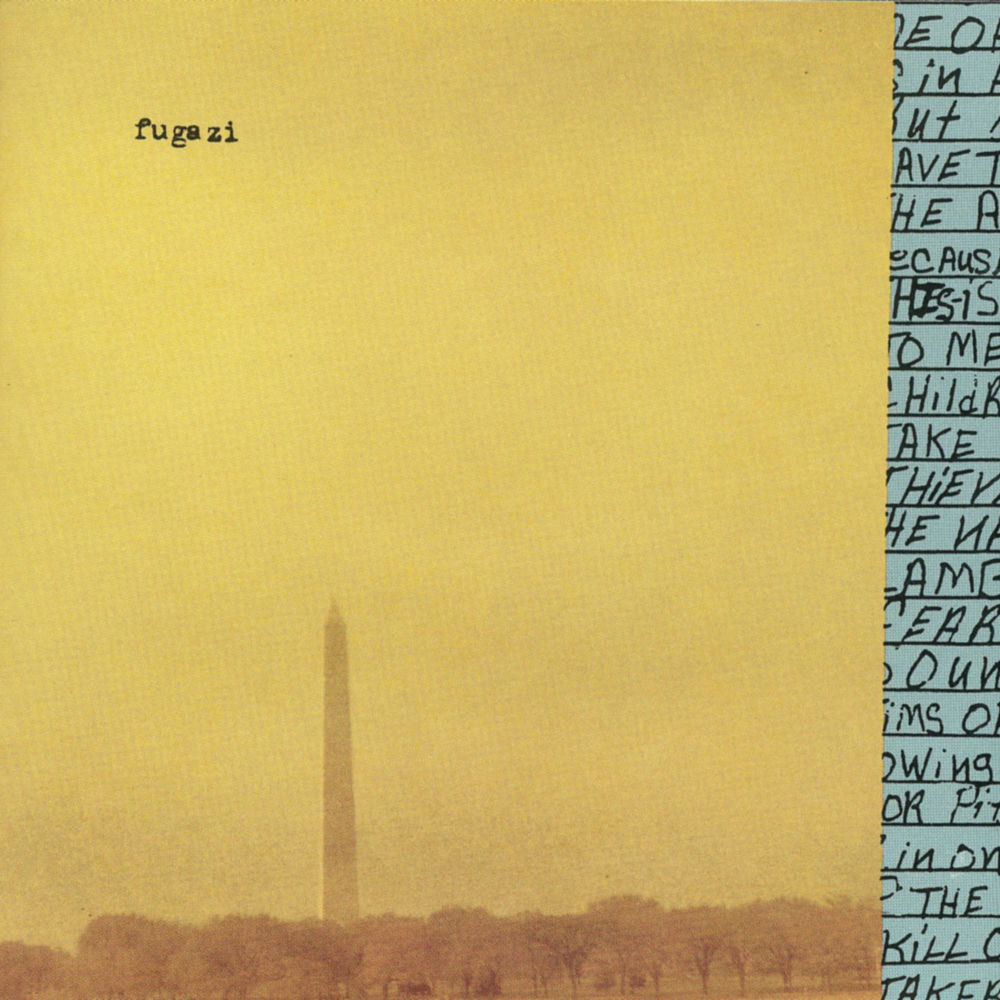
Filmmaker Jem Cohen, a long-time friend and collaborator of the band, was responsible for some of the album's art design and packaging. Found pieces of text and photographs were used to make up the overall layout. The cover image, showing a burned-out gold Polaroid of the Washington Monument, was found by Cohen in the street. The inner sleeve was a piece that Jeremy Blake, a friend of the band, found tacked to a light post in Chicago. The text on the cover side margin and back cover were also found on the ground in New York City by Cohen and contained the phrase "...so I could have tried to put a stop to the hater, the adversary workers, iniquity evildoers. This is big because people in high places are in on the kill taker".
Release
Released in June 1993, In on the Kill Taker was the band's first album to enter the Billboard 200, eventually peaking at No. 153. The album also topped the independent charts of both NME and Melody Maker in the United Kingdom.
Reception
The record garnered rave reviews from many publications including TIME and Rolling Stone. Rolling Stone writer Matt Diehl wrote that Fugazi had reclaimed the "only band that matters" label from The Clash. In a year-end round-up of the best albums of the year, Brad Tyer of The Houston Press included the album and called the band "[t]he beating heart of punk rock."
However, the album received mixed reviews as well. In an otherwise positive review, Jonathan Gold of Los Angeles Times thought that on the album, "Fugazi works in more or less the same meta-pop ballpark as Sonic Youth," and further stated: "Fugazi hasn't a whimsical bone in its collective body, and the lyrics dance around the gloomiest topics in oblique college-poetry metaphor." Spin was even more dismissive, calling it "Fugazi's most rigid and predictable album yet" despite its "spunky moments", and criticizing their politics as being didactic.