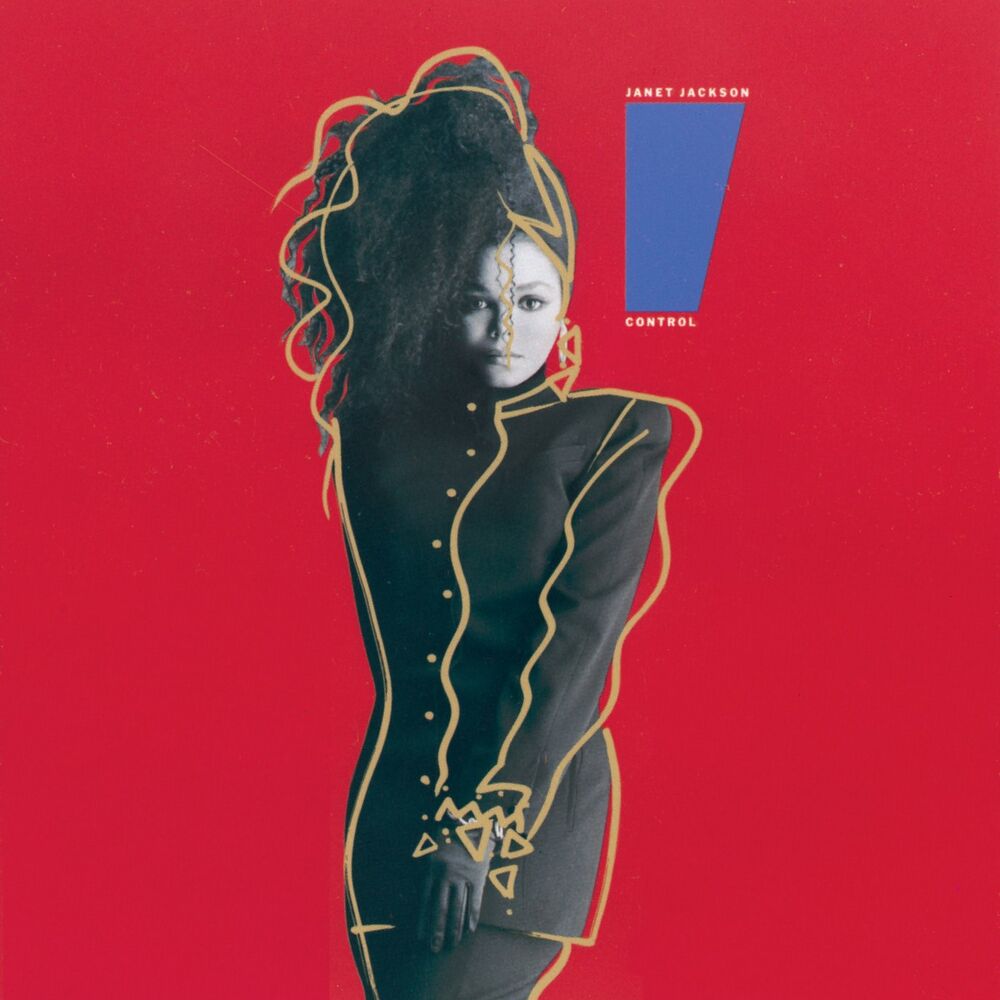
Control
- Released4 February 1986
- UK peak No. 8
- Weeks on UK chart 72
- Entered UK chart 30 March 1986
- LabelA&M
- Tracks9 · 42 min
7 tracks from it charted as singles. Press a flag to play it in the chart where it peaked.
Tracks
| 1 | 5:55 | ||
| 2 | 4:00 | ||
| 3 | 4:59 | ||
| 4 | You Can Be Mine | 5:12 | |
| 5 | 4:58 | ||
| 6 | 3:56 | ||
| 7 | He Doesn't Know I'm Alive | 3:30 | |
| 8 | Let's Wait Awhile No. 2 · 1987 | 4:36 | |
| 9 | Funny How Time Flies (When You're Having Fun) No. 59 · 1987 | 4:27 |
About the album
Control is the third studio album by American singer Janet Jackson, released on February 4, 1986, by A&M Records. Her collaborations with the songwriters and record producers Jimmy Jam and Terry Lewis resulted in an unconventional sound: a fusion of rhythm and blues, rap vocals, funk, disco, and synthesized percussion that established Jackson, Jam, and Lewis as leading innovators of contemporary R&B. The distinctive triplet swing beat used on the record is a precursor to the new jack swing genre. The album became Jackson's commercial breakthrough, helped her transition into the popular music market, and made Control one of the defining albums of the 1980s and contemporary music.
With its autobiographical themes, most of the album's lyrics reflected a series of changes in her life: a recent annulment of her marriage to singer James DeBarge, severing business ties with her father and manager Joseph and the rest of the Jackson family, hiring A&M executive John McClain as her new manager, and her subsequent introduction to Jam and Lewis. Critics have praised the album as both an artistic achievement and a personal statement of self-actualization.
Background
Joseph Jackson, patriarch of the Jackson family of musicians, was known for managing the careers of all nine of his children, most notably the successful career of The Jackson 5. After arranging a recording contract with A&M in 1982 for a then-15-year-old Janet, he oversaw the entire production of her debut album, Janet Jackson, and its follow-up, Dream Street (1984); the latter was written and produced by her brother Marlon and Jesse Johnson. Best known as a television actress, she was initially reluctant to begin a recording career. She said, "I was coming off of a TV show that I absolutely hated doing, Fame. I didn't want to do [the first record, Janet Jackson]. I wanted to go to college. But I did it for my father ..." and elaborated that she was often in conflict with her producers. Amid her professional struggles, she rebelled against her family's wishes by marrying James DeBarge of the family recording group DeBarge in 1984. The Jacksons disapproved of the relationship, citing DeBarge's immaturity and substance abuse.
Composition and production
When Jam and Lewis agreed to produce Jackson's third studio album, they wanted to appeal primarily to the African American community while also achieving crossover success on the pop music charts. Jam commented in an interview with Rolling Stone magazine, "We wanted to do an album that would be in every black home in America ... we were going for the black album of all time." Before their association with Jackson, Jam and Lewis had planned to record an album with tracks they wrote for Sharon Bryant, but she found their lyrics and sound to be too "rambunctious". The duo presented the same set of recordings to Jackson, who gave her input and took co-writing and co-production credits for the album. Jam and Lewis recalled that to collaborate with Jackson on the material, they spent the first week simply getting to know her. Lewis explained, "We got into her head. We saw what she was capable of, what she wanted to say, where she wanted to be, what she wanted to be. We put together some songs to fit her as we saw her, as she revealed herself to us.
Release and promotion
Although A&M did not consider a full concert tour to promote the album, the label funded a three-week promotional tour across the United States in 13 cities following its release. In addition to the studio release, a remix album, Control: The Remixes, was released in select countries in November 1987. Jackson's lyrical expression has been cited as one of the key elements of the album's success. Author Dave Marsh in The Heart of Rock & Soul: The 1001 Greatest Singles Ever Made (1999) comments: "Certainly, Janet must have written her own lyrics, which went after men, particularly thinly disguised stand-ins for her father and former husband—more venomously than a male songwriter would have dared. Control, the resulting album, was one of the best-sellers of 1986–1987, producing five hit singles."
Jesus Garber, then-director of A&M's black music marketing and promotion, noted that in addition to crossover promotion from black to pop music charts, music videos were used to launch Jackson into superstardom.
Commercial performance
Control debuted at number 84 on the Billboard 200 on March 8, 1986, and at number 26 on the Top R&B/Black Albums on March 1, 1986. After twenty weeks, it topped the Billboard 200 and the Top R&B/Black Albums chart, selling 250,000 copies in a single week, a record for an album by a female artist. The Recording Industry Association of America (RIAA) first certified Control gold in April 1986, denoting 500,000 units shipped within the United States. Two months later, in June 1986, the album was RIAA certified platinum, denoting 1 million units shipped. Three years later, Control was RIAA certified fivefold platinum in October 1989. By 1990, Control had sold 5 million copies in the United States and as of December 2009, the album has sold 496,000 copies in the U.S. since 1991 according to Nielsen SoundScan, which does not count albums sold through clubs like the BMG Music, where she sold 883,000. Combined, it has sold over 6,379,000 copies in the U.S.
Critical reception
Upon its release, the album received widespread critical acclaim. Rolling Stone's Rob Hoerburger commented that the "sharp-tongued" Janet Jackson is "more concerned with identity than with playlists", as Control declares she is no longer the Jacksons' baby sister. Hoerburger wrote that tracks such as "Nasty" and "What Have You Done for Me Lately" erased the former "pop-ingénue image" of Jackson's first two albums, and that "Control is a better album than Diana Ross has made in five years and puts Janet in a position similar to the young Donna Summer's—unwilling to accept novelty status and taking her own steps to rise above it." Steven Ivory of Billboard wrote "[v]ocally, Jackson is more aggressive than ever. Indeed, her exhibition of sass and funkiness is certainly more provocative" compared with her previous work. NME wrote: "Jackson has gone a long way in shaking off the experience of being a shadow Jackson child. She is an artist in her own right." Newsweek stated "[i]n an era of big-voiced pop-soul divas ...