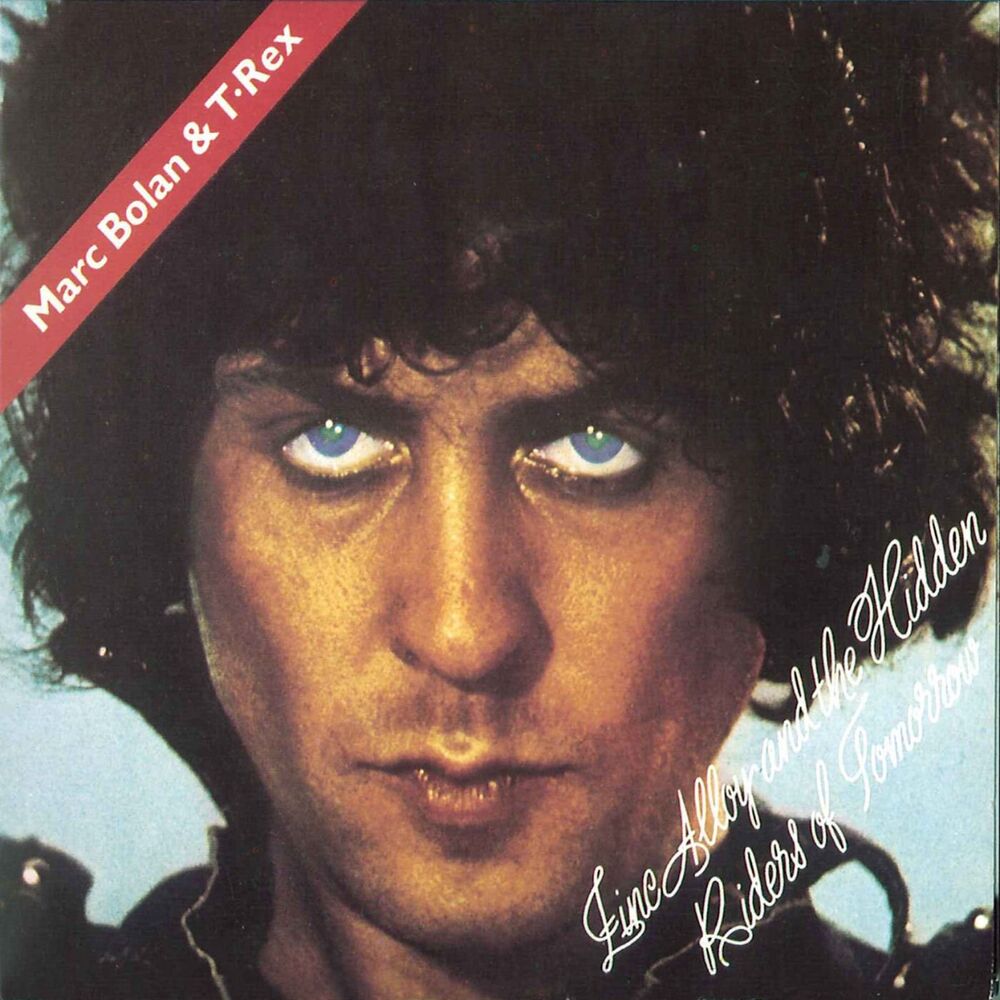
Zinc Alloy And The Hidden Riders Of Tomorrow
- Released26 April 2011
- LabelT-Rex Catalog (Spirit Music)
- Tracks14 · 46 min
Tracks
| 1 | Venus Loon | 3:03 | |
| 2 | Sound Pit | 2:51 | |
| 3 | Explosive Mouth | 2:28 | |
| 4 | Galaxy | 1:50 | |
| 5 | Change | 2:47 | |
| 6 | Nameless Wildness | 3:07 | |
| 7 | Teenage Dream | 5:48 | |
| 8 | Liquid Gang | 3:18 | |
| 9 | Carlisle Smith & The Old One | 3:16 | |
| 10 | You've Got To Jive To Stay - Spanish Midnight | 2:35 | |
| 11 | Interstellar Soul | 3:28 | |
| 12 | Painless Persuasion V. The Meathawk Immaculate | 3:29 | |
| 13 | The Avengers (Superbad) | 4:32 | |
| 14 | The Leopards Featuring Gardenia & The Mighty Slug | 3:37 |
About the album
Zinc Alloy and the Hidden Riders of Tomorrow is an album by English rock band T. Rex, the ninth since Tyrannosaurus Rex's debut LP. It was released in March 1974 on the T. Rex record label, distributed by EMI. It was the first and only album to be released under the moniker "Marc Bolan & T. Rex".
Unlike many of T. Rex's previous albums, it was not released domestically in North America; instead, the record company released the U.S.-only Light of Love in August of the same year, featuring three tracks from Zinc Alloy while the remaining songs would appear on the band's next album, Bolan's Zip Gun.
Zinc Alloy was met with bemusement by the listening public. It reportedly confused listeners and divided the band's fanbase at the time, while critical reception was universally negative. Critical re-evaluation has been more favourable, but it remains an oddity in the T. Rex canon due to its style incorporating funk and R&B influences. The album peaked at number 12 in the UK Albums chart.
Background
In the spring of 1973, Marc Bolan was dissatisfied with what he perceived as an insufficient reception to the single "20th Century Boy" (which reached the UK number 3 position that March) and eager to further explore the musical directions glimpsed on the just-released Tanx LP. His two primary influences at this time were his new relationship with musician and songwriter Gloria Jones, and an affection for the black music he heard on radio while touring the US. In the midst of a European tour that March, the band entered Rosenberg Studios in Copenhagen to record new material with producer Tony Visconti once more at the helm.
Recording
The initial session at Rosenberg Studios on 20 March 1973, saw rough early versions of "Liquid Gang", "Superbad" (a working title for "The Avengers"), "The Groover", its B-side "Midnight" and two outtakes, "All My Love" and "Down Home Lady" committed to tape. On 22 March, two more outtakes, "Saturation Syncopation" and "Delanie" were recorded. On 4 April at AIR Studios saw overdubs and mixing of a few prior tracks including "Midnight", while 30 April at Wally Heider Studios in Hollywood produced "Carsmile Smith and the Old One", the B-side "Satisfaction Pony", "Blackjack" and the outtake "Saturday Night" with Gloria Jones and Stephanie Spruill on backing vocals. Mixing and overdubbing was held at AIR back in London on 6–7 May, then moved to Apple Studios on 11 May for working versions of "Squint Eye Mangle" (released with "Blackjack" later in the year as a single by "Big Carrot") and another outtake, "Mr. Motion".
Bolan became one of the first English artists to record in Germany when the sessions moved to Musicland Studios in Munich between 17 and 24 June.
Music
Marc's ambitions at the time were to fuse glam, pop, soul, funk, psychedelia, and heavy metal into what he called on work-in-progress session sheets "spaceage funk" and "interstellar supersoul". The results were a radical change from the classic T. Rex sound. Journalist Alexis Petridis wrote that the album features a variety of styles including "the funky clavinet, the Jerry Lee Lewis piano, the backing vocals of his new partner Gloria Jones, the strings, the horns and the trebly, distorted guitar on which Bolan would fire off extravagant, Hendrixesque solos." AllMusic described "The Avengers (Superbad)"", "Interstellar Soul" and "Liquid Gang" as "solid James Brown drive".
Title and album cover
The original title of the album was A Creamed Cage in August with the artist name to be Zinc Alloy and the Hidden Riders of Tomorrow, which at the time he insisted was a send-up of the two Stardusts, Ziggy and Alvin. The record company balked, however, largely because the photo of Bolan to be used on the cover featured him with a dramatically short haircut and nearly unrecognizable. To ensure that record buyers knew who it was, the label insisted that a red banner strip stating "Marc Bolan & T. Rex" appeared on the top left corner with the title Zinc Alloy and the Hidden Riders of Tomorrow at the bottom, now relegating A Creamed Cage in August to a secondary title on the back side.
Marc had wanted the album package to be an extravagant multi-layered triple gatefold sleeve designed by John Kosh consisting of a latticework image on the front featuring Bolan's face in a pale gold surround with cage bars revealing another facial shot underneath, meant to fold-out into the 'Creamed Cage' of the subtitle.
Release
The album was released on 1 March 1974, five weeks after the end of the group's first major UK tour in over a year. Despite arriving in shops directly after the tour, it did nothing to revive Bolan's sagging fortunes, spending just three weeks on the UK Albums chart where it peaked at number 12, while the lead single, "Teenage Dream", reached number 13 in the singles chart.
At the time of the UK release, Bolan's U.S. label Reprise had dropped Bolan and he was struggling to find another U.S. label to sign with. By the time he got a deal with Casablanca Records, he had recorded much new material, which the new record company decided to release along with a couple of tracks from Zinc Alloy as the Light of Love album in September 1974; thus, neither Zinc Alloy nor Bolan's Zip Gun were issued in the U.S. in the 1970s.
A companion release to the later Demon Records reissue, entitled Change (The Alternate Zinc Alloy), was released in 1995 and contained alternative versions, studio rough mixes, and demos of the main album and bonus tracks.
Critical reception
Zinc Alloy was poorly received upon release, with nearly universally hostile reviews. The British press slammed T. Rex for copying the title of the album from Bowie's The Rise and Fall of Ziggy Stardust and the Spiders from Mars, even though Bolan had spoken of releasing work under the pseudonym "Zinc Alloy" during the late 1960s. One of the few exceptions was Chris Welch at Melody Maker, who opined "there's a lot more life, guts and twists of the unexpected here than on many a more serious work" before going on to praise "Venus Loon", "Sound Pit", and "The Leopards". On the other hand, Steve Peacock of Sounds drolly stated "my idea of purgatory would be to be marooned on a desert island with a gramophone and copy of this album" while Andrew Tyler of NME groaned that "Bolan has conjured up a series of ponderous titles that he uses as a vehicle to project his inane curly-haired stud image...the whole thing puts you in mind of a half-cocked production-line band content at one stab of glory."
Retrospective reviews have been more favourable.