One track from it charted as a single. Press a flag to play it in the chart where it peaked.
Tracks
| 1 | Slowes' Comb / The May 4th Movement Starring Doodlebug | 4:56 | |
| 2 | Black Ego | 7:02 | |
| 3 | Dog It | 4:21 | |
| 4 | Jettin' | 4:39 | |
| 5 | Borough Check | 6:36 | |
| 6 | Highing Fly | 1:23 | |
| 7 | Agent 7 Creamy Spy Theme / Dial 7 (Axiom Of Creamy Spies) / NY 21 Theme | 5:47 | |
| 8 | The Art Of Easing | 5:06 | |
| 9 | K.B.'s Alley (Mood Dudes Groove) | 2:06 | |
| 10 | Graffiti | 4:03 | |
| 11 | Blowing Down | 3:51 | |
| 12 | 9th Wonder (Blackitolism) No. 80 · 1994 | 4:27 | |
| 13 | For Corners | 7:02 |
About the album
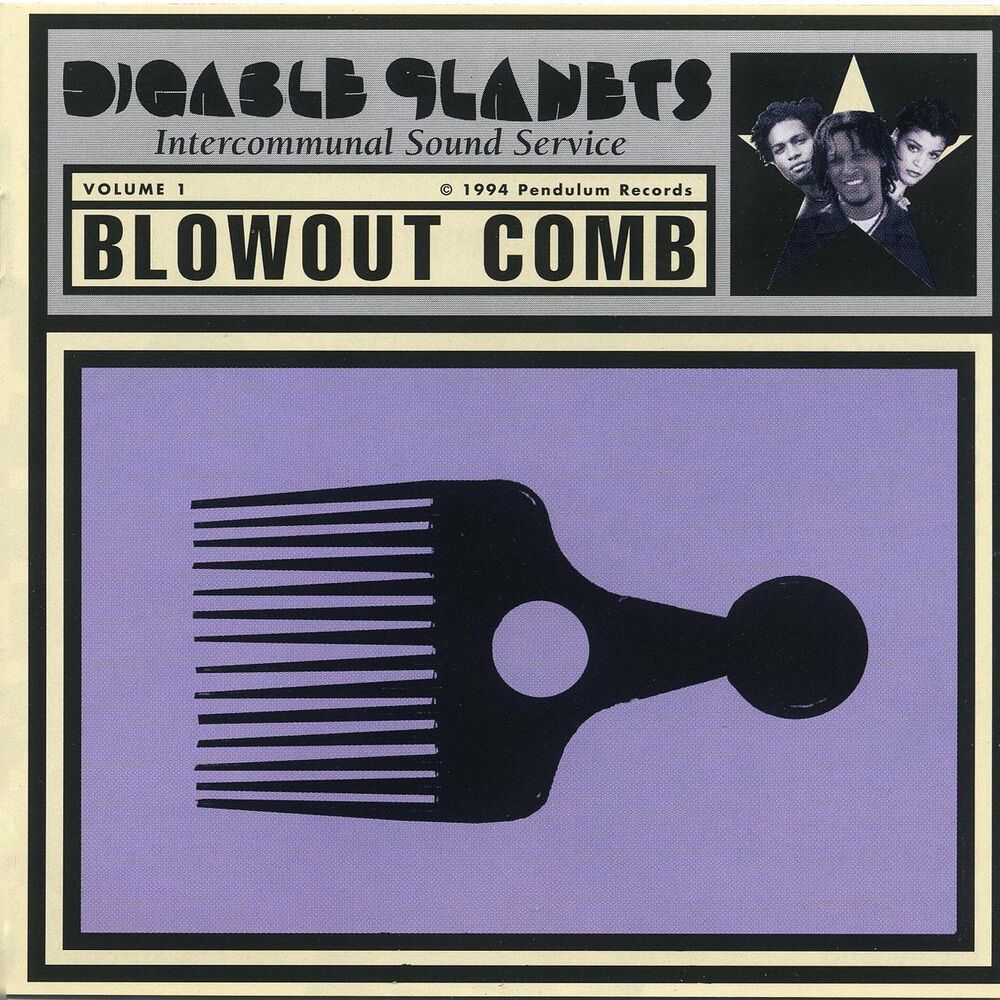
Blowout Comb is the second and final studio album by American hip hop group Digable Planets, released October 18, 1994, on Pendulum/EMI Records. The album was written and recorded in Brooklyn, New York, where the group moved, with recording sessions beginning in 1993 and finishing in 1994. On Blowout Comb, Digable Planets abandoned the radio friendly style of their debut album and worked with a more ambitious, stripped-down sound. The album features a diverse range of samples and live instruments, and contains lyrical themes of the inner city and black nationalism. It also features guest appearances from Guru of Gang Starr, Jeru the Damaja, and DJ Jazzy Joyce.
Upon its release, Blowout Comb received minimal label support, and virtually no pre-release publicity. It peaked at number 32 on the Billboard 200, and number 13 on the Top R&B Albums, making it a commercial failure. It featured the singles "9th Wonder (Blackitolism)" and "Dial 7 (Axioms of Creamy Spies)", which also did not chart well, and failed to match the success of the group's previous singles. Several music writers have attributed this lack of chart and sales success to the album's afrocentric content, and un-polished tone.
Background
On Digable Planets' 1993 debut album Reachin' (A New Refutation of Time and Space), the group used many references to insects. These concepts were inspired due to "insects nature to stick together and work for mutually beneficial causes", which the group saw as a useful principle for African-Americans in low-income communities. However, they abandoned these concepts on Blowout Comb, with group-leader Ishmael Butler articulating "All the insect concepts and imagery was outta there by the time we did Blowout. I felt that it had got misconstrued, kinda like De La Soul and the daisies. Blowout was a natural expansion of what Digable Planets were reaching for in the first place, but shallow ears got lost". Ishmael Butler then changed his group-name from Butterfly to "Ish", Mary Ann Vieira changed her group-name from Ladybug to "Mecca", and Craig Irving changed his group-name from Doodlebug to "C-Know". Black Moon's Enta Da Stage (1993) and Wu-Tang Clan's Enter the Wu-Tang (36 Chambers) (1993) have both been credited for changing Digable Planets' post Reachin' ...
Music
Blowout Comb had a higher record budget, with more musical ambitions, which sought to utilize different samples and sounds that were un-common at the time, as the group viewed most other hip-hop artists' music as "recycled". The album has been illustrated as "a block party, but transformed by Digable's 'ghettopoesis' into a cool abstraction of street life", and "a motley clash of sounds that celebrate boom box batteries-in-the-freezer ghetto ingenuity as a raw, empowered expression".
While on a world tour in support of their album Reachin' ..., the group collected vinyl records from various countries, and formed a deep rapport with various musicians they were performing with. Both of these factors influenced the overall sound of Blowout Comb, with its eclectic samples and live instruments. Ishmael Butler credits engineer, producer and instrumentalist Dave Darlington for helping him create the album. He recounted "Every song on Blowout is a mix of live instruments and samples.
Artwork
The blowout comb was a popular black grooming product in the 1970s, when Afros gained strong popularity. Digable Planets named the album after them because "it means the utilization of the natural" and "a natural style".
The album's liner notes depict advertisements for fake Soul food restaurants and local events. The artwork was modeled after the distinct design of the official Black Panther Newspaper, which Ishmael Butler came across one day while at a relative's house. Many pictures of Ishmael's trip to Los Angeles, prior to recording the album, are also shown in the artwork.
Critical reception
The album was released to rave reviews and critical acclaim. In a contemporary review for the Chicago Tribune, music critic Greg Kot wrote that the tension between the group's dreamy delivery and the seriousness of their questions about the African-American community gives substance to the music's elated mood. Heidi Siegmund of the Los Angeles Times wrote that it maintains a subtle but consistent mood that, unlike their debut album, warrants repeated listening. Time magazine's Christopher John Farley found Digable Planets' rebellious lyrics "constructive" and felt that the live musicians employed by the group lets the songs develop into extended jams.
Commercial performance
The album did not match the commercial success of the group's previous album, and was a commercial failure. Whereas Reachin' charted for 32 weeks on the Top R&B Albums and peaked at number five, Blowout Comb spent 13 weeks and reached number 13 on the chart. According to Kyle Ryan of The A.V. Club, critics originally attributed this failure to the lyrics' black power messages. Colin Larkin, writing in The Encyclopedia of Popular Music (2000), said that part of the reason was because the album lacked a song as catchy as the group's debut single "Rebirth of Slick (Cool Like Dat)". Music journalist Peter Shapiro viewed it as a failed attempt at abandoning pop for "street" appeal by another group whose original success derived from a more amiable style of hip hop.