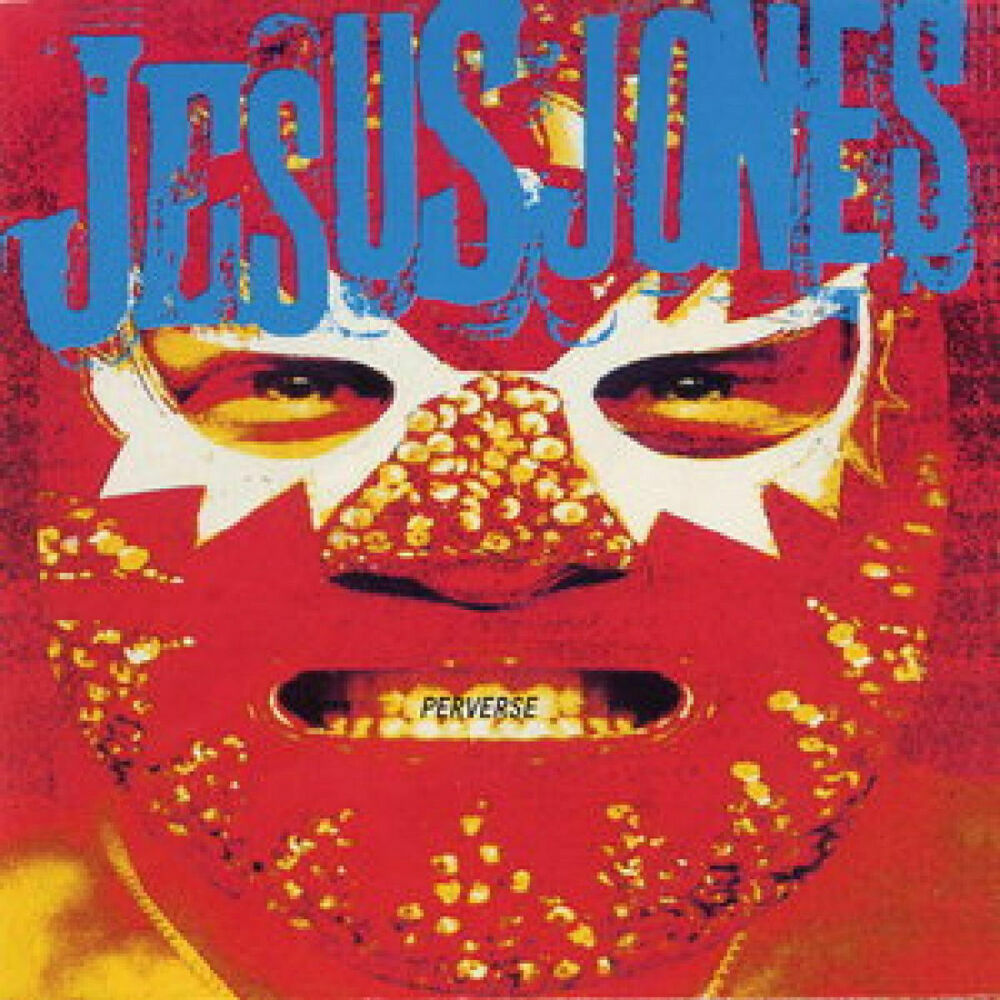
Perverse
- Released29 November 1995
- UK peak No. 6
- Weeks on UK chart 4
- Entered UK chart 31 January 1993
- LabelRT Industries
- Tracks12 · 45 min
3 tracks from it charted as singles. Press a flag to play it in the chart where it peaked.
Tracks
| 1 | Zeroes And Ones No. 30 · 1993 | 3:24 | |
| 2 | The Devil You Know No. 10 · 1993 | 4:31 | |
| 3 | Get A Good Thing | 3:22 | |
| 4 | From Love To War | 3:49 | |
| 5 | Yellow Brown | 3:23 | |
| 6 | Magazine | 2:46 | |
| 7 | The Right Decision No. 36 · 1993 | 3:36 | |
| 8 | Your Crusade | 3:30 | |
| 9 | Don't Believe It | 3:45 | |
| 10 | Tongue Tied | 3:16 | |
| 11 | Spiral | 4:30 | |
| 12 | Idiot Stare | 5:10 |
About the album
Perverse is the third studio album by British rock band Jesus Jones, released in 1993 on Food Records. After their international success following the release of Doubt (1991), Jesus Jones, especially band leader Mike Edwards, conceived Perverse as a darker, more contemporary album. Fusing rave and techno music into more traditional rock and pop song structures, the album is heavier than its predecessors with a much greater inclusion of industrial music and features lyrics that concern the future. Edwards wrote the lyrics of the album during the band's 1991 tour, using a Roland W-30 sampler to develop songs in their earliest stages.
According to Trouser Press, Perverse "enjoys the historical distinction of being the first album recorded entirely (except for Edwards' vocals) on computer." The band recorded the entire album onto floppy disks in Edwards' house, which were then used on his computer to turn the music into "zeroes and ones". Edwards described it as "the second rock album of the nineties," after The Young Gods' T.V. Sky, due to both albums embracing full-on computer technology.
Background
With their second album Doubt, Jesus Jones became internationally successful, thanks to hit singles such as "Right Here, Right Now", which reached number 2 on the US Billboard 200, "International Bright Young Thing", which reached number 7 on the UK Singles Chart, and "Real, Real, Real," which reached number 4 on the US Billboard 200. According to music critic Stephen Thomas Erlewine, the album's best moments "showed that sample-driven dance club music could comfortably fit into pop music." For the album's follow-up, Perverse, Jesus Jones, especially band leader, lyricist and vocalist Mike Edwards and keyboardist Iain Baker, decided to venture further into the technological side of recording music. Erlewine described Edwards' aim for Perverse as "his mission to make techno palatable for the pop masses."
Edwards and keyboardist Iain Baker felt that, despite living in a "very technological society", rock music had "stayed still" since the 1970s by not embracing current technology: "Technology gives musicians so much opportunity to vary what they do.
Writing
Band leader and vocalist Mike Edwards is the sole composer and arranger on Perverse. On previous albums, Edwards wrote complete versions of songs, and sent virtually complete demos to the rest of the band, who would then interpret the material in "their own unique way." However, on Perverse, he deliberately attempted to write what he felt was necessary for the music, and disregarded how it would sound live. He commented, "I remember writing "Who? Where? Why?" on the last album, thinking, damn, there's two guitarists, I've got to put a second guitar part in there. That becomes limiting, so on this record, I took a linear, very fascistic approach: 'this is the song, nothing else matters'. There were songs on the album where members of the band didn't play."
Using a Roland W-30 sampler, which Edwards referred to as his "sketch pad," most of the songs on Perverse began as 15 second sketches that Edwards had "written in hotel bedrooms on Jesus Jones' last tour." Despite having written all the band's previous songs on guitar, Edwards wrote most of the songs on Perverse using a keyboard.
Recording
Edwards' aim for recording Perverse was to take the techniques and 'attitudes' of techno, a genre he viewed as the "most progressive and creative form of popular music at the moment," but use them to create a rock album. He chose this method partially as a concept and partially as he believed creating a rock album with this method would be a success. He told one journalist, "ultimately it made things more interesting for me as a writer, mostly because of the degree of editability at every stage of what you do - notes, timing, sounds - as long as the data exists, it's all changeable."
One of the first ever albums to be wholly recorded through a computer, the music on Perverse was recorded onto floppy disks over two and a half months from 1991–92 at Edwards' house in north London, and was produced at London's Think Studios. The album cost almost £100,000, almost five times as much as Doubt, and was produced by Warne Livesey. Edwards summed up the recording sessions: "We did it in a classic techno way. I have an Atari and Cubase.
Music
Compared to Doubt, Perverse is a much darker, broodier album, and has been described as the band's heaviest album. Stephen Thomas Erlewine of AllMusic, describing Perverse as an artistic expanding of the band's sound, called the album "a synthesis of techno/rave dance music with traditional pop/rock songs and structures." Meanwhile, Douglas D. Keller of The Tech felt that, although many of the songs contain distinctly techno elements, the album itself is not overall a techno recording: "Songs such as 'Idiot Stare' make extensive use of repeating drum tracks, but there are fast and slow movements within the song which add a richness to this and other tracks that is missing in most techno singles." The band continued to be influenced by house music on the album, and according to Q, "hardcore runs through much of the LP, most notably on 'Zeroes and Ones' and 'Spiral'."
According to Graham Reid, samples are either used as the starting point for the music or for further enhancement.
Lyrics
Edwards wrote each of the songs on the album "with a hint of his vision of the future included." Perverse also occasionally reveals contradictory lyrics, such as how "Magazine" appears to celebrate "the distortion of current evens in the media" while "Don't Believe It" is "a biting criticism of the media." In the album's liner notes, "Don't Believe It" is described with the caption: ""May '92, with a little ignorance and media manipulation, there is a whipping boy for every occasion. On our side, truth, decency, and the right way to talk, on the other side, our perfect enemy out for revenge."
According to The Tech, "Zeroes and Ones", whose name is a reference to the binary code and the album's recording method, concerns "the increasing prominence of computers in daily life, from pocket calculators and shopping at home to missile guiding and virtual sex.