Pisces, Aquarius, Capricorn & Jones Ltd. (Deluxe Edition)
- Released15 October 2007
- UK peak No. 5
- Weeks on UK chart 11
- Entered UK chart 7 January 1968
- LabelRhino
- Tracks25 · 72 min
2 tracks from it charted as singles. Press a flag to play it in the chart where it peaked.
Tracks
| 1 | Salesman (2007 Remastered Version) | 2:34 | |
| 2 | She Hangs Out (2007 Remastered Version) | 2:56 | |
| 3 | The Door Into Summer (2007 Remastered Version) | 2:50 | |
| 4 | Love Is Only Sleeping (2007 Remaster) | 2:30 | |
| 5 | Cuddly Toy (2007 Remaster) | 2:39 | |
| 6 | Words (2007 Remaster) No. 11 · 1967 | 2:51 | |
| 7 | Hard To Believe (2007 Remastered Version) | 2:35 | |
| 8 | What Am I Doing Hangin' 'Round (2007 Remastered Version) | 3:09 | |
| 9 | Peter Percival Patterson's Pet Pig Porky (2007 Remastered Version) | 0:27 | |
| 10 | 3:14 | ||
| 11 | Daily Nightly (2007 Remastered Version) | 2:33 | |
| 12 | Don't Call On Me (2007 Remastered Version) | 2:51 | |
| 13 | Star Collector (2007 Remaster) | 4:26 | |
| 14 | Goin' Down (Stereo Mix; 2007 Remaster) | 4:22 | |
| 15 | Salesman (Alternate Stereo Mix) | 3:05 | |
| 16 | She Hangs Out (Alternate Stereo Mix) | 3:26 | |
| 17 | Love Is Only Sleeping (2007 Remastered Version Alternate Mix) | 2:29 | |
| 18 | What Am I Doing Hangin' 'Round (Alternate Stereo Mix) | 3:18 | |
| 19 | Star Collector (Alternate Stereo Mix) | 5:00 | |
| 20 | Riu Chiu (TV Version) | 1:32 | |
| 21 | Special Announcement (2007 Remaster) | 0:37 | |
| 22 | Salesman (2007 Remastered Version Alternate Mono Mix) | 2:35 | |
| 23 | Cuddly Toy (Alternate Mix) | 3:01 | |
| 24 | Goin' Down (Mono Single Version; 2007 Remaster) | 4:23 | |
| 25 | The Door Into Summer (2007 Remastered Version Alternate Mix) | 2:53 |
About the album
Pisces, Aquarius, Capricorn & Jones Ltd. is the fourth album by the Monkees. It was released on November 14, 1967, during a period when the band exerted more control over their music and performed many of the instruments themselves (previously forbidden by Colgems Records). However, although the group had complete artistic control over the proceedings, they invited more outside contributions than on their previous album, Headquarters, and used session musicians to complement their sound. The album also featured one of the first uses of the Moog synthesizer in popular music. Pisces, Aquarius, Capricorn & Jones Ltd. sold over three million copies, becoming the band's fourth consecutive album to reach No. 1 on the U.S. Billboard 200.
Background
By early 1967, the Monkees had become one of the most commercially successful pop acts in the United States, with several hit singles and albums promoted through their television series, The Monkees. Their popularity, however, was tempered by criticism from the emerging rock press and the counterculture audience after it was revealed that the group had not played the instruments on their first two albums.
In February 1967, Don Kirshner, who had overseen the group's musical output, was dismissed by Colgems Records after attempting to release the single "A Little Bit Me, a Little Bit You" without the band's approval. Following Kirshner's departure, the Monkees gained creative control and recorded their third album, Headquarters, with the four members playing most of the instruments and contributing original compositions. The album reached number one on the U.S. charts but was displaced after one week by The Beatles' Sgt. Pepper's Lonely Hearts Club Band.
The Monkees subsequently moved toward psychedelic and experimental sounds for their next album.
Recording
Recording sessions for Pisces, Aquarius, Capricorn & Jones Ltd. began at RCA Victor Studios in Hollywood in April 1967, less than two weeks after completion of Headquarters and the start of filming for the second season of The Monkees. On April 26, the group recorded "Cuddly Toy", written by then-unknown Harry Nilsson, with Micky Dolenz performing drums for the only time on this album. While the song was presented as a lighthearted music hall number, it drew attention from Screen Gems executives when they discovered its lyrics were suggestive of a Hell's Angels gang-bang. The royalties from this composition enabled Nilsson to leave his bank job and pursue music full-time.
On May 29, the basic track for Bill Martin's folky anti-war statement "The Door Into Summer" was recorded, initially with Dolenz on lead before Michael Nesmith replaced him. Nesmith ultimately sang lead on five tracks for the album, more than any other member.
Title and artwork
The album's title stems from each band member's respective astrological sign: Micky Dolenz is Pisces, Peter Tork is Aquarius, and both Mike Nesmith and Davy Jones are Capricorn.
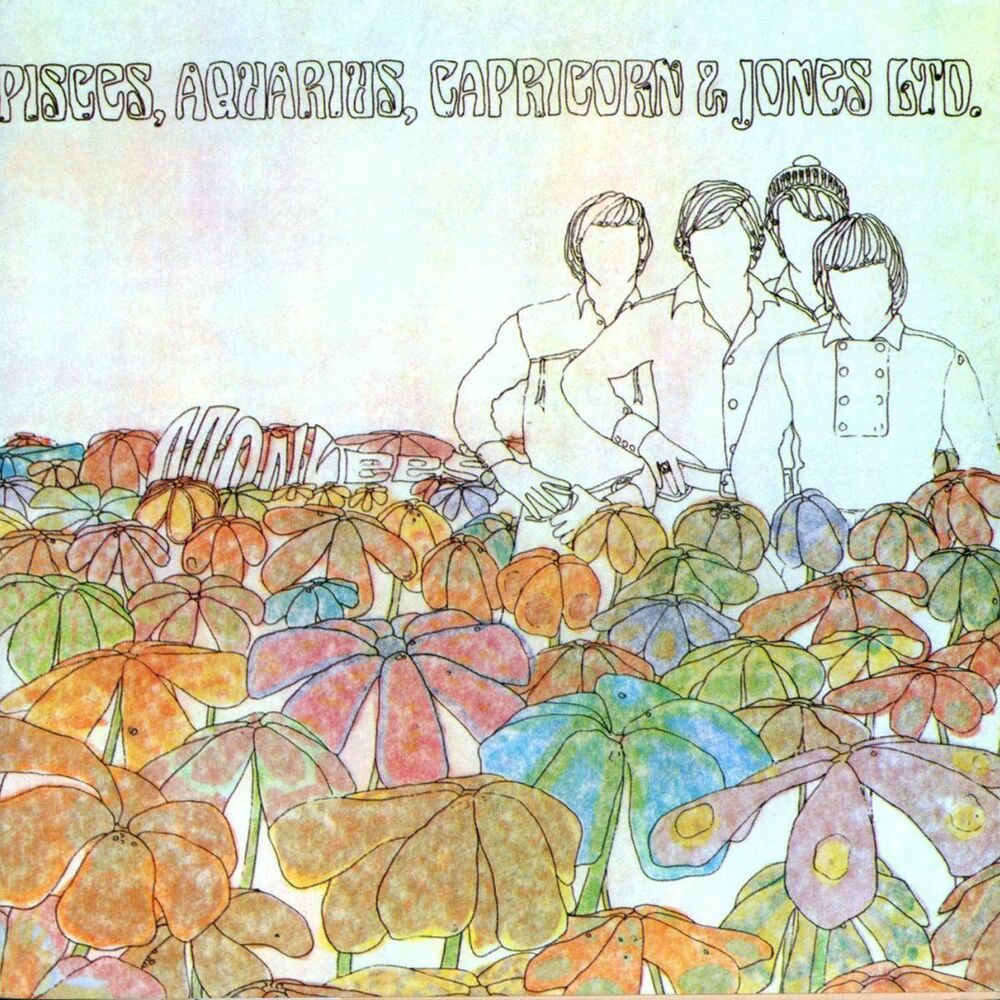
The album's cover features a drawing of the four Monkees by Bernard Yeszin, their facial features blank and standing in a field of watercolored flowers, with the group's iconic guitar logo half-buried. The flowers were meant to represent the flower-power movement which was big at the time, while the choice of silhouetting their faces was, according to Yeszin, because "The Monkees were so popular and so hot at the time...that I could do just about anything that reminded you of The Monkees. I could do an album cover and just show their outline and people would identify them. People would know they were The Monkees." Later reissues of the album use a retraced version of the cover by Lisa Sutton, as the original prints no longer existed.
Release
The album was preceded by the release of "Pleasant Valley Sunday" backed with "Words" on July 10, 1967. The single reached number three and number eleven on the Billboard Hot 100 respectively. "Daydream Believer" backed with "Goin' Down", recorded during the same sessions and issued on October 25, became the group's final U.S. number one single, although the A-side was reserved for the following album, The Birds, the Bees & the Monkees.
Pisces, Aquarius, Capricorn & Jones Ltd. was released on November 14, 1967. After entering the Billboard 200 at number 29, it rose to number one the following week, remaining in that position for five consecutive weeks and eventually selling more than three million copies. Producer Chip Douglas later remarked that sales might have been even greater if "Daydream Believer" had been included on the album as originally intended. In the United Kingdom, the album was released in January 1968 and peaked at number five on the UK Albums Chart.
In 2007, Rhino Entertainment issued a two-disc deluxe edition of the album.
Critical reception
At the time of release, trade publications reviewed the album favorably. Billboard highlighted "Salesman" and "What Am I Doing Hangin' Round?" as "topnotch" selections, while Cashbox described the record as a "sure to please powerhouse," with both predicting chart success. In the United Kingdom, Allen Evans of NME gave a track-by-track review, noting "Cuddly Toy" and "What Am I Doing Hangin' Round?" as standout tracks.
The emerging counterculture press did not cover the album, and it was not reviewed by Rolling Stone or Crawdaddy. In the 2004 edition of The Rolling Stone Album Guide the album received one-and-a-half stars.
Later assessments have been more positive. AllMusic critic Tim Sendra wrote that "not only is it one of the Monkees' best, it is one of 1967's best," describing it as "a must-have for any fan of smart, fun, and exciting '60s pop." Record Collector praised the album as "a pop-psych triumph with Americana signposts" and "the real challenger to the Beatles," citing "Pleasant Valley Sunday" and "Daily Nightly" as highlights.
Legacy and influence
Pisces, Aquarius, Capricorn & Jones Ltd. has been noted for its innovations in both instrumentation and style. The album is among the earliest pop records to feature the Moog synthesizer, which Dolenz introduced to the group; he owned one of the first twenty ever sold. The instrument was played by Dolenz on "Daily Nightly" and by Beaver on "Star Collector." Critics have highlighted the album's use of the Moog as one of the first appearances of the instrument on a rock recording.
The album is also regarded as a precursor to country rock, particularly through Michael Nesmith's "What Am I Doing Hangin' 'Round?", which featured electric banjo by Doug Dillard. Music historian Richie Unterberger observed that the track anticipated the fusion of country and rock later popularized by groups such as The Byrds and The Flying Burrito Brothers.
Within the Monkees' catalog, Pisces is often cited as a creative high point, balancing commercial success with greater artistic control compared to their earlier releases.