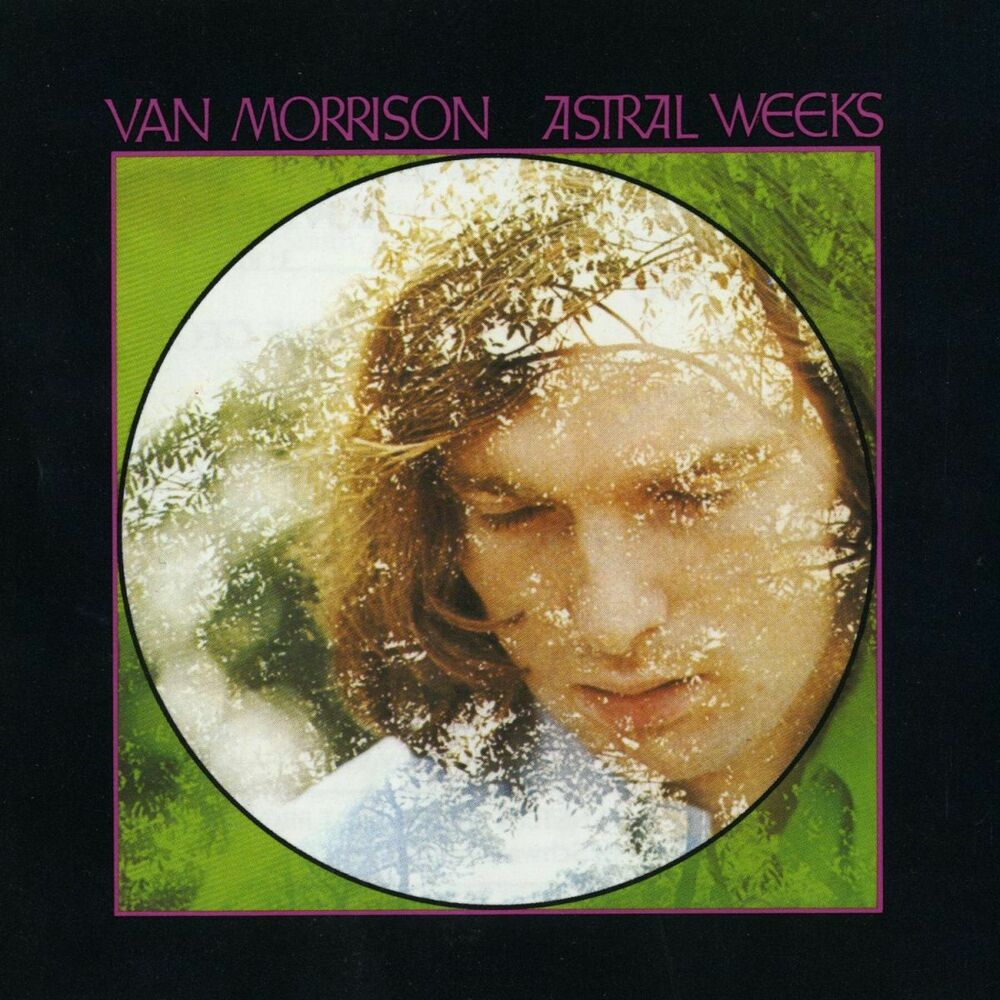
Astral Weeks
- Released29 November 1968
- UK peak No. 61
- Weeks on UK chart 3
- Entered UK chart 15 February 2009
- LabelRhino/Warner Records
- Tracks8 · 47 min
Tracks
| 1 | Astral Weeks (1999 Remaster) | 7:06 | |
| 2 | Beside You (1999 Remaster) | 5:16 | |
| 3 | Sweet Thing (1999 Remaster) | 4:25 | |
| 4 | Cyprus Avenue (1999 Remaster) | 6:59 | |
| 5 | The Way Young Lovers Do (1999 Remaster) | 3:17 | |
| 6 | Madame George (1999 Remaster) | 9:45 | |
| 7 | Ballerina (1999 Remaster) | 7:03 | |
| 8 | Slim Slow Slider (1999 Remaster) | 3:17 |
About the album
Astral Weeks is the second studio album by Northern Irish singer-songwriter Van Morrison. It was recorded at Century Sound Studios in New York during September and October 1968 and released in November of the same year by Warner Bros. Records.
The album's music blends folk, blues, jazz, and classical styles, a radical departure from Morrison's previous pop hits, such as "Brown Eyed Girl" (1967). The lyrics and cover art portray the symbolism equating earthly love and heaven that would often feature in the singer's subsequent records. His lyrics have been described as impressionistic, hypnotic, and modernist, while the record has been categorized as a song cycle or concept album.
Astral Weeks did not originally receive promotion from Morrison's record label and was not an immediate success with consumers or critics. Its standing eventually improved greatly, with praise given to Morrison's singing, arrangements, and songwriting, and the album has been viewed as one of rock music's greatest and most important records (a reputation the singer himself has dismissed).
Background
At the beginning of 1968, Van Morrison became involved in a contract dispute with Bang Records that kept him away from any recording activity. This occurred after the sudden death of the label's founder Bert Berns. Born with a congenital heart defect, Berns had a fatal heart attack and was discovered dead in a New York hotel room on 30 December 1967. Prior to Berns's death, he and Morrison had experienced some creative difficulties; Berns had been pushing Morrison in a more pop-oriented direction, while Morrison wanted to explore newer musical terrain. Berns's widow, Ilene Berns, held Morrison and this conflict responsible for her husband's death. Years later she would downplay this scenario, but Morrison's then girlfriend Janet (Planet) Rigsbee has since gone on record describing Ilene Berns's subsequent vindictiveness towards Morrison.
Following Bert Berns's death, Ilene Berns inherited the contracts of Bang Records. Morrison's annual option on his recording contract was also due less than a week after Berns's funeral.
Recording sessions
With his legal matters resolved, Morrison now had the freedom to proceed with recording his Warner Bros. debut album, with the recording sessions taking place at the Century Sound Studios in New York on 25 September, 1 and 15 October 1968. The live tracks for the sessions were performed by Morrison on vocals and acoustic guitar in a separate vocal booth with the other musicians playing together on upright bass, lead acoustic guitar, vibes, flute, and drums. The strings and horns constituted the only instruments added subsequently to the initial recording sessions. Morrison said later "They ruined it. They added strings. I didn't want the strings. And they sent it to me, it was all changed. That's not 'Astral Weeks'."
Producer Lewis Merenstein had a background in jazz, and according to Merenstein, Morrison "was not an aficionado of jazz when I met him. R&B and soul, yes; but jazz, no." For the Astral Weeks recording sessions, Merenstein first contacted veteran bassist Richard Davis.
Music and lyrics
Astral Weeks has poetic, stream-of-consciousness lyrics that evoke emotions and images instead of coherent, intellectual ideas and narratives. According to Guy Raz from NPR, it is a folk rock album, "perhaps the seminal album of the folk-rock genre", while the Rock and Roll Hall of Fame online biography of Morrison said its music is trance-like folk jazz set to "impressionistic, free-flowing" lyrics. AllMusic's William Ruhlmann, on the other hand, viewed the music as an amalgam of folk, blues, jazz, and classical music that is unlike rock.
Although usually described as a song cycle rather than a concept album, the songs do, when considered in their totality, seem to link together as one long song, forming an "intangible narrative of unreachable worlds" and delivered with what one writer calls "a masterpiece of virtuoso singing".
Packaging
According to Steve Turner, one of Van Morrison's biographers, Irish painter Cecil McCartney influenced the titling of Astral Weeks. Morrison related how "A friend of mine had drawings in his flat of astral projection. I was at his house when I was working on a song which began, 'If I venture down the slipstream' and that's why I called it 'Astral Weeks'." "It was a painting", McCartney corrects. "There were several paintings in the studio at the time. Van looked at the painting and it suggested astral travelling to him." The album cover photograph of Van Morrison was taken by Joel Brodsky, best known for his "Young Lions" photoshoot with Jim Morrison. The squared circle in the cover photo is described as portraying "the mystic symbol of the union of opposites; the sacred marriage of heaven and earth".
Reception
Astral Weeks sold poorly when it was first released in 1968. The album became a somewhat popular cult import in the United States, while in the United Kingdom it was largely overlooked by critics. The British magazine Beat Instrumental published a negative review of the record, finding Morrison's songs monotonous and unoriginal. In NME, Nick Logan regarded it as a pale imitation of the guitarist José Feliciano's 1968 Feliciano! album, which was one of the year's best-selling records. With the exception of Astral Weeks' title track, Logan felt the compositions were indistinguishable and "suffer from being stuck in the same groove throughout". In the American magazine Stereo Review, editor Peter Reilly panned it as a "free-verse mind bender of an album", plagued by nonsensical lyrics and incoherent singing from Morrison, especially on "Madame George".
In December 1968, a week after the album's release, the Detroit Free Press published a positive review by Wilson Lindsey, who wrote that the album was "a rare and unexpected piece of recording art" that "explodes with joy or sorrow".
Legacy and influence
Astral Weeks' critical standing improved greatly over time. It became viewed as one of rock's greatest records and a culturally significant work. Many factors afforded the record its strong reputation in rock criticism: its back story as a commercial underachiever and highly personal work for Morrison, its distinction from the rest of his discography, his artistic autonomy, the music's song cycle composition, the enigmatic lyrics and quality of seriousness and originality as perceived by mature rock audiences and writers. According to Rob Sheffield, it was Morrison's "most beautiful and intense album", the foundation for his "legend" and a work that continues to captivate musicians and listeners. Lester Bangs said its anguished feeling resonated with him on first listen, calling it "the rock record with the most significance in my life so far ...