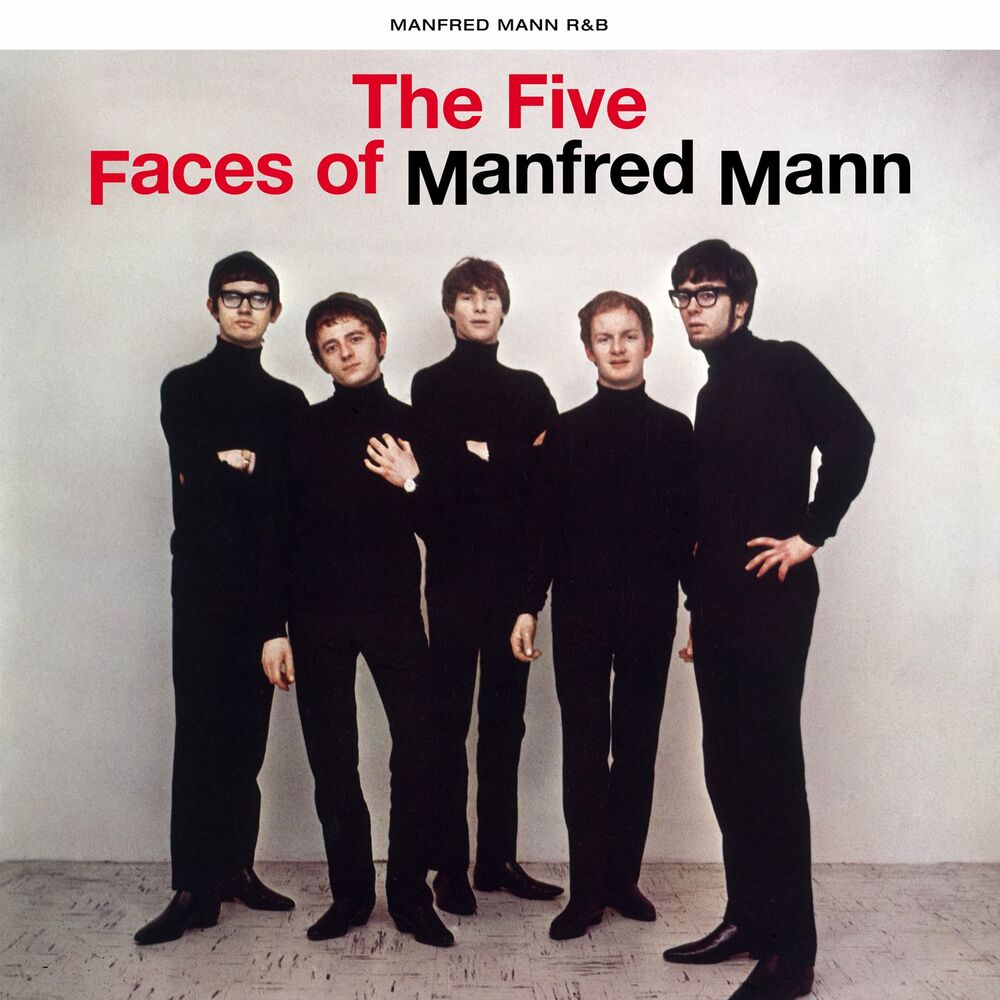
The Five Faces of Manfred Mann
- Released1 January 1964
- LabelEast Central One
- Tracks14 · 39 min
Tracks
| 1 | Smokestack Lightning | 3:33 | |
| 2 | Don't Ask Me What I Say | 3:01 | |
| 3 | Sack o' Woe | 2:08 | |
| 4 | What You Gonna Do? | 2:37 | |
| 5 | Hoochie Coochie | 3:18 | |
| 6 | I'm Your Kingpin | 2:46 | |
| 7 | Down the Road Apiece | 2:26 | |
| 8 | I've Got My Mojo Working | 3:11 | |
| 9 | It's Gonna Work out Fine | 2:34 | |
| 10 | Mr. Anello | 2:16 | |
| 11 | Untie Me | 3:41 | |
| 12 | Bring It to Jerome | 3:30 | |
| 13 | Without You | 2:22 | |
| 14 | You've Got to Take It | 1:54 |
About the album
The Five Faces of Manfred Mann is the debut British and second American studio album by Manfred Mann. It was first released in the United Kingdom on 11 September 1964 by His Master's Voice. In late October/early November, the album was released in Canada by Capitol Records. The Canadian track listing was almost the same as the UK version, except it included the hit "Do Wah Diddy Diddy" instead of "I've Got My Mojo Working". The record has been called "one of the great blues-based British Invasion albums; it's a hot, rocking record that benefits from some virtuoso playing as well".
Background
The songs on the original version of the Five Faces of Manfred Mann are R&B, including the band's cover versions of Howlin' Wolf's "Smokestack Lightning", Muddy Waters' "Got My Mojo Working", and Bo Diddley's "Bring It to Jerome", as well as a few of the group's own jazzy compositions. Particularly noticeable in the instrumental sections are Manfred Mann's keyboard work, Mike Vickers' flute and saxophone work, and Mike Hugg's vibes. The album includes the Cannonball Adderley song "Sack O' Woe" from the R&B-influenced school of early 1960s jazz.
Bruce Eder of AllMusic writes:
The debut album by Manfred Mann holds up even better 40 years on than it did in 1964. It's also one of the longest LPs of its era, clocking in at 39 minutes, and there's not a wasted note or a song extended too far among its 14 tracks.
Reception
In his retrospective review of the US release, critic Bruce Eder wrote, "The band's second American LP (which shares its title with their first British album) was slightly less impressive than their first, but was still a respectable mix of R&B and pop. For pop, there were 'Sha La La' and 'Come Tomorrow,' two of their biggest mid-'60s hits, and 'She,' one of their best self-penned efforts in that vein. For R&B, there was the original 'Hubble Bubble (Toil and Trouble),' a British hit, and some good covers, notably 'I'm Your Kingpin,' 'Groovin',' and 'Dashing Away with the Smoothing Iron,' drawn from a then-recent British EP release."